.jpg)
With the senior living boom in motion and the rise of tech, there is one looming question: who is going to do the work? Kyle Gardner and Jessie Lucci return to answer that question.
Do I work for the technology, or does the technology work for me?
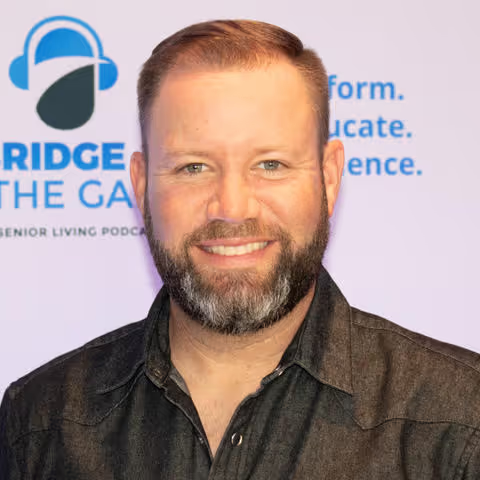
Lucas McCurdy is the founder of The Bridge Group Construction based in Dallas, Texas. Widely known as “The Senior Living Fan”.
Learn More ▶

Find an experiment and just begin. Just start out and testing.
What happens when AI, robotics, computer vision and automation move from the technology world into senior living?
In this episode of Bridge the Gap, host and guests Kyle Gardner of NIC MAP, and Jessie Lucci of AllieHealth continue their conversation about whether senior living is ready for the technology coming next. The panel explores how AI is already being adopted, from large language models such as ChatGPT, Claude, and Gemini to camera-based visitor check-ins and fall-detection systems.
The conversation then moves from today's tools to the bigger questions: Could robots eventually take over certain operational tasks? Where does technology improve the caregiver and resident experience, and where is the human touch irreplaceable? The guests also discuss how operators should evaluate technology, why interoperability and security matter, and who should sit on a technology buying committee.
Key Topics
The rapid adoption of AI and large language models
AI applications already appearing in senior living communities
Camera-based check-in and fall-detection technology
The potential role of robotics in senior housing
Preserving the human connection in senior living
AI's potential to own workflows rather than simply provide software
Technology interoperability and data integration
Security and intentional technology-stack design
Evaluating technology vendors through a senior-living lens
Building an effective technology buying committee
Including operators and end users in technology decisions
Balancing ROI, staff retention, care quality and user experience
Why senior living operators should start experimenting with AI now
Meet the Hosts:
Produced by Grit and Gravel Marketing.
Become a sponsor of Bridge the Gap.








00:59 - 07:34
Lucas McCurdy
All right, listeners, this is part two of an awesome conversation with my good friends Kyle Gardner, CEO NIC MAP, and Jessie Lucci of Ally Health. We're talking about is Senior living even ready for the technology that's coming? This is a great deep-dive panel conversation around tech and AI and operations and everything in between listening. That's that's so true.
And I think that that's actually a great transition point to get to have a little bit more fun here of forecasting what is next. And my mind starts to think about the the what ifs and how AI is truly going to reimagine all of our lives. And we're kind of at the forefront of going and growing through that.
Every day there's something new. We're all personally starting to adopt the ChatGPT, the Claude, and the myriad of other llms I guess, that are out there. And I can't help but think, you know, Jessie, you had that story of, you know, the the, the caregiver also working DoorDash. And I see a future where these delivery services don't have drivers.
Right. I'm sure Uber is obviously already on, you know, buying you know, you know, driverless cars. And do we have a new labor force of Uber drivers and DoorDash drivers that are then maybe going to be coming in and working as caregivers in the community? And then I also wonder, is there a point where technology bypasses the caregiver altogether, which creates another problem, or maybe another issue of surveillance?
And how does the industry even deal with these types of things? So I know I've just laid out kind of a bunch of different things there, but these are these are big issues that I think that the industry is going to come face to face with, whether they want to or not. Any thoughts there?
Kyle Gardner
Yeah, I'd love to jump in. You know, I'd kind of push back on the we're starting to adopt it. And I would say, you know, Llms have already been adopted, whether people call them that or not. ChatGPT has a billion monthly active users. Google's publicly talked about their Gemini product line having a billion monthly active users. So, you know, there's probably some overlap in those two groups, but that means 1 in 8 people on the planet is using an AI at least once a month.
And I think it's probably higher than that just personally. And then so if we assume, hey, in some capacity, whether it's hey, I go to ChatGPT instead of using search engine, I'm using an LLM. I think that's a really common use case and very low friction to I'm using AI to code, or I'm using AI to do data analysis or write documents.
Those are things I'm I'm seeing within map. I'm seeing within our customers to using AI paired with some type of hardware, whether it's a wearable device or a camera. You kind of alluded to the surveillance component, you know, or in the the very high tech world of robo taxis and driverless cars, you know, those things are real today.
I think within a community you've got AI up and down the stack. It's just kind of going back to our earlier topic, how much capital do you have to spend on it? I've seen solutions for camera based check ins, so instead of having an office admin at the front desk all the time, there's just a camera that takes a quick photo of you and logs you in the visitor log, and maybe there's a tablet for you to sign in with.
We've seen a myriad of camera providers who are using video detection software, paired with machine learning or neural nets to see when someone falls or if if someone's found on the ground. Was it a fall? Was it an accident? Was it intentional to alert nursing and other staff to help care for that person and triage it, and try and predict when something like that might happen?
There's a half dozen of those products on the market today. So, you know, the technologies here, it's the competition is amazing because that means the products are going to get better every year. The cost to the consumer should go down over time, like we're in the moment of AI at our doorstep and AI in the house. And I think where we're really going next to where the the next 3 to 5 years would be is how deep can we integrate it while still having control over, you know, how we use it being.
And what I mean by that is like, how intentional can we be as we build out our stack? Do we have 50 different point systems that each do one task, but they don't connect very well? It has someone's, you know, intentionally curated their their tech stack or their hardware stack that everything talks all the all the metadata flows into a single system and lets us utilize that.
That's a very difficult challenge to take on regardless of your company. And it is a very technical challenge at that. So I think as operators are kind of looking at the systems, they've got to if they haven't already, they've got to learn how to evaluate technology providers in a way they probably haven't had to before, you know, pre pre ChatGPT the the big data talk was just interoperability between my CRM and my EHR.
And like other industries that's so common. You know, we use Salesforce which has like hundreds of integrations. Basically any tech tool out there you can connect to Salesforce in some capacity. You know, I see the big names in the HR world. They've got partners in programs that they're kind of working towards that scale or some have achieved it.
But the newcomers maybe, maybe having prioritized it yet. So I think we're just in a different stage of that development curve. And that unfortunately puts a lot of pressure on our customers, the operators, to be smart and be savvy with what they're doing
Jessie Lucci
100%. I want to add two points to that. So one is, does the technology company have the senior living context?
07:34 - 11:47
Jessie Luccie
I think integration is a part of it, but do they understand the business? This is not a hospital. This is not a, you know, a a short term care community. Yeah, exactly. I think that's very important. Second of all, it's like, hey, are we still selling software or are we, you know, or this technology can do the job for me.
Can own the work. I think we're gradually getting to that stage is like, hey, you know, like we're conditioning between, you know, a technology software. I still have to deploy a human being to use to this technology actually can own that line of work, keeping my team in the loop. I think that's a transition needs to happen. It should happen like, you know, like a lot faster. And that's exciting for us.
Kyle Gardner
We recently did a survey with NIC. This would be, you know, the audience for this was predominantly like corporate staff, not building staff, but we just did a kind of an AI adoption survey and just a quick pulse survey, a couple questions. We got about 50 responses. So not a massive not a massive like population, but 86% of respondents said they use AI at work and 79% said they use it daily.
So that was mostly in the realm of, like, LLMs- Claude or ChatGPT or Gemini or something of that nature. But in the corporate world, it is pervasively used. I've got to imagine in the in the community staff, it's similar, but probably very for very different reasons. You know, to Jessie's point, they're not at a desktop all the time, so it's probably more mobile use.
It's probably more search questions. It's maybe it's an AI feature inside of an app, right. Anyone who's ever used TikTok or Instagram Reels or YouTube, those are all AI products at their core. You know, we don't really I don't I'm not really thinking about those in the same way. I am something like fall and AI, fall detection software, or a video recorder with AI notes and things of that nature. But that's the product category that we're in it. It wears many faces.
Lucas McCurdy
It certainly does. And it's it's moving so quickly I can't help but think about these. You know,
there's so much attention on senior housing right now. And Kyle, correct me if I'm wrong about this, but it seems like I heard you and Eric talk on a panel with people like Harrison Street and these big real estate, you know, monitoring, you know, entities where you have, like, data centers.
And it's like senior housing is like on the map right there as far as a real estate asset class for potential high growth. And I think it's gaining a lot of attention. And you mentioned the supply and demand issue is that, you know, our tech company is going to be pushing and kind of like putting a lot of pressure on our industry to adopt, like these really, really advanced systems and programs.
I think about, like robotics and like robots, you know, is there going to be like a push to say, okay, you don't even need caregivers anymore? Just put our robots in your community. And I you know, I don't really see, you know, we can't lose that human touch. Right. And, you know, I think that there are some verticals out there that are very much in trouble, you know, lawyers, accountants.
Like there's there there's a little bit of trouble on the horizon when it comes to AI and things like that. But when it comes to senior housing, that human touch is still, to me, very centralized. And, you know, I'm sure that there will be some robots and things that will come into place. But I can't imagine, you know, I think that there's a future where that pressure is going to be very, very real and it's going to be coming from outside tech.
11:47 - 15:30
Lucas McCurdy
Any thoughts?
Kyle Gardner
The outside tech is already here. You know, if you go and look at if you just googled, you know, you did a, did an AI search or a Google search of like private equity investment in senior housing technology, you would find some massive headlines. There's multiple you know, it's it's mostly been on the air systems. Krems the fall detection software where there's been eight and nine figure headline rounds in this space.
And I don't want to name names to call anyone out. But it's very easy to find references where there's been big Silicon Valley names coming and backing companies in this space, because the market is basically going to double over the next 25 years. And there's this perception, as we've talked about here on this very show of like, hey, this industry is slow to adopt technology will to an investor or to a technology company.
That means there's unmet need. There's unmet opportunity arbitrage, indeed. So if we just look at what's already happened in parts of the industry, you know, I think they're here now. The other side of the coin, the technology company and the investors responsibilities like find product market fit. Because if you go and spend $100 million on robots that no one buys, you just burned a lot of cash.
So the industry has to be willing to test the product and hopefully find tremendous value from it, because every customer, every consumer is been trained by Amazon and social media for instant gratification. And so if you're not getting an Roy like Jessie talked about earlier, you will stop buying the product. You won't come back. And that retention is so important to technology businesses and data businesses.
You need that customer to stay with you for a long time to get your to get your return. Otherwise the system breaks down. So I think if you look at the industry and you think about like, hey, what are the problems technologies most capable at solving now that's where capital is going to flow to freely, and it's going to take some entrepreneurs or it's going to take some customers to raise their hand and say like, hey, here's a problem no one's talking about.
I would like to find a solution. You know, if I'm the operator, I want to find a solution for X, and if I'm the technologist, I want to go and find as many X's as possible so I can run my experiments. So, you know, on the robot piece, I don't think the resident is going to accept a robot bathing or changing or helping with toileting, but is there is the resident going to care if it's a robot that pushes the meal cart down the hallway, or if at nighttime there's a silent vacuum running around and picking things up while no one's in the hall?
Probably not. Right? So it's about kind of slicing and dicing the problem to feel, to figure out what does the the ultimate end user or the ultimate customer need, what are they willing to accept? And sometimes, what are they willing to tolerate so that they can get more value. So we'll see how it pans out. I you know, I am not in the my customers are operators and investors and developers.
So I'm a little bit removed from that ultimate resident experience. But I think if we're all just kind of going back to square one as humans and as consumers, it's like, what? What do I want out of life? And can technology help me about that? And is the payoff is the trade off or the payoff worth it to kind of have that experience?
15:30 - 19:59
Kyle Gardner
Yeah, I think, you know, like I think on the community level, the robotic technology and the only operator, the home office level, or they're almost like two separate line of thoughts. I agree with Kyle is like on the consumer and the community level is like the end user experience critical, right? I mean, the question is like, hey, why do I want to move if I can buy the Elon robot for 30, $35,000?
I crave that human, that socialized experience. Right? And that's what I'm looking for when I move to senior housing. But if the robot delivering the card from the dining hall to my room can be a little bit faster, I'm all for it, right? And think about the caregiver walking the long hallway and spending that time. That's not personal.
It's just not good for the caregiver experience because it's a taxing task task. And on the other side, it's not good for consumer. So there's a lot of opportunity there. But coming back to the Home Office, you know, when you're managing an operations bottom line, the business I think about like, hey, there are so much still a lot of opportunity to proactively tell me what I need to do.
How do I pay my time today? I think they are reactive using of AI. If I think about problem or ACI, I will drop my graph and charts in a place versus like hey, why don't I wake up from the feed? It's like, hey, this is how you prioritize your time. This is how you should look at how you you should be focusing on. There's still amazing opportunities. There was the senior living context I think need to be explored in the industry.
Kyle Gardner
Who do you think, Jessie, is involved or maybe should be involved in kind of figuring out where to start with these things, right? As new innovations come in, you know, who's kind of the the buying committee on technology that you're seeing?
And, you know, I'll give my point of view, because we have our core businesses have different products. So I know we're addressing different audiences. But, you know, as operators look to have a technology strategy, you know, every person is going to have their own opinion. Not everyone's thinking about the integration or the security. So who do you see on the buying committee?
And I'd love to just trade notes here because there's probably an opportunity if the operators don't have an internal opinion on the buying committee, maybe that's a place for them to start as they're looking at tech of like, all right, who are we going to put in charge of connecting these systems and being intentional with these systems?
Jessie Lucci
If I put my operator hat on, I think if I run an operation, the committee I will put together is a competition between the CEO, the CFO, a few regional and the community of 1 or 2 community users, because on one side is margin has to talk, right?
It's like, again, every single question is like, who's paying for it? How can we realize benefit to it? I think on the CFO side is black and white. It's numbers, right? I mean, we need to make sure as operations they deliver to their investor and owner group, on the CEO side, they get to balance between like retain our staff, creating better care.
Obviously working with a clinical, with dining, with all the different department head to be able to, you know, like find that trade off in the balance. But then those two individuals, from my point of view, they're a little bit far away from the day to day. And user right. We also need to make sure adoption need to be there.
Right? So adoption need to be there. The combination of a few, maybe 1 or 2 regionals that, you know, like started from the community level folks really understand and, you know, like really deeply understand the pain point still can talk both sides of a language on the performance side, but also on the user experience side, but looping in 1 or 2 community level and user in this community I think is for me is a perfect balance.
Obviously we got to keep the CTO involved, right? I mean, in the loop because, you know, understanding all the tech stack, how do they talk to each other, you know, like is data safe and secure is helpful alongside with a few other folks. Depends on obviously what technology you're talking about.
Kyle Gardner
Yeah, I agree. You know, we run into less so on the community side because our product and map is typically kind of like regionals to corporate office or kind of in the investor function.
19:59 - 24:30
Kyle Gardner
But I do the principle of like having the end user be part of the buying decision holds true kind of. Regardless, I, I don't often see a CTO in the in like medium sized operators. I think when when teams start to get 30 buildings and above, they've got enough capital to pay for that CTO. Maybe there's a VP of of IT or security.
Maybe that responsibility falls on as like the second or third hat for the CEO or some type of outside outsource consultant. But a lot of the times when I'm talking to 15 or 20 building operator who's doing real revenue, like, you know, 8 to 9 figures of revenue across the portfolio, they typically have someone who's got budget responsibility, operational responsibility, the end user typically for me, that's in investment or that's sales and marketing, and then you kind of hope that they have in IT security position.
But that does that's not always like in the room. But I do think that's a need of it doesn't have to be an IT professional or a developer or an engineer, but it has to be someone who's like intentionally spending time on, all right, how do our systems connect? How do we make sure that it's easy for the end user to access, but also it's not it doesn't create friction or problems for other people and other existing processes.
Jessie Lucci
Yes, I love the word friction. Got to remove the friction, right? I think for end user that's critical. Yeah. Great points.
Lucas McCurdy
So good. I am so excited about our industry. I feel like that senior housing is, if not the is definitely one of the most unique industries out there. We have a physical plant. We have a building. We have real estate, we've got management, we've got upkeep, we've got human beings, we've got care, we've got activities, we've got dining. We've got a congregation of older adults that want to still have purpose left in their lives, and they do, and that should be respected in our industry, is really tasked with doing so. And I think the future of technology in moving that forward and making sure our older adults are living fantastic lives, supported by great technology, is the future of this conversation around signal, which is our main theme here. I'm very excited. Okay, Kyle. Jessie, final thoughts?
Kyle Gardner
I think as we're kind of starting this conversation about technology and AI in senior housing, I would just encourage, you know, everyone listening, hey, experiment, find something, whether it's a task you try to automate with an LLM or it's questions you haven't been able to answer in the past, it could be as simple as that.
It could be much larger of like, hey, we want to transform and automate this entire workflow or this entire rethink how we do dining. We rethink how we do X, y, z, right? Find an experiment and just begin. Just start out and testing. Because if you have that mindset, it does take practice in order to really make that part of your personal culture and your team culture. So find an experiment doesn't matter the size and just get started.
Jessie Lucci
Yeah. From my side, it's like as you're evaluating technology, I want to offer to ask the questions like, do I work for the technology or it's the technology work for me. And will the tool no matter is there slapping on an AI or not? And the tool own the work? Or I have to deploy more staff to work for the tool.
Lucas McCurdy
That's great. That's great. And a great final send off here on our Signal series around technology in senior housing. Kyle and Jessie, thanks so much for the conversation today.
Jessie & Kyle
Thank you. Cheers, guys.
Lucas McCurdy
And to our listeners, I know you're going to love this content. We want to hear your thoughts. Connect with us at BTGvoice.com And if you want to connect with Kyle and Jessie, just scroll down in the show notes and click those links right there. I'm sure they're happy to engage. And thanks for listening to another great episode of Bridge the Gap.


