.jpg)
Demand is outpacing supply in senior living, so how do we catch up? Carrie Boone joins the show to discuss this topic.
Executive directors really are the leaders of our building.
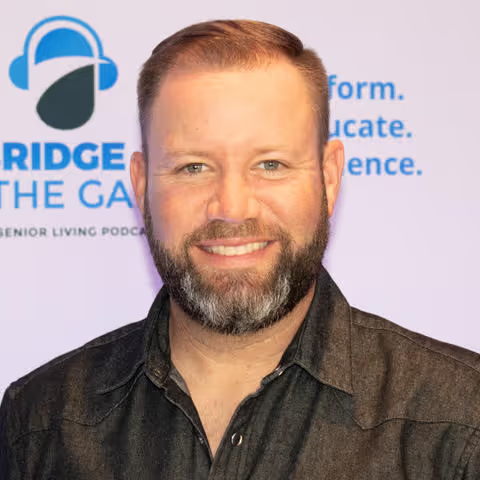
Lucas McCurdy is the founder of The Bridge Group Construction based in Dallas, Texas. Widely known as “The Senior Living Fan”.
Learn More ▶

Sometimes it's just best if you can get somebody that's already in a position somewhere in your building to make them that executive director, or step them up on the stair step.
As demand for senior housing continues to outpace supply, operators are preparing for one of the biggest growth opportunities the industry has ever experienced. In this episode of Bridge the Gap, Lucas McCurdy and Cameron Bell sit down with Carrie Boone, Founder of Generation Healthcare Managers, during the NHI Music City Symposium in Nashville.
Carrie shares her unique journey from land development into senior living operations, explaining how a single assisted living project became a lifelong passion for serving older adults. The conversation explores the critical role executive directors play in community success, why promoting leaders from within often produces the strongest outcomes, and how family culture has shaped Generation Healthcare Manager’s growth.
Key Topics
Meet the Hosts:
Connect with Our Guest
Produced by Grit and Gravel Marketing.
Become a sponsor of Bridge the Gap.







01:00 - 04:01
Lucas McCurdy
Bridge the gap. Three two. Welcome to Bridge the Gap podcast, the senior Living podcast with Lucas and Cameron. My guest host today, Cameron Bell from NHI. A very exciting program because we are here in Nashville, Tennessee, a beautiful summer day at the NHI Symposium and we have an awesome guest, Carrie Boone. Generation Healthcare Managers. Welcome, Carrie.
Carrie Boone
Yeah, thank you for having us. Just glad to be here.
Lucas McCurdy
I know, I know, it's already been awesome. We're just getting the day started here. But we had a great dinner last night. Cameron and the NHI family are the greatest hosts, you know? I mean, we've come to this for years and it gets better and better every year. How has your experience been?
Carrie Boone
Oh, absolutely. I mean, NHI is like I said earlier, it's more of a family, you know, than what it is your banking institutions or however. But I mean NHI they have everything you you just never, never meet a stranger. You know, once you get to know them, you know them all. And so we're very fortunate to be affiliated with them and we love their events. And I love the Symposium it's always a fun time.
Lucas McCurdy
Great education, and a lot of great networking to bring the NHI operators together and break bread and share some camaraderie. And you know, Cameron, you've done this for years. This is not your first symposium. What are the goals for NHI today?
Cameron Bell
Yeah. Well, thanks again to Lucas and the Bridge of Team. And thank you to carry for joining us on this wonderful podcast. And yeah, we're going to have a great day today. I think this is our 11th Music City symposium.
And I actually got a little tidbit of information that this is, I think, our highest attended ever and a 25% increase from last year. So I think that's, you know, a testament to who we are as a company and the individuals that work here. But it's also a huge testament to carry and other operators within our portfolio. And, you know, when I think about what this day means, it's not just the relationship between NI and its operators and partners, it's the camaraderie and friendship that develops from one operator to the next.
And that's what I think makes it super special. And you both kind of hit on it. It's it's somewhat of a family type feel. Were highly relational because our operators are highly relational. That is their business. They need to connect with seniors and their families. And we recognize that. So we need to meet them where they are. And that allows us to be good partners with the entire set of operators that we have.
Well, you know, Carrie, I've said this for years because I have worked in other verticals in the past, is that senior housing is incredibly collaborative, and this is no different. You've been in the business now for approximately 20 years out of the Midwest. Tell us how that all started.
Carrie Boone
Actually kind of started when I was doing land development construction, and I was asked to build assisted living in a town that I actually live in now. I'm from southern Indiana, so it was a little, you know, move to come up there and do that.
04:01 - 07:51
Carrie Boone
But I fell in love with this industry, fell in love with everything. And it's about and it was just an easy decision to say, okay, this is where I'm going to come. This is what I'm going to do. I'm going to do this from going forward. Then we got into the operations, in the management, you know, and I even love that more.
I still love the construction. And I know you do too. But the operations and the day to day management and overseeing, you know, with some wonderful, wonderful executive directors and nursing programs, you just become so involved in everything you do that it just feels right. It just feels right to be able to do that.
Cameron Bell
Carrie, maybe walk us through like, you know, you were doing land development, then you were asked to do that one building and run it. Talk about from that first time to where you are now and like the opportunities you saw, maybe some of the challenges you saw and then maybe high level. Just currently, when you think about your company and what states are you in, how many communities do you have and what keeps you motivated and excited?
Carrie Boone
Yeah, I mean, like, you know, when you build the first one, you know, it kind of people get affiliated with what you're doing and familiar and they say, okay, could you build one for us? So I've kind of ran into some wonderful investors who also seen where they would want to be in this industry, too. So we built a couple for them. Then it went on to build additional. So I'm being I've kind of learned as we you know, at first I didn't know anything. I had to even kind of look it up, see what assisted living was.
I'm very familiar with nursing home. I knew I didn't want to do that, but it just grew from there. And so we just, you know, built we got six assisted living right now. Somes memory care sums al mc and we got an independent living standalone right now. So but you know from there on we just, you know, kept moving and kept growing.
And you know, we hope to grow more within H.I. And you know they've really give us encouragement as well. And right now we're in the Midwest. We've got one here in Nashville not too far. And we got a couple in Georgia. So, you know, kind of keeps us going. But it's not nothing we can't drive to and get to right away.
That's kind of one of the things I always want to do is be able to get into our building in case, you know, we need to talk to somebody, talk to families. I'm still very involved in families and also with my executive directors and our nursing programs. So I got to see that firsthand.
Cameron Bell
So a couple of years ago, the community that we have with carrying her team is in central Illinois, and you guys are hosting a 100% celebration.
So I came up for that for her family was heavily involved. Just the way she interacts with everyone on the team. It was just a really cool environment. And I think you had some guys that were smoking some barbecue out back, and we did that with the residents and yeah, her sons. And it was it was really cool. Yeah, it's very special. Thank you, thank you.
Carrie Boone
We had a wonderful day that day. You know, we are very family oriented. You know, my my sister who's here with me today is my corporate at marketing. You know, she's I don't know of anybody who's a better marker than her. So anyway, she wants to retire, but, you know, we're not going to let her today, so.
But anyway, my sons, he's construction and we have some that's caregivers. My husband you know he's really involved in the in the financial side of everything new acquisitions looking at those. So we are a family oriented business and we love it that way. I mean, luckily we all really get along together, you know very well. So that's crucial.
07:51 - 11:18
Lucas McCurdy
Well, you know, on that same kind of framework, you talked about executive directors. You talk about leadership and you've got family involved. How do you create that culture of leadership and how important is that executive director role to success?
Carrie Boone
We found as you go through time in the last 20 years, executive directors really are the leaders of our building. It is very crucial, you know, we give them the right, you know, to run their building if they need help where they are. But for the most part, we build, you know, have strong men and women in that position who can really lead and extremely and I know Cameron knows that as well, that it really depends on, you know, your executive director in your nursing program to where your building is going to go. And, you know, we just can't say enough about them.
Lucas McCurdy
Cameron, you get to see a lot of buildings maybe. I mean, you're one of the few people in the industry, you probably walk more buildings than anyone, and you get to see the different levels of leadership, the different types of leadership weigh in on this leadership role, especially executive director.
Cameron Bell
Yeah, I mean, Carrie hit the nail on the head. It's and yes, I've seen a lot of communities. Luckily, as our portfolio has grown and as we've tried to become more of a better partner and steward to the operating operators, we have, we've hired some really great people. And so I'm trying to share in that task, which is good.
You know, it's we've we've brought in some people who grew up in this industry like we have. I'm going to name drop here. Becca Hymes started as a caregiver when she was 18. And she's currently a senior asset manager for us. So it's like she's lived it, breathed it, knows it. But she also can build a high degree of trust with our partners, both in the community level, with the executive directors.
Yeah, with the caregivers, because she can immediately walk in and say, like, I've done this, I know it's hard and just bring the walls down. And it just helps with the transparency and communication, which then ultimately allows NI to be a resource to everyone that we encounter. So but back to your main question, Lucas. I think, you know, anytime there's a director change, you know, there's some level of unrest, even if the new person that's hired is a rock star, right?
Because there's just a lot of unknowns. So it really is a requirement to, you know, the corporate team to make sure that they're pouring into the regional team who's then pouring into the local team, who then is pouring into those families and residents. So, you know, as Carrie said, you you really have to do your very best on making that decision and that hire.
But it's an ongoing process. They have to fill lead. They have to feel supported. And I think Carrie and her team do a fantastic job on doing that. And again, I got to see it firsthand. So it was lovely.
Carrie Boone
I think, you know, hiring within, you know, we see the people who dedicate their lives to the seniors and taking care of them and the leadership that they can, you know, provide.
And sometimes it's just best if you can get somebody that's already in a position somewhere in your building to make them that executive director, or step them up on the stair step. And that's worked in a lot of, a lot of our communities in favor of. So yeah. So it's fun thing to do too.
Lucas McCurdy
So let's transition to future.
11:18 - 15:28
The industry is at a major inflection point where demand is out out pacing supply. Right now the stat on new development is about 10,000 units per year. The demand for units is about 100,000 per year. NIC MAP has a figure over from from now to 2044, the investment gap is $840 billion. That is needed to meet the demand. And senior housing, you know, with that kind of statistics, what what are your goals as an organization? Where are you looking toward as occupancy increases?
Carrie Boone
Well, you know, I am construction. So, you know, I look forward to that coming up because, you know, watching something from the ground up go. But it's still, you know, acquisitions out there right this moment are, are pretty high, you know, and it's really, you know, putting our full concentration on getting that right acquisition.
And you know, just whether we build up on that, you know, whether it's a land to build upon it or new construction, it's still new construction is a little risky for the banks. You know, they're still looking at it like, you know, a risk factor. But I think you're right. The supply and demand is going to be great. So I mean, we do look at sites as well, still looking at acquisitions but also looking at sites that we can build upon.
Lucas McCurdy
So you mentioned expansions is that you think that's going to be a big thing going forward where you have an existing community. If you could add another wing or a memory care or some other form of acuity, is that part of a focus?
Carrie Boone
I do I think that, you know, and sometimes when we're looking at the acquisitions that come across our table, you know, we're looking what kind of land, you know, how much lands there. It's only like an 80 bed or something. How can we put, you know, get a 100 bed, maybe a 20, 30 more units on it. So I think that's something, you know, that we always keep our eye on because we know that it's going to come and it's going to happen. And so we just got to be prepared for that.
Lucas McCurdy
So Cameron, from a rights perspective, what's your you know, what's your kind of thoughts on those trends?
Cameron Bell
First and foremost, there's a lot of excitement and optimism around those numbers. And as someone that's generally optimistic, that excites me. But I still feel like, you know what we came out of, like, that's still there's still some scar tissue there for us and for everyone else in the industry.
However, I still believe that ultimately, that period that we all collectively went through made this industry stronger. A lot of good has come out of that better transparency, heightened sense on like leveraging technology, heightened sense on what I said earlier, pouring into your local teams because the work they do is so hard. They need to feel loved by you guys so that they can then go take care of others.
So, you know, I think in maybe a peculiar way, perhaps we were intended to go through those challenging times so that we are equipped for what lies ahead, because the expectations of the future clientele, I think, are going to be a little bit more intense. That's coming both from the residents themselves, but also their their families. So, you know, I think there's going to be a lot of creativity.
I think there's going to be a lot of best practice sharing within the industry, and there's going to be heightened transparency from what's happening with mom or dad day to day. And that's getting deployed out to their families, and they're just in the know about everything that's happening. So, you know, from an operating level, I think that I'm excited about there's still going to be challenges, but I think those key things will will help us get better.
I don't want to touch on the government regulation stuff that's such an unknown. Have different thoughts about that. It can change day to day. But now there's a lot of excitement and it's good to, you know, have conversations like these. It's good to go like to the Nic conferences. You can feel that buzz growing and I think it will only continue to grow from there.
15:28 - 19:22
Lucas McCurdy
So Cameron, you mentioned technology. That's a conversation. It's unavoidable. Almost every podcast, it comes up in some form or fashion. And then obviously the whole world is talking about AI. You know, this industry. I've been in senior housing personally for about 17 years, historically a slower adopter of technology. And you mentioned, you know, what the industry went through with Covid and it was really forced to really catch up.
And there's been a lot of changes since then. That said, you know, AI is not going to in any time soon take the place of a caregiver. Incontinence care, medication, socialization community. But there are maybe some other areas that AI could could help out in from a business perspective. Carrie. Any is that a conversation you all are having?
Carrie Boone
Yeah, absolutely. I think technology right now with like fall detection, you know, these are things that we have to really look at as well as, you know, with our new nurse call systems. And there's so many out there right this moment that we're we're just kind of looking at which direction to go, because it does get confusing after a while, but it really kind of keeps you focused.
And the residents focus as well as in our employees and makes them accountable. So I think that's what's really been important to us is trying to get accountability. You know, are they going in that room? You know, are they doing this? Check all this. The technology now can tell you and how when you've been in that room, how it's been again, the fall detection is such a big thing right this moment as well.
And so I think with it again, Covid probably did open that door for a lot of people. I mean, because normally you probably wouldn't have thought to do some of these things. But as as we were getting older, technology is just being more sought out after new developments coming. We're working with a software company out of, I can't say the name yet, but a new software company out of Atlanta that I think is just going to be changing condition, you know, which is really good on, you know, helps us with the residents, the residents families, you know, it tells them the story of what's going on as well as the revenue side, you know, what are you missing? So, you know, there's just so much out there at this moment. And I love it. I love that we're doing this right, this moment for these these residents.
Lucas McCurdy
You know, I'm going to come to you next from a reeds perspective. I mean, I'm sure every technology company in the world is knocking on your door. Hey, can we get a meeting? We want to pitch this new product, things like that. You know, we talk about Shark Tank today. You really at your, you know, y'all y'all probably live that where people are pitching pitching, pitching. You know what's kind of temperature reading on that. How are y'all approaching it.
Cameron Bell
Yeah. So a couple things I don't know if it's quite like Shark Tank. It's not like we're investing in those companies. Although I think we did have one group that did ask us to invest in them. And it's like, that's not what we do. But to your question, I mean, part of my new role, we is that because, you know, I was already naturally doing it, creating vendor programs that, you know, brought our scale and generated savings to all our operators.
But because of the, you know, future demographics, the supply demand scenario that we're in, in the horizon, we have ahead of us, more entrants are in this space that's both on the investment side and that's also on the vendor and technology side. And so, yes, the volume of inquiries to us has increased tremendously. So now my role is almost more of a consultative type of position to where I can aggregate and vet a lot of these vendor partners and, and try to help our operators like select not that we select it for them, but again, you almost create like a catalog.
19:22 -
Cameron Bell
It's like, hey, check these couple of groups out. You ultimately still need to pick the one that's right for you. And that's going to vary from group to group. But, you know, I think that's a part of the role that I enjoy. I'd like to help people. I like to help our operators. And if we can leverage our track record and our size to to do that, then that's something we're going to go after.
And then on the AI front, you know, there's a few groups out there that I think are doing some tremendous work. I think two things are going to happen with the new investment partners that are coming to the space. They will have that requirement of like knowing your business. And so Carrie mentioned like really keying in on how we're billing and focusing on the revenue.
But then the labor piece is going to be there as well. So really the most efficient way to do that is to leverage technology to satisfy what these new groups, who are probably in other verticals and have already seen this occur. It's just that our space is so complicated and deep. There's just a lot of thought and effort that goes into cultivating something like that.
So, you know, internally, I think that's what we're going to see with AI is it's going to help our operators tell their story better and to make or effectuate change better and quicker. And then the other side is non senior living, the utilization of AI there. Does that open up opportunities for us to go find people to bring them into senior living.
Right. Because you'll see a reduction in workforce in other areas, other industries. And I think this new generation thankfully they have a huge heart for making an impact, seeing what their work can do to others. And we're a perfect place for them to land.
Lucas McCurdy
That is amazing. And that's a whole nother podcast to talk about. The workforce. You know, Carrie, I know you have a busy day today and a lot of education and fun. Final thoughts?
Carrie Boone
I think, you know, again, you know, we're just tickled to death to be here within high. And I think moving forward we you know, who knows. Right. Who knows what's going to happen? I went to Asha last week and, you know, just so much new people, new coming into the space. And basically I just have a welcome arms to everybody. And I think, you know, I think this industry is one of the best industries you could ever be in. \\
Lucas McCurdy
I love it. Great note to end on, Carrie, Cameron, thank you so much for your time today, and thanks for co-hosting with me on this great episode. Appreciate it. Thank you for having us. Yeah. My pleasure. And to all of our listeners, you can go to btgvoice.com and download this content and so much more. Thanks for listening to another great episode of Bridge the Gap.


