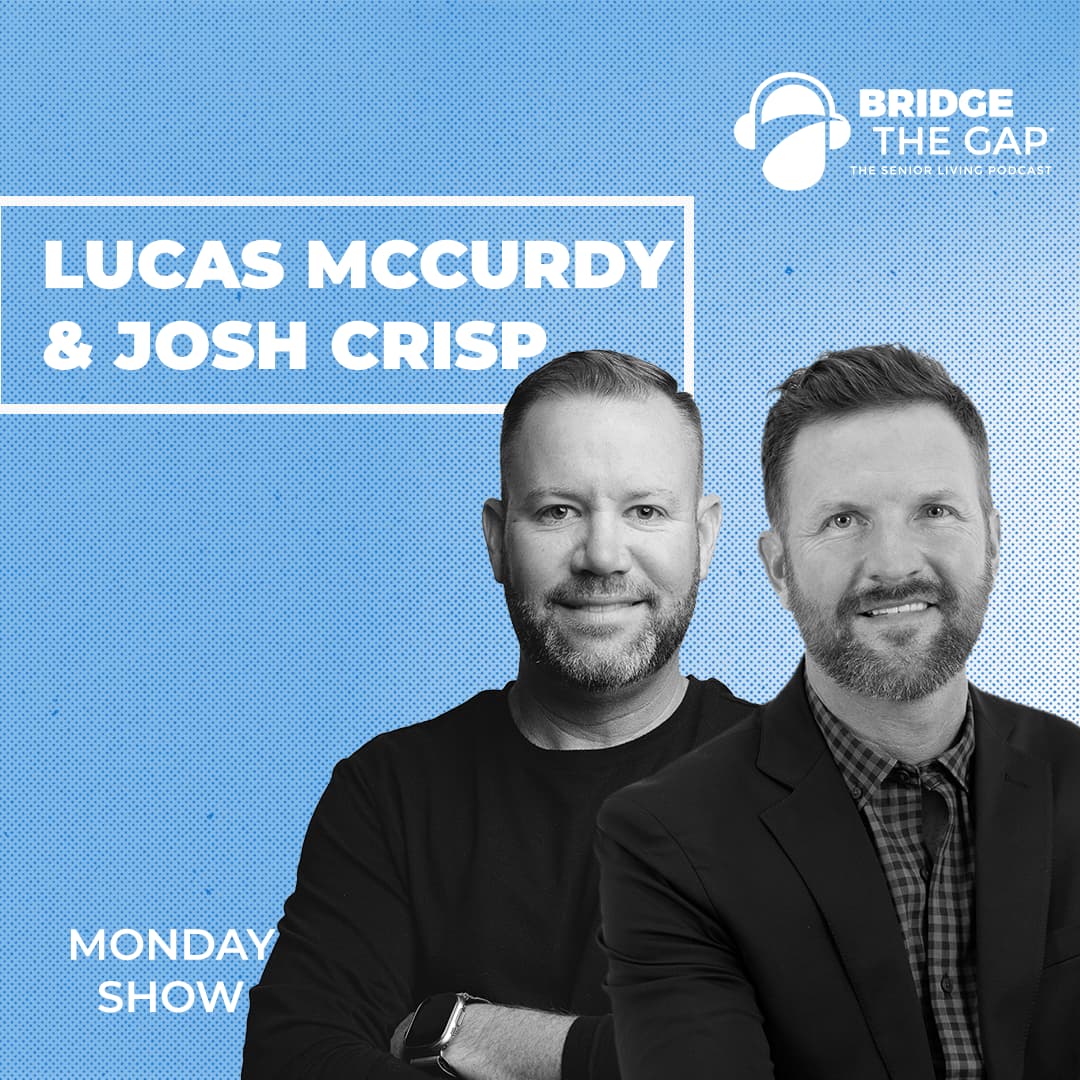
Senior living is rapidly growing, and new trends are starting to develop. Josh and Lucas sit down to talk through what they see happening and what it means for the future of senior living.
The complexity of the conversation actually gives the operator a great opportunity to serve as the thought leader.
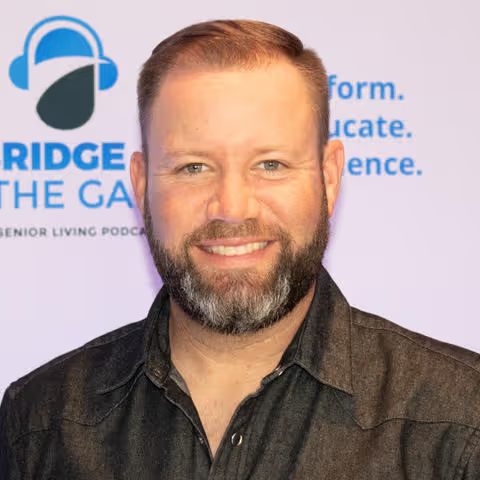
Lucas McCurdy is the founder of The Bridge Group Construction based in Dallas, Texas. Widely known as “The Senior Living Fan”.
Learn More ▶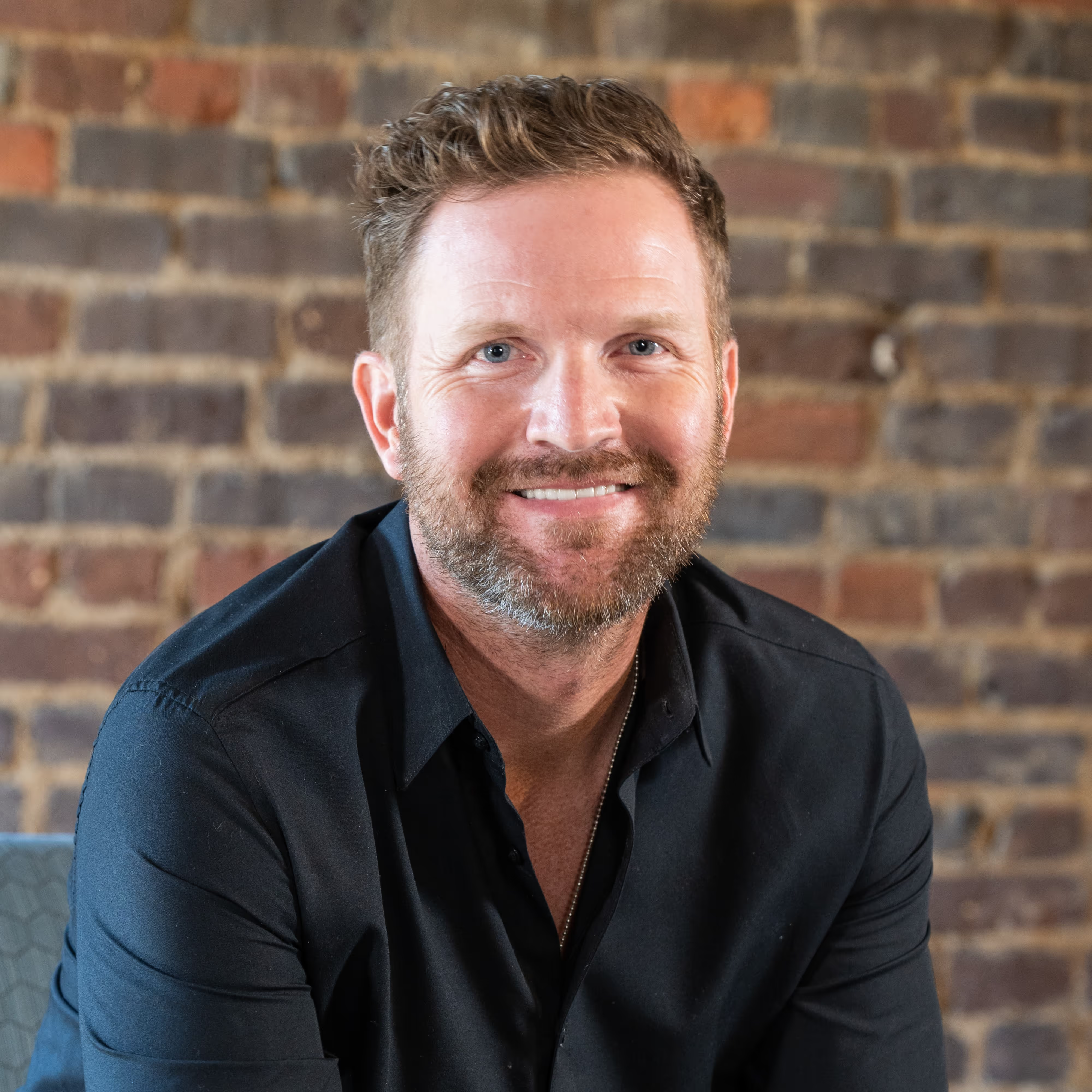
Josh Crisp is a senior living executive with more than 15 years of experience in development, construction, and management of senior living communities across the southeast.
Learn More ▶If you can't find the people and deliver on culture... you're not going to be successful.
Senior housing is entering a pivotal moment. Occupancy has recovered to more than 90% across much of the industry, new capital is increasingly looking at senior housing as an attractive asset class, and a prolonged lack of new construction is creating a major opportunity, and challenge, for owners and operators. In this episode of Bridge the Gap, Josh and Lucas explore what this changing market means for investors entering senior housing and why experienced operators are becoming increasingly valuable partners. They discuss the complexity of state and local regulations, licensing, life-safety requirements, labor, technology infrastructure and the operational realities that outside investors may not fully understand. The conversation also examines the growing opportunity to acquire and reposition existing senior housing assets rather than rely on new construction. With much of the nation's inventory aging, strategic renovations, expanded services and thoughtful repositioning can create opportunities for both operators and investors.
Key Topics
The changing senior housing investment landscape
Why new capital is entering senior housing
The increasing value of experienced operators
Senior housing's operational complexity
State and local licensing and regulatory differences
Life-safety requirements and local interpretation
The implications of labor and workforce availability
Why existing assets are increasingly attractive
The four-plus-year slowdown in new construction starts
Repositioning aging senior housing inventory
Technology and infrastructure upgrades
Expanding the continuum of care within existing properties
Secondary and tertiary market opportunities
The importance of understanding local market fundamentals
Preparing senior housing for the next generation of residents
Meet the Hosts:
Produced by Grit and Gravel Marketing.
Become a sponsor of Bridge the Gap.







01:07 - 04:26
Lucas McCurdy
Welcome to Bridge the Gap Podcast, the senior living podcast with Josh and Lucas on a cool virtual episode. Today, Josh, you're in Knoxville. I'm in Dallas area and we're recording about the things that we love to do in senior housing. It's going to be fun today.
Josh Crisp
It's fun. And, you know, even though it's virtual, I'd much rather be hanging out with you in person. But thank God for technology. We can.
Lucas McCurdy
That's right. Well, you know what? In just a matter of days, you and I will be hanging out. We'll be hanging out in Chicago, of all places. And this North Texas native is looking forward to a little cooler weather. But even more than that, what I'm looking forward to is some very important conversations about the industry fall.
NIC is coming right around the corner, and I think this is possibly one of the most important Fall NICs at least in my career. 18 years of going to the NIC conference, probably similar for you because the market has never looked like this before.
Josh Crisp
Well, it's never looked like this before. And I, you know, I can only speak for myself, but from what you know, you and I have been working on together as well as, you know, I've heard you talking about, you know, I feel like the culmination of our 20-plus years in the space, you know, all the blood, sweat, and tears, the learning and the challenges, has all come up to this
moment for this great opportunity that many of us have been talking about, you know, for literally a decade of not only just, you know, starting out with the demographic information, but sort of this perfect alignment of new capital that's looking at our industry. And through a lot of what I would say, challenging circumstances, the silver lining, which is, you know, that that pressurization on the core of our industry and our industries, partners, that has forced us over the last 5 or 6 years to adapt, to change, to pivot.
Many of those changes needed to happen, right? We wouldn't have ever dreamed or wanted them to happen necessarily forcefully, but in many ways it's advanced us and we're coming out. Those that have been committed on the other side position for success. So therefore I am very excited. And we've been talking about the last two. NIC's. We went from, oh my gosh, this is a tough environment to oh, there's a big bright side coming to my gosh we're back performing better than ever. And now this wave is hitting, so good time to be in senior housing.
Lucas McCurdy
It is, I mean, when we're talking about 90-plus percent occupancy across the portfolio across the industry, that's a major thing. And also a major thing when you start to realize that senior housing is performing as an asset class right next to data centers; I mean, this is a big deal.
04:26 - 08:33
Josh Crisp
It is a big deal, and it's causing big deal conversations to happen, right? I've been talking to capital markets for the better part of 20 years, and what's so exciting to me is that many groups that would have never considered entering senior housing R now at the forefront and knocking on the door and talking to us and being educated.
And they're not only looking at the past seven quarters data of success, but they're looking at all of the the forward looking data. And and we're having these conversations and it puts operators at such a valuable position. Right. And there's going to be so much opportunity whether you're investor, a capital provider, whether you're a partner to the industry and a partner to operators, any sector that you are, you're going to have a great opportunity if you're entering this industry right now.
Lucas McCurdy
So let's talk to that investor that you just identified, and let's presume that that investor is out there. And they googled, and they found this episode, and they're trying to figure out they've got the money, but they're trying to figure out how to invest in senior housing, or somebody has sent them this episode. Talk to talk us through how, when you say the operator is very valuable, what does that mean to an outside investor?
Josh Crisp
Well, you know, what I'm learning it means is, is is very fun conversations if you're an operator. Right. Because you're talking to often very sophisticated, very expensive, experienced investor types that have many of them, huge asset management platforms that go across verticals, many different verticals. And it's very interesting that many of them use the same asset management group across many verticals, because it's not extremely complex, right?
The, the to run or to operate those businesses. No. You know, certainly not trying to insult anyone. But when you when you come into senior housing, historically, one of the barriers to entry and why people don't is because of the complexity. Right. So we are in a position now to where a lot of the conversations were very much led by the capital provider, within very tight boundaries of them knowing as much as the operators did about the business.
It's really turned upside down. And now it's really for that capital provider, that investor. It's all about the partners that they pick because they have to have the local knowledge. They have to know how to operate the community. They have to know how to be able to transition the assets and the operations from serving the greatest generation to serving this next generation of the boomer generation.
And what is that going to mean for all of your operational teams for dining, delivery, housekeeping and maintenance, for your care teams and your clinicians and the providers that you partner with in that market? And what is that going to mean for tech, and what are the implications on labor and occupancy and managing that community and managing delivery of care?
So the complexity of the conversation actually gives the operator a great opportunity to serve as the thought leader on the conversation and inform the capital providers on how they need to allocate their dollars and how they need to spend their dollars, rather than the capital telling the operator where they're going. And that's a conversation. I've never been in a position because of the market, the market, to be able to do so, that that's a cool place to be.
08:33 - 11:35
Lucas McCurdy
Well, and I've heard you say in the past that there are no standard nationwide licensing regulations for senior housing. It's very localized. So you add that into the mix, you add life safety into the mix. Licensing regulations. I mean, how important are those in this conversation?
Josh Crisp
Well, it's important at every level, Lucas. And you see this just on on positioning assets, repositioning assets, adding two assets on the construction side.
You know, while there are certainly federal life safety codes, right, that are often consistent from place to place, how those are interpreted and carried out from a, let's call it a licensure board, a regulatory standpoint, a health department standpoint, and how that building is going to be regulated at a state, at a regional, at a local level, can drastically be impacted.
And I can't tell you and you've you've seen and heard this more than I have, even positioning the asset from a capital expenditure or repositioning asset, how important it is to have the partnerships, not only have your general contractor that has the relationships that's licensed in that state and understands the state has the teams to deliver in that state, but it's the same thing with the operator.
And so the that that is in and of itself a big, big piece. But, you know, it's not like you you learn it and it never changes. It's a constantly changing environment. So when you're talking about something that changes at a federal level, and then every state is interpreting it and carrying it out at their own level. That's happening in real time every day with legislatures all around the country and municipalities.
And so to have boots on the ground, knowledge and forming backup stream to your capital providers in real time is more important than ever.
Lucas McCurdy
Well, Texas is going through that right now with the generators and that that bill that just came out and the interpretations around that. Florida went through that same generator bill probably ten, 15 years ago there there passed it. But I imagine that that we're going to start to see that throughout any coastal states in the Gulf or the Atlantic. I think that that's going to be a big thing. And there's a lot of interpretation around that, because there's a lot of dollars behind that. You try to put a generator or retrofit generator to your building. I mean, it's just a big price tag.
I don't get caught up on that. But and I mean, even another point is explaining the local fire marshal while your memory care doors have to be locked. I mean, even something down to something like that is, you know, a big deal, that if you're an outside investor in trying to navigate this, you may not know how to deal with it.
11:35 - 17:05
Josh Crisp
Yeah. And that's a tough conversation even for the operators that know the local fire marshal because, you know, lots of good intentions on the regulatory and legislative front, and then how it gets carried down to a local inspector. A lot of times there's a huge gap in information and education. And so, you know, if you're not typically better versed in what's happening at the local level than the local people, you're in big, big trouble. So partnerships from top down, bottom up are extremely important.
Lucas McCurdy
M&A transactions are at an all time high. We're going to set yet another record year over year. It's a big deal right. Construction starts are essentially nonexistent for four plus years, which is kind of I mean, just unbelievable to think about that. There's essentially no new product coming out of the ground.
And even if you started one today, you, you, you hit that shovel on the ground today, you're 3 to 5 years from realizing that in a big price tag on that and a lot of change, even, you know, and the question would be, are you even building what the marketplace even once needs or desires for 3 to 5 years from now?
And so that leaves people to existing assets and the majority of the product within senior housing inventory nationwide is old. It's 20, 25, 30 years old. And it's it's due for a retrofit. It's due for a reposition. You're focused on that. I'm focused on helping operators and investors do that from a construction standpoint, and we're busy as ever. There's a lot going on right now.
Josh Crisp
There's a ton going on right now. And actually, the pace is pretty mind-blowing that you alluded to. And it just that when you think it can't get faster, it's moving faster because it is the time to by if you're an operator, if you're an investor, versus new construction. And you're right, there is a lot of aging inventory, legacy inventory that has to be repositioned.
Right. It's just candidly, it's not really relevant as far as the infrastructure in the communities to run the current tech platforms and and the point of care systems. There's a lot of infrastructure changes. There's a lot of just design changes to run the more sophisticated current programs and the spaces that you need, and then you've got to appeal to the different demographic, the different consumer.
So a lot going on there, a lot to reposition. And there's a lot of operators and ownership groups that candidly, we owe such a huge amount of respect to because they built our industry and they're faced with a position of, okay, I've been doing this for 15, 20, 30 years. Am I going to invest and double down and reposition these assets and look for, you know, to get ROI on that?
Or am I going to turn this over and let the next generation of leaders, operators take the mantle now and serve this great industry that's growing. And so you've got that that opportunity. But candidly, you know, we're also seeing still because that inventory that was built between let's call it 2013 that really started a lot of development after, you know, the Great Recession of oh eight, 2013 to let's call it 2019.
You had a lot of sophisticated developers that were in other verticals that could get they had great balance sheets, they had a lot of cash. They were good developers. And they thought, hey, how different can it be than a hotel, a multifamily, my residential neighborhood, all challenging things, but they were not so operator centric. So they were able to, with their financial prowess and development skills, get a piece of property, develop it.
And it struggled. And they never realized how difficult it would be to do that business through 2020 and beyond. And so there's still a lot of what I would say, relatively great assets that simply need a facelift. They might need some additional continuum. They need a sophisticated operator to come in and work with a partner like bridge Group to reposition that asset for success.
So we're seeing a ton of that. And and this is across the board. This is from the primary markets to the secondary and tertiary. We're primarily focused in the secondary and tertiary markets. We believe that's where we're seeing the greatest opportunity and unique challenges. And we're hyper-focused on a geographic area. And you know, it's it's just a fun time.
17:05 - 22:51
Josh Crisp
Not without challenges, but it's a fun time. And it's it's rewarding to see now that the capital is coming into the industry that traditionally had sort of didn't look at the industry, but we're
performing to such a great standard that, you know, they almost have to.
Lucas McCurdy
Let's talk about strategies on repositioning assets. What I have seen, if you rewind back ten, 15 years ago, I saw a very conservative approach on acquiring a value add it the the kind of strategy, your mindset was low budgets, common spaces only as just as as far and as cheap as we can get it. And now, fast forward to today. What I'm seeing is a totally different approach. I'm seeing, I mean, a more realistic kind of budgetary. It's not really the budget. That's the focus. It's more of, we just want it all done.
We're going to do everything, including the units. And if the roof needs it, we're going to do the roof and the outside looks like garbage. We're going to do the outside. If it needs landscape, you're going to do landscape and we're going to get this building reposition now, not kind of piecemeal it over the next five years. What has been your approach? What are you seeing out there?
Josh Crisp
Well, you touch on a really interesting point. And it's and so before I give you our approach, you know, it's important to understand why people are even willing to do that. And I think it's we've heard from our friends at Nic Map, you know, the the broadening gap between supply and demand, combined with the occupancy improvements and then the trifecta of that, the boom of the generation coming in, people are more willing now to take that risk, which doesn't seem like much of a risk anymore, to invest that much in an existing asset.
So our approach is I don't think it's too complex. You know, when we look at any asset acquisition, we look at basic fundamentals, we study the market. And just because there's this huge macro demographic boom that does not replace the nuance at the local level, you really have to be attuned to, especially when you get down into secondary and tertiary markets and what's going on in that market, you know, really understanding what is the competitive landscape, what are the housing programs and services available and not available to serve that market?
But more than ever, we have to also look at the labor side, because now one of our biggest challenges that we don't talk about enough is you can build an incredible or reposition an asset, and you can nail what you're going to deliver as far as service. You can nail the finishes, you can nail the layout, the programing and all that.
But if you can't find the people and deliver on culture, which starts and is embraced by the people and carried out by the people, you're not going to be successful. And so really, the most fundamental core is understanding the market, understanding how you're going to position that asset and how you're positioning your team to be the number one employer of choice and best care delivery in that market.
And really looking at that. But outside of that, you know, we're looking at everything from the infrastructure of how is our care delivery systems, even on the tech side, going to be carried out? What has to change from an infrastructure standpoint? But we're also looking for growth. Almost all of these assets, even the ones that aren't performing really well, are trending in the right direction.
And with the boom of the demographic, we know that if we come in there and reposition the asset, we invest that CapEx dollar and we update the culture and we're more appealing. It's going to not only fill up, but because of the supply and demand gap combined with the demographic, we're going to need more of it. So we're paying extra close attention to any asset that has any little bit of extra space, right?
Whether that's adding additional few units to give that smaller community some scale and make your operations more efficient and more profitable. Is it and or is it adding additional units? There's a lot of freestanding assisted living and or memory care product that's been built over the last 20 years and adding cottages, adding some villa product, adding something that's sort of an entry point at a lesser level on the on the continuum spectrum, and diversifying your product to where that operation is sustainable in and of itself on that property.
And it's much easier to scale and existing asset than it is right now to go out and build a ground up and then hope it's stabilized in 3 to 5 years right from the time that you start. So that's kind of where we are and what we're looking at right now. And I know it's exciting to have partners like you.
22:51 - 27:58
Josh Crisp
You're growing in all of these markets. I keep seeing these announcements licensed in an additional state. So I know that you're working with some of the best operators in the country. What are you seeing?
Lucas McCurdy
I'm seeing exactly what you're talking about. These are the conversations we're having every day, and we're expanding our services to help our clients and our customers that need trusted partners. I often tell people that, you know, because senior housing is the only thing I do. I have to make different decisions because at the end of the day, I have to make you happy. I don't have another vertical to go to. I'm not opening bridge Group multifamily, don't want to, not going to do it. So I'm here and really invested in this marketplace and want to make everyone happy and accomplish their goals.
These are these are big goals. These are big numbers and big challenges that need a good team. And senior housing is just a very hyper focused industry. It's very complex. And when you have the right team in place, which you've alluded to, it's the only way to get success in these complicated scenarios. In my opinion.
Josh Crisp
Lucas, in all your spare time, you know, we're doing this podcast and it's been really cool, educational for me through the years to to learn what my peers are doing, what my partners in the industry are doing. But we've had some incredible partnerships that have come alongside us. You talk just a few minutes ago about NIC map and all that that's been able to help bridge the Gap. Our podcast with and here, just as you said, in just a few days, we're going to be at NIC, which is another huge partner of ours, you know, how valuable has it been to us, but also to the industry that this all started really with the conversation we had at NIC years ago.
You again as a partner to the industry, providing construction services and repositioning services. Me as a young operator back then, how cool is it now that we've got all these partners and we're at this opportunity talking about this? Did you ever think, you know, ten years ago when we started this, that this is where we would be?
Lucas McCurdy
No, I never would have thought that. And what a great blessing it's been. And the history of the past almost ten years has now been preserved on the Bridge the Gap network. You can go back and listen to all of these conversations and the evolution of that which sidebar with AI. You know, you and I should probably go and get some AI to kind of track some of this historical information.
That's a side project, right? We'll come back to that later. But that would be a very interesting kind of project to put together is a timeline of history of these conversations. But it really is fascinating. And as we approach this fall, NIC, I'm very excited of the conversations that we're going to be able to have as we set up our studio there and figuring out how the industry is going to tackle this amazing challenge of supply and demand. And I can't wait for you and I to bring those conversation in that content from other thought leaders there to our audience.
Josh Crisp
You know, we're we're also blessed. We've got an incredible team behind us that makes it possible because so often, because our podcast is so public and people see us on Instagram, LinkedIn and Facebook and YouTube and they watch and they listen and they think, gosh, you guys actually have day jobs.
We didn't realize that. We thought all you did was podcast was we see your content every single day, 365 days a year. Thankfully, we have an incredible system and process that we've sort of just refined through the years that enables us at at NIC, you're going to be meeting with tons of clients, prospective clients, answering tough questions for people that are repositioning.
I'm going to be there with our Solinity teams, management and development services and repositioning services. And then we're going to sit down and we're going to have some amazing conversations. So to our audience, if you have seen us, if you have heard us, if you've heard about us and you see Bridge the Gap Studio, we hope that you'll stop and please introduce yourself.
It's super great pleasure for me and Lucas to ever, like, actually connect with those of you who are out there listening and oftentimes probably even feel like you know us a little bit and we've just never met. So please stop by and say hello. Can't wait to see everybody at that NIC event coming up.
Lucas McCurdy
Absolutely. There's a lot of new people in the industry and we look forward to meeting you, new friends and older friends too. So great conversation, bud, I appreciate it. Josh, we'll see you in Chicago just in a few days. And to our listeners, you can go to download this content so much more. Connect with us on LinkedIn. Hit us up. We want to hear what you have to say. Thanks for listening to another great episode of Bridge the Gap.


