.avif)
Looking for practical, cost-effective ways to elevate your space? We've brought in the design expert, Keri Moore of 828id, to be your guide.
Not every campus can afford to knock down walls, so we try to redesign and reprogram. Inside the walls and inside the structure.
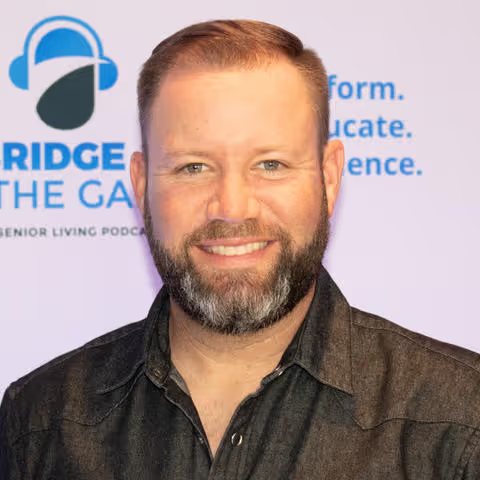
Lucas McCurdy is the founder of The Bridge Group Construction based in Dallas, Texas. Widely known as “The Senior Living Fan”.
Learn More ▶
If they're informed, residents aren't as resistant to the change in the design.
In this episode of Bridge the Gap, Keri Moore of 828id goes on a deep dive into how life plan communities (CCRCs) are adapting to today’s market realities. With new senior living development at historic lows and occupancy on the rise, operators are turning to strategic renovations, reprogramming, and interior-led transformations to stay competitive.
Keri shares practical insights on maximizing limited capital, from rethinking FF&E investments and flooring strategies to activating underused spaces and creating signature experiences that attract both residents and the broader community. The conversation explores how resident committees influence design decisions in not-for-profit communities, why first impressions matter more than ever, and how specialized senior living design expertise reduces risk while improving outcomes.
Key Topics Covered
Meet the Hosts:
Connect with Our Guest
Produced by Grit and Gravel Marketing.
Become a sponsor of Bridge the Gap.
Listen to more episodes here.








00:00:46
Lucas McCurdy:
Bridge the Gap in three two. Welcome to Bridge the Gap podcast, the Senior Living podcast with Josh and Lucas. A great day here in Boston at Leadingage National Conference 2025. I've got a great friend and an awesome guest on the show today. I want to welcome Keri Moore of 828 Design. Welcome to the show.
00:01:06
Keri Moore:
Good to be here. So exciting.
00:01:08
Lucas McCurdy:
It is exciting we're here in the conference center. It's like a million square feet. It's huge.
00:01:15
Keri Moore:
It's a big show this year.
00:01:16
Lucas McCurdy:
Big show? You're here with your twin sister, Kelisa, and she's manning the booth right now. Because you guys are. You guys are hustling.
00:01:24
Keri Moore:
We are. I think it's better when I'm not at the booth because I'm in that I walk away. She's got a lead coming in, so I said, maybe it's best if I'm not at the booth.
00:01:34
Lucas McCurdy:
I don't know about that, but it is best that you're here on the Bridge the Gap network today because there have been a lot of changes in twenty twenty five. The moment has shifted, and you have been on the front lines of this development is way down, right?
00:01:50
Keri Moore:
Yes.
00:01:51
Lucas McCurdy:
But repositions, acquisitions, and renovations are way up. Yes. And that is a big topic of conversation here at the convention for Leading Edge. Obviously, life plan communities. These are CCRC’s. This is the not-for-profit side of the industry that many of our listeners understand. But there are a lot of listeners out there that really don't understand. There are two sides to the industry, and this is a very big side. It is a huge, big conversation. So today we're going to be diving into what these life care plan communities are looking at when they're thinking of expanding, when they're thinking of reimagining these spaces. We're going to talk about F.f.a. We're going to talk about AI. We're going to talk about a lot of different things. , and so let's just dive right in. You are a senior living-focused designer and do a lot of work on the not-for-profit side of the industry. What are some of the challenges that some of these legacy campuses face when they're looking to stay modern and stay competitive?
00:02:57
Keri Moore:
Being competitive is the biggest question on everybody's mind. You know they don't have the bankroll or cash flow that some of these for-profit investors and competitors that are, you know, renovating next door to. So I think, you know, the partners that we join with and operators that we try to really encourage and use their dollars wisely is to kind of position them not with just like the standard remodel that you see of like, let's just replace your dining furniture. Let's do a one-for-one replacement, which I think has been historically what the dollars were used for. You know, it's like, well, there's carpet here. Let's replace the carpet. We've got a sea full of dining chairs. Let's just say we need one hundred and fifty more dining chairs. And so, you know, not every campus can afford to knock down walls, you know, move the barriers because they can't have an architect. They can't pay for a big contractor. So it's really the last couple of years has been heavy, heavy interiors. And so we try to redesign and reprogram. Inside the walls and inside the structure. By diversifying the types of furniture that we put in, integrating lounge seating into dining rooms, , you know, using their existing spaces just with finish applications to create new programs, spaces that they can't fully renovate. So we really try to see what the market's doing and repurpose those spaces at an affordable cost. , and a lot of times, you know, we're up against campuses that are managing it themselves. And a lot of times we find ourselves being kind of a project manager and owner's rep at the same time. And so we really try to lean into what our client needs are and then link them up with people with like minds and focus to try to help them meet their goals. So it's a lot of reprogramming in the real estate that they have, because they just simply don't have the funds to cash flow and expansion. So.
00:04:53
Lucas McCurdy:
Well, let's get granular. I'm going to ask some kind of like in the weeds questions. So these campuses typically, you're dealing with a lot of square footage. So if you make a carpet selection just because, oh, this looks really pretty. This fits the design. But people aren't really thinking, oh my gosh, this really adds up over the course of all of our miles of corridors. Walk us through, like, hey, is it should it be carpet tile? Should it be plank? Should it be this carpet? How do we balance this budgetary, you know, necessity but also hitting the design intent on a durable product?
00:05:30
Keri Moore:
So we try to keep, you know, a lot of the really great carpets out there that don't feel like office carpet, you know, are like forty-five, fifty dollars. That's material cost, not including demolition. And you know, the put, you know, the installed labor to put it in. So we really try to find the biggest bang for their buck and isolate those areas. So you may have a custom inset, not really custom, but it feels custom, right with the really high-dollar material carpet, and then you may surround it with a really inexpensive vinyl plank. Right. And I think when you don't have the funds to completely blow down the walls and reposition your whole campus, we can divide up the spaces strategically with both flooring, finishes, and furniture to break that up. And I think that's when you can introduce the textures of flooring, whether it be vinyl or tile. And we really, truly have really great relationships with our manufacturer reps. We know that we're going to have so much yardage coming in. They really fight for us. You know, a lot of times, you know, construction markup gets really high. And so we'll go back to the drawing board with our reps and be like, I need this vinyl at this cost, but I need we need a twenty mil wear layer, and it needs to be the thickness to avoid a trip hazard. So there are so many factors that play a part. But we lean into our industry vendors. They want the same end result that we do, and they get it. And so you know, there are so many different approaches to it.
00:06:57
Lucas McCurdy:
I know you work with a lot of vendors and also contractors across the United States. I've been fortunate to be a part of your design process and install your visions that you have at some of these communities. I've noticed that there seems to be a trend around resonant doors really activating that space to give it something, you know, just make it really pop. Walk us through that trend and how to kind of balance, because that can get expensive when you multiply that over hundreds of doors. , but it's, you know, it's more than just a little accent, accent paint, which, you know, let's think a little bigger here.
00:07:31
Keri Moore:
Yeah. A lot of designers lean into, like, what does a hotel door look like? What does a front door in your house look like? You know, you want some unique identity where it doesn't feel like you're walking by a back-of-house door or a regular office door? , and a lot of times you can't afford to replace all the doors. You know, they're fire-rated, they're solid core. Then you get into locks and hardware, which, you know, here goes the dollar signs rolling up. So we get really innovative with the way we apply paint to it. And then a lot, a lot goes a long way, which is the application of trim, as you know, you've seen it in some projects that we've done and showcased together, where we apply trim in different, unique ways to make it feel like an elevated entry so it doesn't feel just like a boring hallway, because not all the time we can rip down the ceilings and give some dimension and scale as you're walking down the hall, because that's cost prohibitive too. So we've been able to do it on a smaller scale per unit turn and still make it feel individualized for the resident, which makes them feel special and important, which they are, but really highlights them. Instead of ripping down a ceiling that they don't see the value in, the dollar. So we've been really creative, you know, the last couple of years, you know, and it depends on region, what they, what the style is.
00:08:49
Lucas McCurdy:
So let's talk to the providers out there who think? You know what? It's been a while since we've done a renovation project, and I remember the one we did eight years ago. It was really hard to manage because our residents couldn't get on the same page, and they're involved in the process a little bit differently than the for-profit side, where typically the corporate office makes those decisions, and the residents have to live with it, whether they like it or not. How does your role as an interior designer come into play when you're having to deal with resident committees and all the politics around making a decision about what this design is going to look like?
00:09:28
Keri Moore:
You know, we've done both spectrs, as you know. , and on this side, on the not-for-profit side, it is so culturally driven by the residents, and their voice matters. And so, you know, we've had small, and it varies by campus. Some campuses are very, very large and have a bigger city environment, and some are more in a rural setting. And so we kind of lean into the executive directors and the decision makers of the campus to see how involved they want us. But we'll do intimate design sessions where they can, you know, pull pallets together, and they get a vote. Sometimes it's just informative, right? If they're informed, most of the time, residents aren't as resistant to the change in the design. It's just being heard. So I've seen it very successful with change when the renovations start occurring and happening when they put us as the face from the get-go, they get us in front of them. We are part of letting them know what's going on so they feel heard. We can listen to them, even though maybe decisions are being made in the background. Sometimes we pivot and adjust from what we hear, but I think if we can get involved in the very start of it, make them feel and have them be integrated and involved in those decisions, or they're listening to what's being made it, it goes much easier for the contractors in the field once change starts happening.
00:10:51
Lucas McCurdy:
I bridge the gap. We follow the data trends in the marketplace very heavily because one of our key sponsors is NIC MAP. And they have all the data for the industry. Arick and Kyle are the tip of the spear on just really analyzing all the marketplaces. Arick was here, and we got to sit down with him, and I was really shocked by one of the statistics. , and as it relates to occupancy, occupancy is going up, that is a trend that we are seeing, and we know that. And over the next few years, the age of, you know, the demand for age and income, qualified people are going to be moving into these communities. And, , there's going to be a need for more. , and he said that over the past twelve months or so, there has been one new planned community open, one new in the country. And so that begs the question, what are the existing campuses focused on? Yeah. , and so I want to pick your brain when they're looking at their campus and they may not, you know, think like we're going to redo everything, but they're looking at these individualized specialty projects where they say, we want to take this specific space and we want to reimagine what this is and make this a big feature of our community. Are you seeing a trend in these types of projects?
00:12:12
Keri Moore:
What we're seeing trend-wise for these big CCRC’s is these campuses have aged in place and, you know, a lot of some of the future planning that we're seeing with some current development projects that we're working on currently, is a lot of their existing independent living may swap licenses and go to Al and future build for Ill. But in the interim, until that happens, we're starting to see signature restaurants, chef-inspired, you know, vibes. And you know, everybody's trying to catch up to the trends that we started building before, you know, prices got a little bit too high, and Covid kind of wrecked the economy. But, they're really leaning into something signature that maybe can start drawing in the public earlier on, and a platform where they can host events to keep that funnel coming in for prospective residents. I think that's huge. And in the forefront of, , every marketing team out there is how can we stay connected to the community, and what space can we flex to make sure that that happens? And we can, you know, harvest that and kind of really nurture that relationship. I think that the biggest thing is keeping that connection to the community and keeping that marketability current. It's huge.
00:13:29
Lucas McCurdy:
Absolutely. So, talking about cost, to your point, costs have gone up on just about everything. And this is the world that we live in. , and f.f.a is no different, right? Gone are the days of the chair that costs a couple of hundred dollars. You know, I was in a community recently and, looking at a, you know, some of the new chairs and stuff, and some I think I heard somebody say that that chair was seven hundred and fifty dollars just for this chair that was in the dining room or whatever. And I thought, oh my goodness, this is insane. This is getting out of control. How does a provider out there really balance? Hey, you know, we really do need a refresh. We need new tables, new chairs. We need to activate some of these spaces. How do you help them walk through that process of budgeting and planning?
00:14:13
Keri Moore:
It's kind of different. We look at the performance first. You know, a lot of the cost-driven dining chairs are the highest cost, in my opinion, because of the sheer quantity, just like when you're renovating units, it's the quantity that adds up. It may not be an expensive material, but with the sheer quantity. So that's kind of the test, right? Is where's your budget at? You know, we used to do a lot of budgeting. The high-cost dining chair was a wooden chair. Most people are moving completely away from wood dining chairs because they get banged up and chewed up. Your dining room starts looking a little shabby. And so we've been able to kind of pivot and kind of coach and present different options that look like they would like alin, for instance. And it's very lightweight. It's not a fraction of the cost. It's maybe about one hundred dollars cheaper than a wood dining chair, but still, because they know they've captured a market, those costs are completely coming up. So the way that we try to budget or balance the budget with them, because it's very hard to get a dining chair under four hundred and fifty dollars and some of the just the net cost are three, three hundred to four hundred dollars, not including fabric. So, depending, you know, we try to budget healthily, and if it's a little bit too much, we try to manage that. With fabric selections. We can get the same look and feel with a different fabric manufacturer and still get you a great quality chair that only we know the difference in, right? And a lot of operators are leaning more into vinyls, which are, you know, definitely more cost-effective than a woven textile. So that's kind of our way of balancing the budget a little bit to get them the same bang for their buck. We try to give our clients the best we can, and to stretch their dollars the best we can. But it's I, we get pricing in every day, and I'm like, oh my God, like, we need one hundred more dollars a chair. This is crazy. So it doesn't stop.
00:16:09 Lucas McCurdy: Let's talk about the front door and first impressions. You know, on these campuses, sometimes the wayfinding of just like people coming into the community and finding their way. Where is the lobby? Where is the receptionist? Can be a bit of a challenge, just depending on the nature of the layout. Talk to us about the importance of first impression and that receptionist and that lobby, walking in and not just seeing maybe like a piece of furniture that's just an old desk.
00:16:38
Keri Moore:
Yeah, we've seen campuses that are, you know, twenty-plus years old that have an office desk, and that's where you kind of check in. So when we approach those types of projects, we try to, you know, just like with skilled nursing, you used to see the really large nurse stations that were huge, and everybody sat there, and that was like, this is where you check in. Family member. , and, you know, we used to design really large lobby desks. And so we've kind of re-orchestrated it as a more affordable approach and do more of a concierge. It still feels custom. It feels elevated. It's a way to give greater presence at the front door because we don't need all the printers. You don't need all this. You know, technology has come a long way where people can monitor different sectors and not have like five people at the front anymore. So we've scaled back and done like a concierge, kind of more like a hostess station, if you will, at the front door. That kind of lets people navigate, and we really, truly try to activate the front door. We want someone walking in to feel like there's life and there's activity and there's a great culture and presence. You know, you need that for a campus to survive. And so we try to scale the foot back a little bit to really put bistro and lounge and different opportunities for life engagement at the front door. I think it's key.
00:17:55
Lucas McCurdy:
Yeah, it's nice to walk in and actually see the residents using some of those spaces, enjoying them. You get to envision, oh, I can see myself here enjoying this with others.
00:18:04
Keri Moore:
Yeah. You know, different levels of care yield a different first impression, and we navigate around that. , but I think the first impression is the, the most important thing for somebody to come back and put a deposit in.
00:18:17 Lucas McCurdy: So as we round out the conversation obviously, your entire career has been focused on senior living. You know, there's a multitude of design options out there, and there's other verticals and, you know, hotels look very sexy and multifamily is exciting and things like that. Why do you think…
00:18:36
Keri Moore:
You don't think senior living sexy?
00:18:38
Lucas McCurdy:
I think it's exciting.
00:18:39
Keri Moore:
It's exciting.
00:18:40
Lucas McCurdy:
It is very exciting. This has been your focus for your career. Why is it important when people are looking at future projects? Why is it important to have senior living as a focus, to understand the industry like that? From a design perspective.
00:18:57
Keri Moore:
If you're starting with a designer completely separate from the platform, you don't have the experience that you know, and you're not getting a learning curve from us. You know, I've come in on some projects for other residents or other campuses where they've specked residential textiles or, you know, that don't perform. They don't meet flame resistance, they can't clean the fabric, or they're not at a certain double rub. You know, it starts with the furniture, right? And the performance of the furniture's cleanability is huge, with chemical treatment ever since Covid is completely different now. , so I think performance in textiles is huge. And then the other thing is, , you know, flooring, you know, people don't who don't work in our platform don't understand how much their shuffling foot traffic, and they want to spec a large format tile. And I'm like, why is this in a bathroom? Like, we need more grout joints for slip resistance because we don't want someone to fall and break a hip. We want it to be completely safe and universally safe. And so we really, you know, infuse that in our designers, and you're not getting a learning curve on us and getting a liability lawsuit on you because of a trip hazard. So there are a lot of different factors. And even to the fact of like putting certain textiles and finishes on a wall, you know, residents typically walk close to a wall in case they need to fall, you know, if they're leaning in and need to catch themselves. And I've, you know, seen brick walls done where I'm like, you're going to get skin tears. So we really try to think of that navigation through the campus in daily life, and what that circulation path happens to be. And we take that into consideration. And because we want our residents to feel safe, live in a beautiful environment, and not, you know, get the liability factor away from the campus. They've got way more things to think about.
00:20:48
Lucas McCurdy:
Awesome. I totally agree, this has been a really fun conversation. Kari, thank you so much for your time today.
00:20:54
Keri Moore:
Yeah, thank you for having me.
00:20:55
Lucas McCurdy:
And to our listeners who want to learn more about Keri and her design team at 828 out of Austin, Texas, go down to those show notes right there and click that link to learn more. Go to voice.com, download this content, and so much more. Thanks for listening to another great episode of Bridge the Gap.
Thanks for listening to Bridge the Gap, a podcast dedicated to informing, educating, and influencing the future of housing and services for seniors. This show is powered by our sponsors Aline NIC MAP, Procare HR, Sage, Gibson Insurance, Hamilton CapTel, ServiceMaster, The Bridge Group Construction, and Solinity, and produced by Grit and Gravel Marketing. Connect with the BTG network team and use your voice to influence the industry at btgvoice.com.


