.avif)
Demand in senior living is changing, but what about design? Tune in to hear Rocky Berg give his vision for senior living design.
The community has become more inclusive and less exclusive.
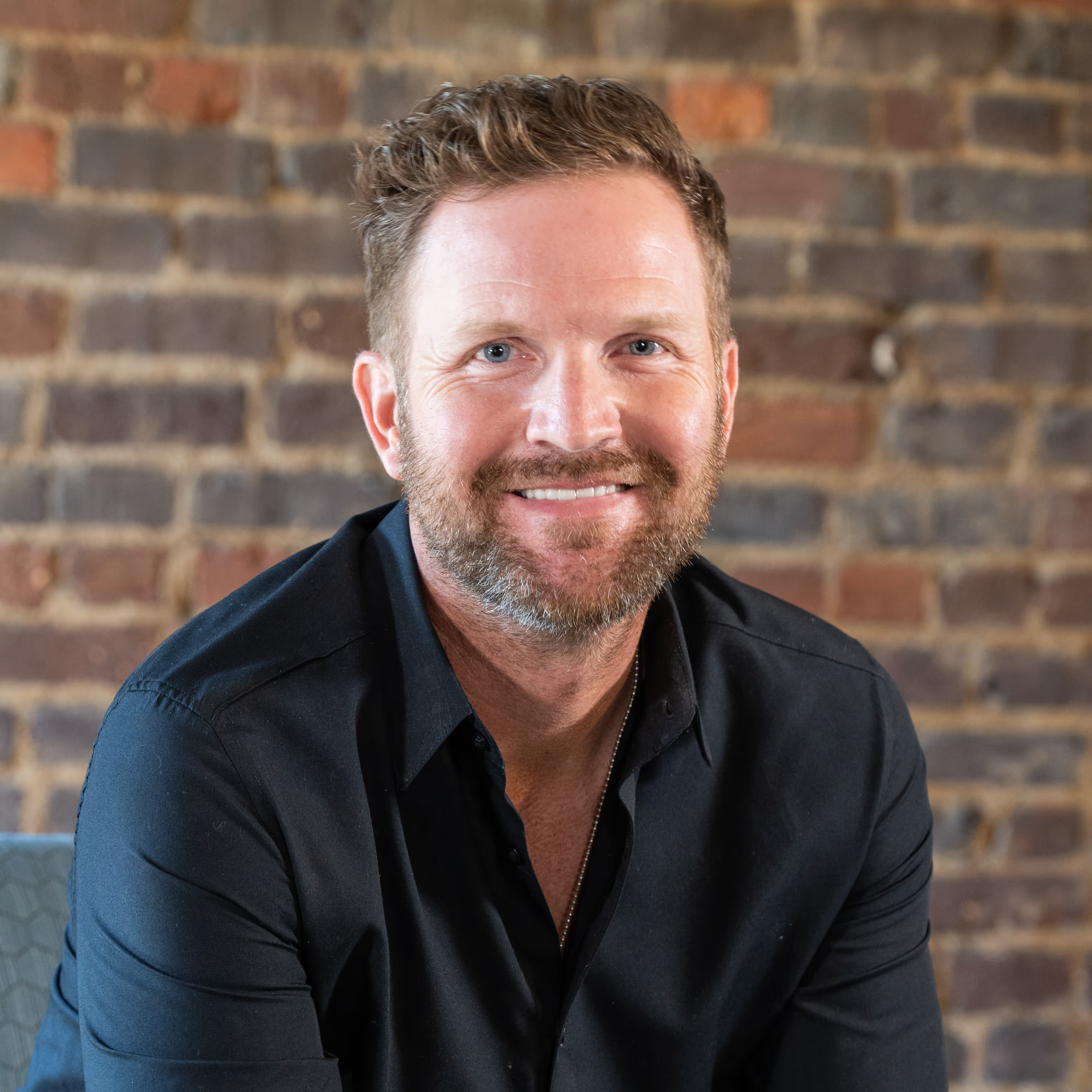
Josh Crisp is a senior living executive with more than 15 years of experience in development, construction, and management of senior living communities across the southeast.
Learn More ▶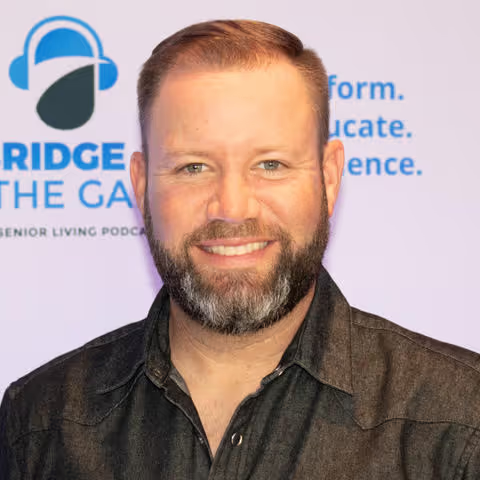
Lucas McCurdy is the founder of The Bridge Group Construction based in Dallas, Texas. Widely known as “The Senior Living Fan”.
Learn More ▶
We're no longer just purely designing grandma's house on steroids.
Senior living design is evolving rapidly, and architects like Rocky Berg are helping shape what the future looks like. In this episode of Bridge the Gap, Josh and Lucas sit down with Rocky, Principal, Director of Business Development at Three Architecture, to discuss how senior housing design is shifting to meet the expectations of the boomer generation. This conversation explores how thoughtful design can elevate the resident experience while balancing operational efficiency and financial realities.
Key Topics Covered
Meet the Hosts:
Connect with Our Guest
Learn more about Three Architecture
Produced by Grit and Gravel Marketing.
Become a sponsor of Bridge the Gap.








00:59 - 06:31
Unknown
Bridge the gap in three two. Welcome to Bridge the Gap podcast is senior living podcast with Josh and Lucas. We have an exciting guests on today. Very excited to welcome Rocky Berg to the program from Three Architecture. Welcome to the show.
Rocky Berg
Thank you.
Lucas McCurdy
Rocky. It has been fun to get to know you over the past couple of months. In person. Many people know you've been in this industry for a long time, and I think this is really perfect timing to have someone with your expertise and knowledge in the industry. Before we kind of dive into your background in history, obviously, you are a principal at an architecture firm out of Dallas. Three architecture, design and trends is a big, big topic right now.
It has been a very slow development period, maybe the slowest in the history of the industry. How have you weathered the storm and where do you think we're going right now? Is, is is now the time?
Rocky Berg
Yesterday was the time. Yes. We've seen the last couple of years pretty slow. Right. But the momentum is clearly picking up, especially at the end of last year and moving into 26.
I have clients that are not just purchasing sites, but getting them entitled. And of course, we're on the front end of master planning that work. And prepping them to get properties built and developed. So, I'm expecting to see the cost of money dropping and people motivated to get going again. So, that keeps my tribe very busy.
Lucas McCurdy
Now, let's jump into your background. How did you get started in senior housing?
Rocky Berg
I love my grandparents, and I've been in churches where I've had, elders take care of me and my family. Right. So those relationships were very, very personal. So, the mission, just really works well with my heart and the people that I have that I'm working with.
So they get it. We get it. So that's that's at the foundation of it. It's probably the most innovative place to work today as an architect. It's been changing so dramatically. So as an innovator, it's given me an opportunity, to really start to change the game as we moved out of the Greatest Generation into the appetite of the boomer, all sorts of opportunities open up.
And quite frankly, I'm designing for myself. I've been in the practice for 40 years and watched the change and it's very, very exciting. I've worked across the globe, Australia, South Africa, hospitality projects, typically on those venues, but in the senior space now 40 years, the smile states. So, you know, from Florida to Hawaii, you know, hurricanes and tornadoes. And so, it's a great place to work, changing so quickly.
Josh Crisp
Well, when you say designing for yourself, I think is what you said. Yes. What exactly does that mean?
Rocky Berg
I'm watching it. We're no longer just purely designing grandma's house on steroids, right? It's they're they're, the residences are more open planned. The window openings are larger, although we're using sophisticated shading devices and things. But the units are opening up the kitchens, and the spa bathrooms are beautiful places. And of course, we can't underrate the storage needs on the way to do that. Cleverly, the technology has been changing, allowing us more freedom. And so, yeah, it's an exciting place, to to move all those things forward.
Our clients are very discerning. They've traveled. They know what they want, when they want it. And it's our job to sublimely support our clients. And the operators to, you know, do it really, really well. That's what I expect, you know? You know, a piece of that is as much pride as I take in the architecture. Food is king.
And so I'm watching the delivery of food diversify. You know, it's going to be in a expanded marketplace. Casual dining venue. It's going to be outside alfresco, in the lawn and in creature comfort furniture and and heating and cooling right lighting. It's going to be up in the sky lobby. It's. And so the ability to do that well, is an art. And so understanding the business side of it, the business model side of it, how to operate it, but ultimately the experience and that's what this is really all about. It's all about that experience. And so when we're starting a project, yes, there's a program. Yes, it's ultimately going to be sticks and bricks, you know, in terms of building it. But we start with that experience.
Josh Crisp
That's really interesting. So what about like specific trends? I mean, I think everybody's trying to figure out what is this next generation of senior housing consumer, what do they really want. And you you alluded to some of that, but is there anything that you're seeing that everybody seems to be like, this is this is a definite need. And the community's got to have this that you didn't see 15 years ago.
I'm watching the programing become more flexible. Ultimately, our residents and their families, it truly does become their home. It's so often I hear, I wish I had moved in sooner, right? And so very quickly they begin to own it. So within the overall scheme, the program has to be flexible and within the spaces we have to make them smarter, you know.
06:31 - 10:00
Rocky Berg
What does that mean? Well, the technology, the lighting, the acoustics, the ability to flex these spaces as they inherit them and ultimately try to change the program to what they want. So there's an art to doing that and doing it correctly to optimize the dollars. So it's still yes, it's all about the food. Wellness is huge, both inside and outside the building.
So taking care of the outdoor rooms and thinking about those spaces between the buildings, the spaces on the perimeter and how these communities relate to their neighbors. So I've watched, the community has become more inclusive and less exclusive. As nice as they are, there really are about connecting the community to the larger community and a two way communication.
So, you know, but like I said, the spaces are a little more contemporary. In terms of the esthetic and what people are wanting, which means a little bit cleaner architecture. To do clean architecture, you got to be, creative, inventive on how to make that detailing look really, really well, you understand that that purpose.
So. Yes. Yeah. So that's, that's an a way of how it's changing. The residences are are growing in square footage. Everybody's moving from a house, but I'm watching the unit sizes increase again. We're not doing any studios or anything like that. So it's one twos and three bedrooms with extra, you know, spaces.
Mid-Roll
This episode of Bridge the Gap is sponsored by NIC MAP. If you're trying to read the market's pulse right now, you should know what the latest Nick map market fundamentals reveal. Overall, senior housing occupancy climbed to 89.1%. Annual rent growth remains healthy across property types and absorption continues to outpace inventory growth. With 20 years of historical data behind every quarter snapshot, you're seeing trend lines that matter for strategic planning, investment, and development. Dive into the details and learn more at nicmap.com.
Josh Crisp
Are you sensing any pressure with all of these changes, changing and dynamics in these, different types of spaces and different design, is there any pressure on efficiency to try to keep it all somewhat affordable, or is that kind of out the window, or like, where does that challenge come in when you've got these great elaborate designs that are creative?
Rocky Berg
I'm assuming that challenge comes in at some point, right all the way through the process. Even when we start with that concept now, I'll tell you, we differentiate ourselves in terms of we work really hard with the clients to understand those emotional connections. So we start with that space before we get into probing. But at the very beginning of the project, we start with a definitive expectation of how the math is going to work.
We measure it all the way through the process multiple times through that process. So we're already always on spot in terms of what the expectations are. So yes, optimizing the dollars and trading out those decisions, you make one decision. There's 100 more that come off of those decisions. And so we're very pragmatic in experience of taking our clients through it.
And a lot of ways I feel like we're a Sherpa where we'll go up to the base camp, we'll help the client make decisions. We move up to the second camp and ultimately help them decide if they're going to summit or not. And so it's a it's a great experience. We've done it many, many times. We just want to come down in one total piece.
10:00 - 16:01
Josh Crisp
Yeah. Well, I heard you and Lucas talking before we hit record. You're saying you've been in the business so long that a lot of the things that you built, you're now redoing and things for the next generation.
Rocky Berg
Let's not overrate that. It just, there is an instance where on a campus we're working together on where I'm where my mom lives. Yes. The entry feature now has we've changed that whole new front door experience. And so I took down the tower, the lighthouse tower originally, and now it's a great opening. Yeah. And reception.
Josh Crisp
So it's not only as you often and the, the, the, the business that Lucas is in on a daily basis, not only these new developments but also taking the existing and sort of repositioning them, making them relevant for the next generation of senior housing. That's something you get to do every day, Lucas.
Lucas McCurdy
It is. And it's a lot of fun. And I really think that we're in a time period where, you know, between ground up or expansion, which I think is going to be a really big thing, today and going forward and renovation, I'm trying to think of like, ranking what is the most important one right now. And they're all important. I think that they are on the starting line. All of them at the same time. Obviously, with development and an all-time low in the industry, you know, renovation and repositioning, you know, a value add or a legacy building or just a struggling, you know, community or, you know, just one that's just out of date.
Obviously. That's been a big focus, right? Over the past four years. And it will be going forward. What, as far as like deal flow for what you are in your company is seeing is, and I know y'all do a lot of ground up, but what do you think is going to be the, the biggest focus for for owners and investors?
Rocky Berg
I'm watching single-site owners expand out, and I've helped a number of clients recently do that. So they're taking on sister properties and expanding out, and of course, leveraging their infrastructure and to do good. Right. So, so I've got a client that I've been very fortunate to work with who's definitely been growing in these last four and five years.
So very proactive strategic growth. And so they have taken advantage of the fact that our multifamily friends have been pretty quiet, but they were assuming a lot of sites. So they've been able to acquire great sites, they've been able to get entitlements moving forward. And so they're proactively moving forward. Now we're helping them conceptually design and document new design.
So they're constructing next year. Construction and flat costs have been relatively flat. Labor kind of eked up a little bit. But materials have been pretty flat. So they've been able to take advantage of this moment as rates drop. On the financing side, business picks up, constructors are going to be busy, competitive, and I expect to see and we'll have to anticipate with the way we do things to, optimize those dollars. Right. And so we've got a lot of different ways that we do that so that our clients can make smart strategic decisions along the way.
Josh Crisp
Yeah. So, Rocky, you've been at this obviously a long time. You seem very passionate about what you do. And very thoughtful. Intentional, obviously. Have a cool mission story. Your mom's even and, in one of the communities. But what's behind the name? Three, three arches.
Rocky Berg
There are so many trilogies out there. But, yes, it's really premised on the trilogy. There are more than three in our shop. So, but yeah, so there's so many, you know, trilogies that we kind of build off where you talk about shapes, colors, spiritually. Yeah. Yes. Very, very cool. Well, it's it's it is about a legacy firm.
You know, we're now celebrating over 40 years. We cut our teeth in boutique hospitality. And then a client came to me and said, I love what you do in that space. I'd like. And this is 35 years ago, and 40 projects ago where he said, I really like what you do. I'd like to bring it into what I'm doing here in the senior space.
And it's been a differentiator. And again, we think about this process totally different expert in terms of building a building, licensing a building. But, you know, the differentiator is how these buildings, these spaces really make you feel and how they attract you and re attract you. It's a reference market. So as the residents and the prospective residents, I just made a presentation last week.
They were so come by. Yeah. Because they got they they endorsed it right into their families. And it is so much about the families. So yeah, that's that's what it's all about. Well and it's very consistent. We were talking with another operator just yesterday and how the shift is occurring where oftentimes we as operators and developers felt like we were sort of trying to figure out and inform the residents and their families what they should be doing or what they should experience and what technology they should be using. Now, that sort of flipping, we're getting the feedback and them telling us what we should be doing for them. Right?
Josh Crisp
So very interesting. So it's great to have an awesome partner. Here. Thanks for taking time with us. And so I'm actually really excited to hear more about the project you guys are doing together when that all finishes, and maybe we can get a report on that.
Lucas McCurdy
That's right, that's right. A very famous community Presbyterian Village North and, just there in Dallas. Which leads me to my final question. There is a big difference between the not for profit side and the for profit side. So when I think of the not for profit, not for profit side, we're talking about, crosses life planned communities.
And then the for profit side, there's a variety of different options from AL and ILI, AL and memory care. In your experience, talk about the differences of working as an architect in these two different sectors.
Rocky Berg
Worked probably 50/50 through my career with both entities. And across the country. The missions are always the same. I found them all to be purposeful, mission orientated, and they're all they still have to do.
16:01 - 17:27
Rocky Berg
Well, they've got to be financially, proactive and strategic about how they spend the money. Right. So I find that part very consistent. The building programing to is, is oftentimes familiar. So they're they're competing with each other in the same marketplace often. So the process might be a little bit different because on the nonprofit side I'll have a board that I'll be speaking with and they'll have counsel as well.
But same time on the for profit side, there's a head of development, head of marketing, head of ops, and and they all they all have their special purpose within that process. So I'm still building a constituency in terms of opinion and decisions timely basis. So they're going to be successful. So you know, the product itself, they do want to optimize the dollars that they've got.
And I work with them to do that. And I my goal is to for to exceed, you know, what they're expecting. I've had a couple of times where I said this is to they've told me this is too nice. This turned out too nice. We're trying to be here. Right. So sometimes you gotta modify a little bit.
Lucas McCurdy
Yeah, absolutely. Well what a great conversation here. Thank you. And thanks for taking time out of your busy schedule. You bet, you bet. My pleasure.
Rocky Berg
Thank you.
Lucas McCurdy
Fun conversation, shared passions. Rocky Berg will connect with you in our show notes. You can go to BTG voice.com, download this content and so much more. And thanks for listening to another great episode, A Bridge the Gap.


