.avif)
Senior living is booming, but who is educating the next era of industry professionals? Tune in to hear Nancy Swanger give her answer.
We really stress that no one cares what your degree is in. Do you have a caring heart?
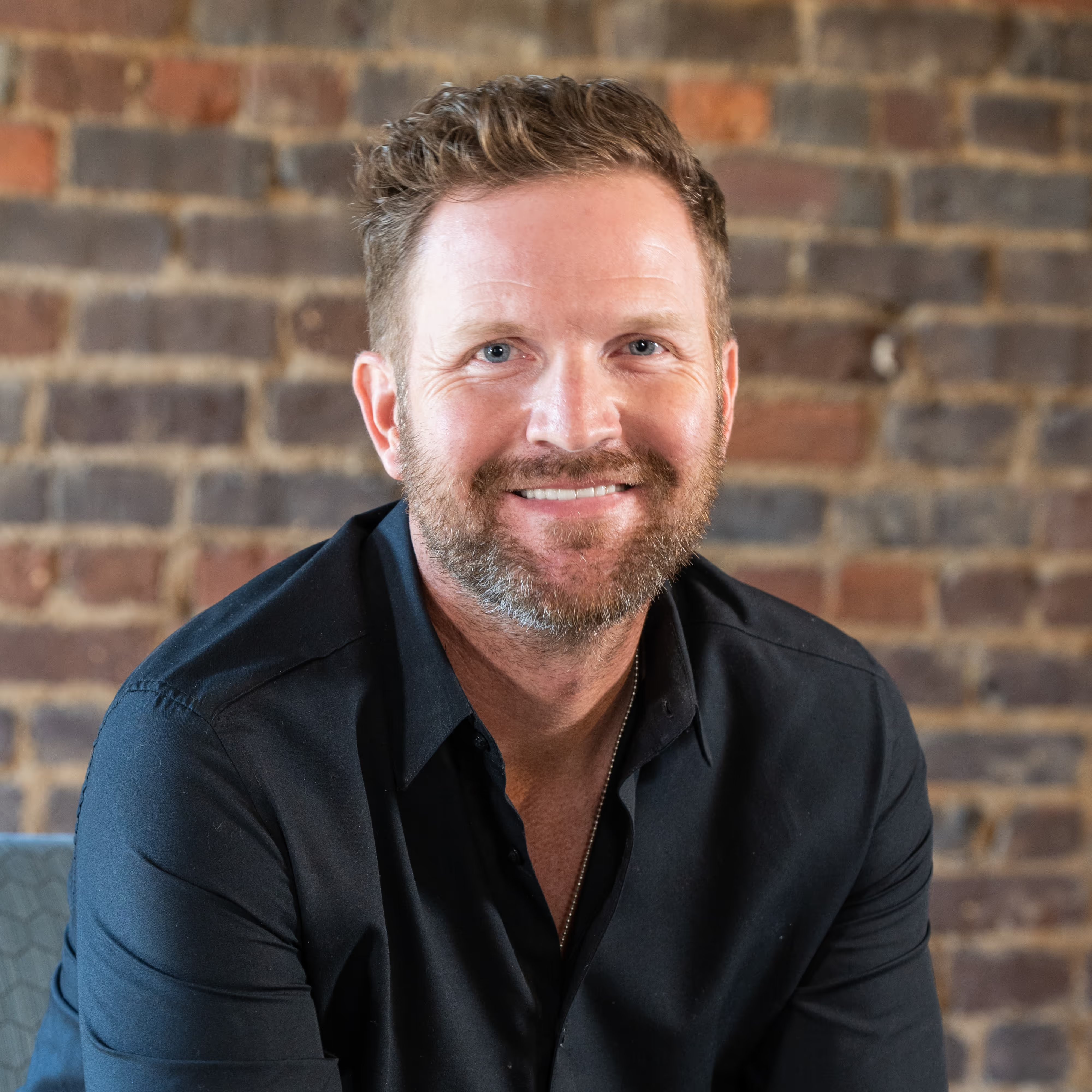
Josh Crisp is a senior living executive with more than 15 years of experience in development, construction, and management of senior living communities across the southeast.
Learn More ▶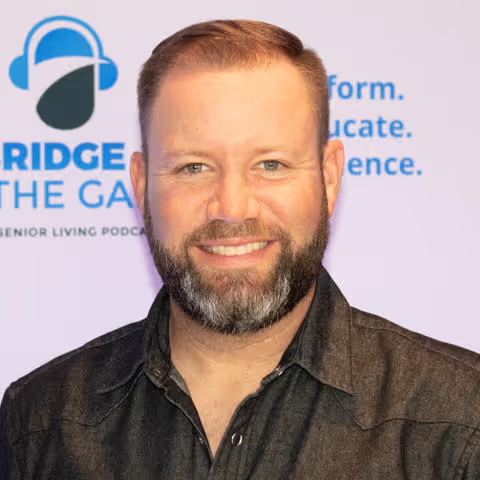
Lucas McCurdy is the founder of The Bridge Group Construction based in Dallas, Texas. Widely known as “The Senior Living Fan”.
Learn More ▶
For the next 40 years, you can probably write your own ticket because the demand is huge and the supply is low.
On this episode of Bridge the Gap, Josh and Lucas sit down with Nancy Swanger of the Granger Cobb Institute for Business of Aging at Washington State University. Nancy shares the origin story of the program and how it has grown into a pioneering academic pathway preparing students for careers in senior living. Nancy highlights the powerful role of purpose-driven work in attracting the next generation. She also discusses how industry collaboration, mentorship, and real-world exposure are key to the program’s success, and why the future of senior housing depends on innovative workforce solutions.
Key Topics Covered
Meet the Hosts:
Connect with Our Guest
Learn More about the Granger Cobb Institute
https://business.wsu.edu/granger-cobb-institute-for-business-aging/
Produced by Grit and Gravel Marketing.
Become a sponsor of Bridge the Gap.









01:10 - 05:41
Lucas McCurdy
Bridge the gap three, two. Welcome to Bridge the Gap podcast the senior Living podcast with Josh and Lucas. A beautiful day here in San Diego and we have an incredible opportunity to talk to Nancy Swanger. Welcome to the show.
Nancy Swanger
Thank you. Thanks for having me.
Lucas McCurdy
Yes, yes. You are the founding director of the Granger Cobb Institute for Business of Aging at Washington State University. That is correct. So, many of our listeners are going to recognize that immediately. Granger Cobb is a legendary icon. Tell us more about his life.
Nancy Swanger
Oh, he was incredible. And we were blessed in that. We had, four founding folks who, helped us start this program at Washington State University, and he was one of them. And, I would love to tell you that this idea was mine. It was not.
I was the director of the hospitality school at Washington State University for about ten and a half years. And, in 2010, Jeremiah, who was at that time the president and CEO of A Just Living, approached me through a random connection. It was just wild how the universe works. But, and said, hey, you guys have this great hospitality program and we have these great senior living communities, and we need to be working together.
And, I was just super grateful that it was over the phone because I have zero poker face. And I'm thinking, but what? What? Because I didn't know anything about the industry personally. My my parents were in their 80s and they were still living in their own home. And my frame of reference about this industry was nursing homes.
And I'm like, oh, I just I got these 18 to 22 year old kids thinking they're going into hospitality and we're in these cool suits and these glamorous, sexy career. And I'm going to think about a nursing home. I'm not getting the connection. Well, at long story short, I was way wrong. But besides that, almost weirdly, at the same time, completely independently, Bill Pettit, also came to me and he, of course, was the co-founder or founder and president of Merrill Gardens.
And along the same lines, and I thought, there, Scott, there's got to be something to this. These, this is weird that two superpowers in this industry that I know nothing about have approached me. So kind of long story short, we, we we met for a meeting, and, they brought a couple of friends. And those two friends were Tana Gall, who was at that time president of leisure care, and Granger Cobb, who was the CEO of Emeritus.
And we sat down at a table and I thought, oh, this is cool. And then I went on a little tour and I realized how wrong I was, and that what amazing places these were and what the how happy the residents looked and all this other cool things. And so we, I sat down around a table with them and they helped me knock out a curriculum for a at that time was was an elective course in our in our traditional hospitality program.
And so we we got it all together and I'm like, okay, look, I can, you know, I can, I can, you know, help write a syllabus and I can herd the cats. But man, I know nothing about your industry. My degrees were all in education. My industry background was all restaurants, primarily quick serve restaurants. I don't I can't really teach this stuff.
And, they literally we we, we taught the first class in the fall of 2011, and they literally flew people over the mountain from Seattle to Pullman, Washington, which is right on the Washington Idaho border, where our university is, to teach the classes on various topics. And they put it all together and it wasn't, it was never a promotion about their particular companies.
They used, sort of sort of WSU generic deck, PowerPoint slide deck backgrounds. I mean, it was literally about trying to, inform kids about a career option they'd never thought about. And so that's where it started. And we just kind of started building after that. And then, sadly, in 2015, when Granger Cobb passed, we were down the road doing some things, but we got real serious and created this, institute at WSU.
And, friends of Grangers’ came together and, put together a $2.5 million naming gift to honor him. And that became an endowment for us. And that's our little pot of gold that we operate from. But we we try every day. I, you know, I had the I had the blessing of knowing Granger and working with him and, and so I try to honor that legacy every single day.
05:41 -
Josh Crisp
So that is an amazing story you captured really well. So thank you for that. So 2011, the passing in 2015, in the naming and sort of that endowment, you all it sounds like I've done amazing things. So catch us up on a little bit of history from 2011 2015 to modern day. What does the program look like now and and what's the future look like?
Nancy Swanger
Yeah. That's, we, as I mentioned, we started with one little elective course that was just a generic special topics course. It didn't even really have its own number for a period of time. And what that has grown into is we now have a major in
And let me back up step. We are in the School of Hospitality Business Management at WSU, which is housed in the Carson College of Business. So when we started down this path, we were the first of, of of that program became kind of the first of its kind. There are a lot of really great successful, you know, long term care programs and a variety of things, but they tend to be in, you know, health care management, health and human services, a variety of areas there.
When we started, there wasn't one in, you know, there were very few in the College of Business, and there absolutely wasn't one in that was part of a hospitality school. But but Bill Pettit, in particular helped us realize that, you know, the value with this value proposition being around socialization, it makes a whole lot of sense that that there would be this hospitality component, that that's really where the industry needed to be headed.
Kind of. It's not that we're we're denying there's a care element, but that doesn't need to be the sole focus. There's this this hospitality piece to it. And then at the end of the day, it's still a business. These are businesses that have to be successful in order to, to to be be self-sustaining. And Granger Cob, you know, his his comment was always no margin, no mission.
And so they like the fact that we were in this college of business. And so our hospitality school has been around since 1932, and we're the third oldest one in the country. Cornell was the oldest, then Michigan State and then US. I mean, they just kind of kept moving west, I guess. And, and so we this became the third major in the hospitality school.
We have a traditional sort of generalist hospitality degree. Then, because we're in the state of Washington, we have another very specialized degree in beverage business management. And then this third one that we have now with us is in aging business management. So we in 2020, you know, so we started with our a little elective class. We moved along.
We got the institute going all these things. And then since 2020 while we started in 2020, hey you know what wasn't a good time to start anything 2020. But we we launched the major in aging business management in the fall of 20. Then we launched a minor in the fall of 21. We also in that period, I think it was summer of 22 launched, and noncredit bearing online on demand professional development certificate program.
We also have a four credit certificate program for those who might be on campus and want, you know, have a major in construction management will want to do something in senior housing. And so that's, that's where we are. And, we it's interesting because since that first elective course, we've probably put about 900 students through just that course.
And, we did a little research project with a graduate student, last spring and discovered that there are about of those of tracking, as best we could, stocking them on, mostly on LinkedIn. But we found that of that group that we could find there were almost 20% of them that were either in seniors housing or in a seniors housing adjacent career, like in a vendor, as a vendor or something.
And man, that's a huge success rate for me. I mean, I thought that was a big deal because these are not people that have a degree stamped on their forehead. They are a lot of people who have, degrees in something else and realize that they now have a different, an opportunity. They'd never thought about, in seniors housing.
And, and so the course, the one course, I still teach that intro course of that sequence and, and the one thing we're, we really stress a lot is, is that no one cares what your degrees in, quite frankly. Do you have a caring heart? Do you have an affinity for an aging population? And if you do, there's a place for you.
You know, these buildings have real estate people and finance people and maintenance people and groundskeepers and horticulturists and, you know, ops people and nurses, the whole gamut. Right. But the cool thing about it is, is that for the next 40 years, you can probably write your own ticket because the demand is huge and the supply is low.
And, so that's it. I think for young people graduating right now, that's a huge that's a huge sell. And, you know, today's today's young younger people, the people that we have in class now, they they want they want a great job. They want a they want a lifestyle. They want, you know, a balance in their life. They want to be taken care of and compensated.
But really what's important is if they don't want a job, that's just a job. They want to know that their job matters. And you know what could matter more than this? Making the making a difference in the life of of a resident every single day. What could possibly be better than that? And so we see those lights, in their little eyes, twinkle and turn on when they it's like, oh, yeah.
Like I'm one of my great success. You know, my favorite stories we have several of them are very recent one, we have a young lady who's an accountant was in the class our class last semester, and, her major was accounting, and she had a standing offer, with an accounting firm when she graduates this May, she took the class. Was totally turned on by the idea, and has since declined the accounting offer and is taking a management development, program with Touchmark. So, I mean, that's the that's those are the wins.
12:03 - 17:59
Josh Crisp
And that's so exciting. The impact you're having. It's such a huge need. When I first got, in the business over 20 years ago, I, there was no resources like that. And so it's exciting for me, as I've been able to go and speak at some of the universities in the South, I always think, gosh, none of them when I go in and talk to juniors and seniors in business, none of them even understand at all what senior housing is.
So the the gap that you all are filling is great. And so we wish you so much growth and success. And with that, so you obviously, know the opportunity that senior housing as an industry has for growth. How is that informing your strategies for growth of your program?
Nancy Swanger
First of all, let me say, our, our, our program has been since those are the four of those great people we went around the table, it has absolutely been industry driven since that day.
We have an innovation Leadership council. Adam Clark, who's the president of a just business Development, is that is is the chair of that committee. I mean, we we have speakers in class, all the all the, all the big names. Bob Kramer kicks off our class, and, you know, the one great thing that came out of Covid, we learned to have meetings and visits virtually.
We aren't limited to speakers in our backyard anymore. We learned that, you know, Bob Kramer can come to us from, you know, the East Coast. And so Bob, Bob kicks us off. Bob. Bob gets on in the zoom space and does a phenomenal job of sort of laying out the 30,000ft picture of why these students need to think about senior housing.
And so it's all it is all industry driven. They've they've, they've written, a lot of the modules in our, in our certificate program, the curriculum, they've reviewed it. This is, this is all them. And so there's a ton of buy in there and, and support that way. And the speakers and they mentor our students. We do group projects and they all have a mentor and industry mentor.
And so there's a lot of a lot of involvement. And I think that helps us stay relevant. And, and and we're humble about that. I don't I don't claim to know this stuff. I've learned it. I take as many notes as the students do when we have these presenters in class. I've been learning this stuff since 2010 and and I can talk.
I can talk about it a lot better than I could. But it was easier for me back in the day when I taught food and beverage cost control class, because I we don't restaurants for 35 years. I can tell you a whole lot about cost controls. And and because I knew that stuff. Well, this is stuff I've all I've had to learn.
So it's been the industry that has really guided us and and helped us grow and keep growing. And, you know, I would love to get to the point that we just have so many students that we don't even know what to do with them all. We're not there yet. Yeah. So and I don't know what that would be. I'm being a business person. How could you ever say you have too many, you know, customers in our case, which would be students. Sure. Yeah.
Josh Crisp
Well, it's really exciting. I'm curious, so for you all, it's it's sort of, part of the hospitality. Yes. And how many do you have any instinct, or is there hard numbers around people that come seeking hospitality or that's what they think they want to do, and then they're like, what is this senior living thing?
And they turn their attention. When, when is the moment happening for people? Is it after they maybe stumble into a class and hear about it, or are they they seeking this out?
Nancy Swanger
So that's a great question. And I think and I think we've seen it morph when we, when we first started teaching this class. And we would, we would ask students, why are you in this class?
And I guarantee you, 99.9% of the time, the answer was I needed three upper division credits and it fit my time block. Hey, you know what? I haven't been in college for a long time, but I get that. I mean, if this class was going to keep me all on Tuesdays, Thursdays, and I didn't have to go Monday, Wednesday, Friday, I'm taking it whether I'm interested or not.
Right. And so I get that. But what we're seeing now, in the last I would say, oh five, six, seven years maybe, is that it's more intentional of people being in the class, just in general, not necessarily the hospitality students, but people taking the class. So when we say, you know, what? Why are we in this class?
More and more students have had, a loved one. So they've they've gone to see grandma, grandpa or an aunt and uncle or someplace in the community so they know it. I mean, the number of hands that go up to respond to that on the survey much higher. The other thing that's quite surprising to me has been surprising to me is that, oh, it was my first job because there was a community in my neighborhood and I served in the dining room.
And, and so we're seeing that as well. So there so I think there's a shift in just general kind of knowledge about it. But then there are then there are people who are hospitality majors that take the class as an elective. It also our this class also fulfills a diversity you core requirement in our general WSU requirements.
Because we thread, a strand of ageism through the whole thing. And it's ageism on both ends, not just the older end. Young people are get discriminated based on their age as well. And so we we talk about that. So so people will take that course for a variety of reasons. And I've been on this my 26th year on the campus there a lot of students know me.
And so, so they're just there. Then something happens sometimes and it's not it's not me. It's not the curriculum. It's some it's some presenter who's been in class, who that they connect with, whether that be, sometimes we have a lot of folks who are there in person, but a lot of them are virtual. But they'll reach out via email or LinkedIn or whatever and connect and then they're kind of off to the races about shifting their idea about an interest in this as a career path.
17:59 - 21:53
Josh Crisp
It seems like a huge opportunity. Lucas and I have been amazed through the years. We have had people find us who are young, attending school, looking for careers, and they stumble upon senior living, and we pop up, and we're able to connect them to resources. There are probably going to be some people right now who are hearing this, maybe thinking about getting into senior housing, and are not really sure how to be equipped to do that. Is there any opportunities, is there distance opportunities in virtual opportunities for learning?
Nancy Swanger
Yes. So, our degree, our traditional four-year baccalaureate degree is available completely online. In fact, we have a graduate this spring that's in Kentucky. And that'll that's kind of fun. Who's never been on the Pullman campus and won't be there until she comes for her and her family, come for graduation.
I love those kinds of stories. But so we do have that. And then, of course, the, the certificate, the Noncredit bearing certificate program is, is always it's available completely online on demand. And to me, that program is targeted, I'd say to two buckets of people, one is people who are already in the industry, maybe more of a, caregiver, caregiver, entry level, early supervisory kind of position that, that would like to move up but may need some extra tools or a little help or sometimes just a little confidence to be able to get to the next level.
And I and so I, so I think there's that group that we'd like to that's already here. We don't have to sell them on the industry. They just need some tools and some help to advance. The other group is in especially hospitality professionals who are looking for another career. They want to shift. You know, I like I said, I've been a hospitality my really my entire life.
And it's great, but it's really great when you're younger and you can stay up til three in the morning that I've that passed for me many years ago. But people are, people are, you know, wanting to transition and, and especially those hospitality professionals have all the really, quite frankly, all the same skills and abilities. They just need to transfer them to this new space and in doing so, need to understand that there's a care component now and that people are moving in or, you know, that's their home.
They're living there for, you know, 22 months plus not 2.3 days. And and so there's a different there's there's some different components to that, a regulatory environment, a care piece. So if you take those hospitality, professionals and you add a couple of those kinds of modules, then you've then you've also positioned some folks for some, some lovely careers in this business. So that's where we are.
Josh Crisp
Well that's very exciting. What a successful program. What a great story. It needs to be told. We're excited to be able to share that. Thank you for the enthusiasm, the commitment to excellence, and helping our industry grow leaders and attract leaders to our space.
Nancy Swanger
My pleasure, my pleasure. Honored to have been invited to do this.
Lucas McCurdy
We need to have, Bridge the Gap. Come and visit the campus and meet some of these kids. That would be fun. Well, would be fun.
Yes. Let me know when we're. You know what? And we're in hospitality, so we'll take good care of you when you get there. Eat, drink and be merry.
Josh Crisp
Say no more, say no more.
00:21:18:13 - 00:21:37:21
Nancy Swanger
We would love to showcase our campus.
Lucas McCurdy
It's on record. This has been recorded. That'd be great. Yeah, we'll set that up. So to our listeners, should Bridge the Gap. Show up at the Granger Cobb Institute? Yes, I think so.
Josh Crisp
Survey says yes, Nancy will set that up. So thank you so much for your time today. We really appreciate it.
Nancy Swanger
Thank you. Gentlemen. It's been a pleasure.
Lucas McCurdy
And to our listeners, go down to the show notes, because you're going to want to check in, with Nancy and her team there at the Grange Cobb Institute. Those links are right there. Click it. And if you want to learn more about Bridge the Gap, go to Big voice.com. And thanks for listening to another great episode of Bridge the Gap.


