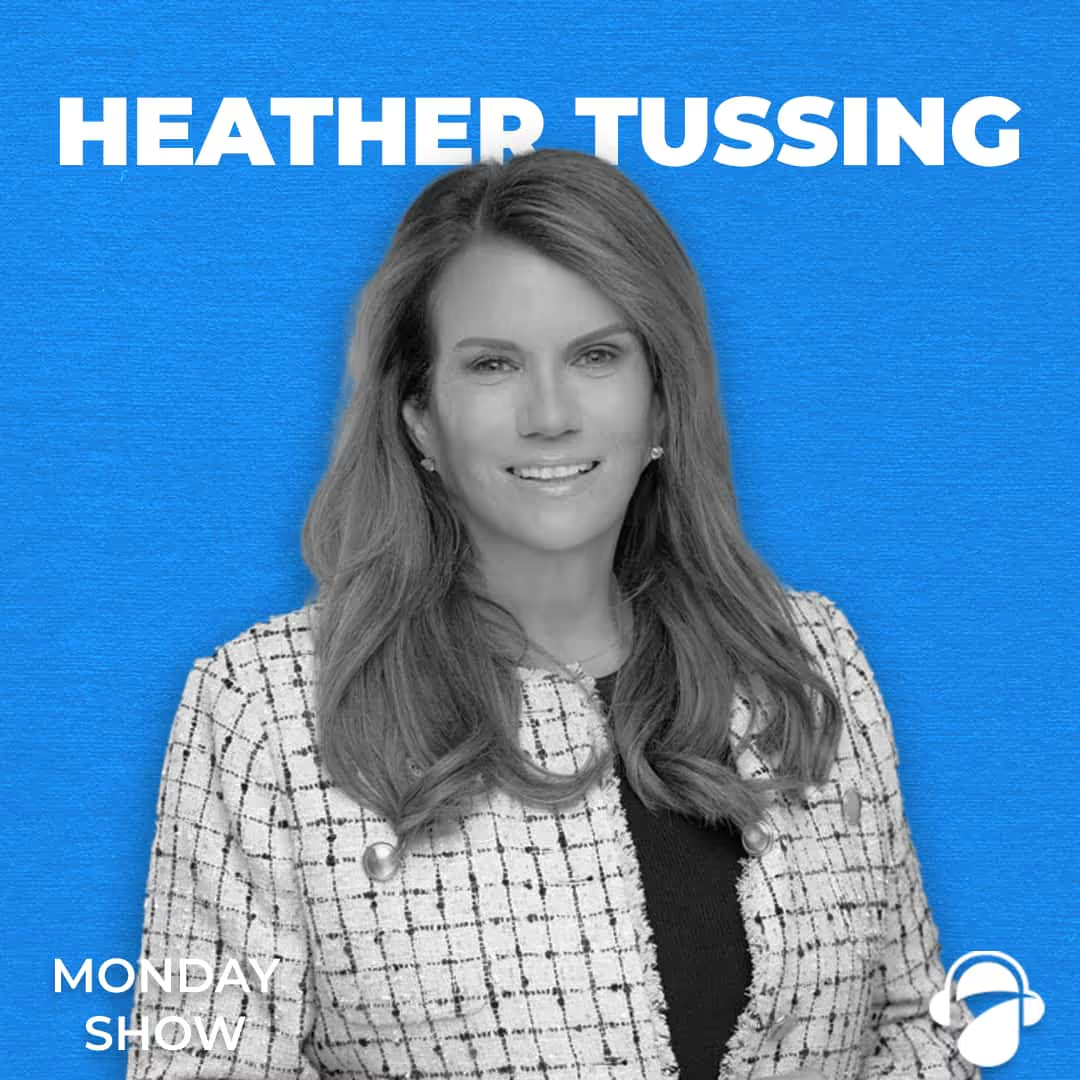
How can you navigate urban infill and development in tough markets? Heather Tussing is back to share her thoughts
You walk in the front door of a community. You can either feel joy, or you can feel like “Eh, it’s alright.
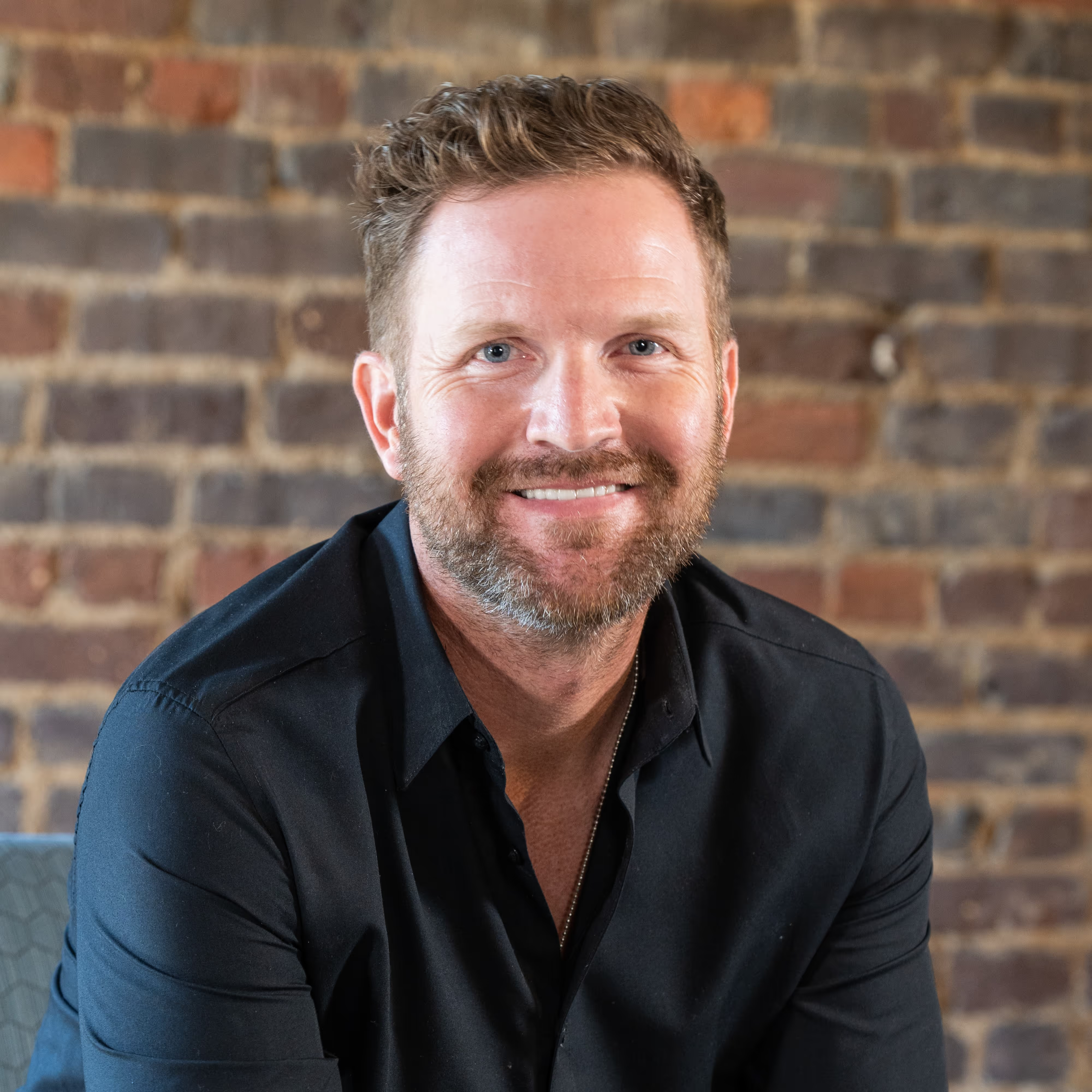
Josh Crisp is a senior living executive with more than 15 years of experience in development, construction, and management of senior living communities across the southeast.
Learn More ▶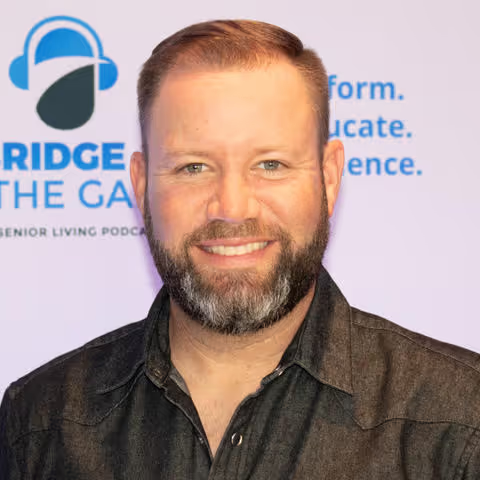
Lucas McCurdy is the founder of The Bridge Group Construction based in Dallas, Texas. Widely known as “The Senior Living Fan”.
Learn More ▶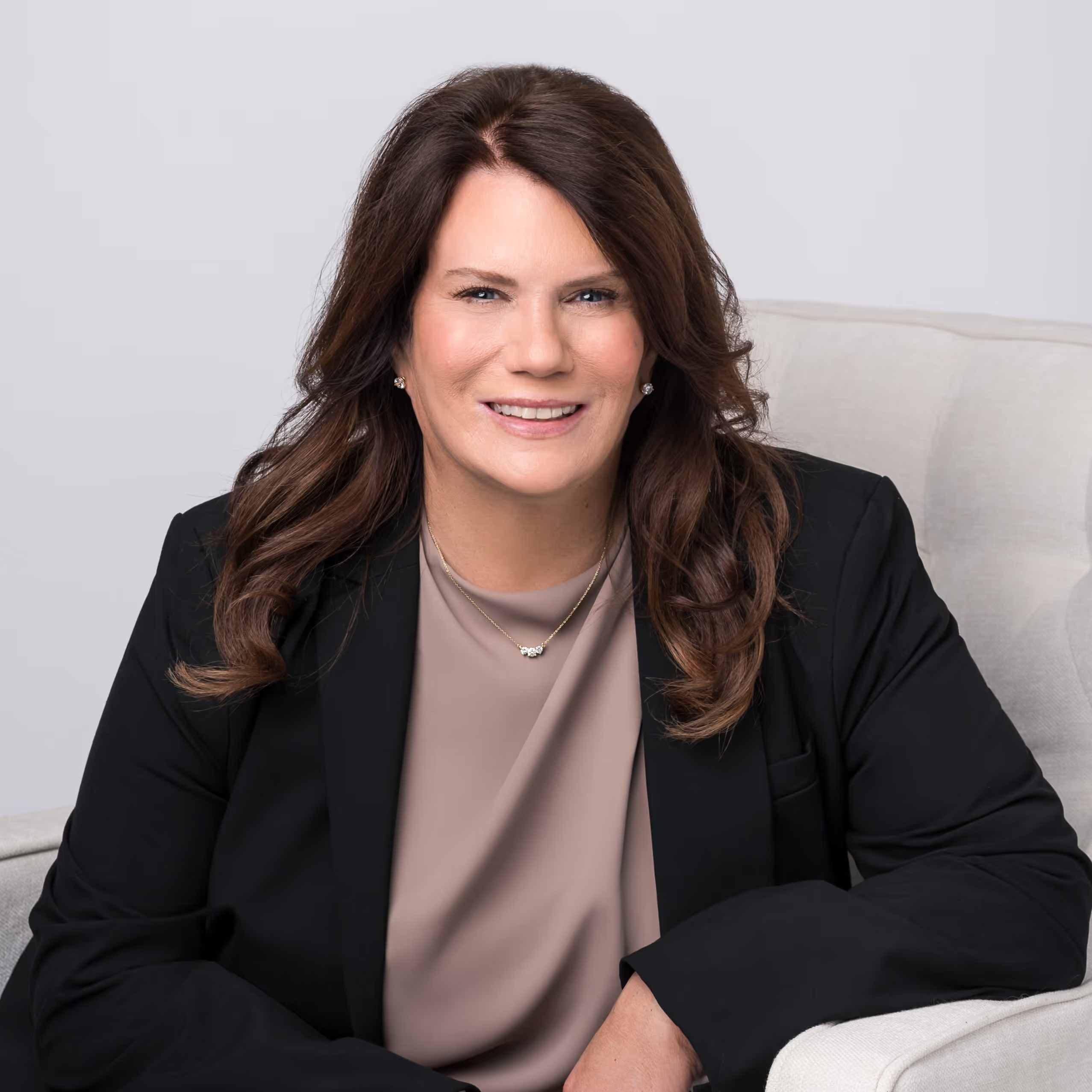
Just because somebody is successful and seeing success doesn't mean they don't need support.
In this episode of Bridge the Gap, we sit down with returning guest and industry leader Heather Tussing, President of The Aspenwood Company, to explore what it takes to build thriving, scalable, luxury senior living communities. Heather shares updates from her three-year leadership journey: from launching successful urban infill developments in Nashville and Charlotte to expanding through acquisitions and third-party management.
This week, we cover:
Meet the Hosts:
Connect with Our Guest
Produced by Solinity Marketing.
Become a sponsor of Bridge the Gap.
Listen to more episodes here
This episode was recorded at the NIC Fall Conference 2025







Intro
Welcome to season eight of Bridge the Gap, a podcast dedicated to informing, educating, and influencing the future of housing and services for seniors. The BTG network is powered by sponsors, Aline, NIC MAP, Procare HR, Sage, Hamilton CapTel, ServiceMaster, The Bridge Group Construction, and Solinty and produced by Solinity Marketing. Bridge the Gap in three, two.
00:42 - 01:01
Lucas McCurdy
Bridge the gap in three, two. Welcome to Bridge the Gap podcast, the senior living podcast with Josh and Luke. It's a great day here in Austin, Texas at the fall. NIC with a great friend a Bridge the Gap. Former ambassador, president of the Aspenwood Company, Heather Tussing, welcome back to the show.
01:01 - 01:03
Heather Tussing
Thank you. It's a pleasure to be here with you all.
01:03 - 01:32
Lucas McCurdy
It is so good to see you. We always have the best conversations. And, this is one of the funnest things about NIC is just reconnecting with old friends. Right. And we have, really enjoyed watching your career success, and driving, culture and change and success at the Aspenwood Company. Bring us up to date. Where is the company at right now and how, what's the culture like?
01:32 - 03:26
Heather Tussing
Well, I am so proud of what we've built. I've been there three years this week. So, an anniversary coming up, but it's been such an exciting time to really take a really good company and make it great. And it really goes down to the team members that I'm fortunate enough to work with, and also working with Jim Gray, who allows me the autonomy to to do what we need to do on the operations side.
I'm so grateful for that. We just opened our, our most recent community in Nashville, Tennessee, right in the Green Hills area. Very much urban infill, very walkable to the Green Hills Mall. All the areas there. And it has been a smashing success. And again, it goes down to the development team picking the perfect location and really spending the time to dive in and find that right location that checks all the boxes.
But also having the best possible team on the on the ground there in Nashville as well. I'm just feel so fortunate. And I do think it all ties into our culture because you have to attract the right talent. You have to have a reputation as an organization of having the talent that people want to work with, because there's a lot of great organizations that team members can go work with. So you have to have the right, the right culture for talent, but also the right culture in a community. So not only the culture that we want to have at the Home office and trickle down, we have to have that culture in the community level as well, because that is what makes a difference. That's what our residents and members feel every day.
That's what individuals feel when they walk into our in the front door. You walk in the front door of a community. You either you can feel within seconds you need to feel joy. You feel like it's all right, or you can feel tension and you don't want that. These people chose to move into your community to have a bigger, better life. They need to feel joy when they walk in. And so everything we do is centered on that and that that affects our team members, and that obviously affects our residents and members, and that's what we build upon.
03:26 - 04:08
Josh Crisp
Well, you know, Heather, your team speaking of that team culture, you've overcome some huge obstacles, I'm sure, just to get a development out of the ground. Yes, during this time. So we're here at NIC and, you know, development still hasn't come back, anywhere close to what it was years ago. But you've managed to, put a great project together that's already been successful, from the ground up.
And I, I would imagine probably a difficult market to do that. Nashville. There's, a heavy population there. I'm sure that's not an easy task. So maybe walk us through some of your secrets to success there. That won't be so secret anymore, right? Okay. You know, we'd love to. To learn.
04:08 - 05:46
Heather Tussing
Yeah, well, I think in Nashville again, it was really picking the perfect site. So picking a site that's very much. Our developments are urban infill. They're walkable. They're where people already live. They're close to their physician offices, are close to shopping. They're walkable to restaurants or an easy drive, but also walkable. So that's key. Is picking the right site in, Jim Gray and Alex Passion do an amazing job of that side of the of the business.
I get to come in and do the fun side of what I consider the fun side is the upside. So hiring the right team. And we have such a tremendous team in place in Nashville, and it really does make all the difference. They have built such amazing relationships with our members there, long before the building even started coming out of the ground.
When we were blasting for the underground parking garage, they started filming these deep, forming these deep, deep connections that people we would host monthly every other month, huge events for members or prospective members. They would really form a line to hug our sales director, that we had at that time. Now we had two amazing sales directors, but they would really form a line in that because she built relationships and she it wasn't just a transaction, and that's how she is as a person.
It's it's truly authentic. So it's really making sure that you have the right team in place and that you provide the team support to that team as well. Because just because somebody is successful and seeing success doesn't mean they don't need support or attention or some loving on or to be able to, just speak their mind or whatever the case may be.
So making sure that even if you're see success, that you're still there for them and that you're not only focusing on challenges, you're also focusing on success as well. Yeah. And we actually have had to come out of the ground in the last two and a half years. So we did an urban infill in uptown Charlotte area as well.
05:46 - 06:24
Josh Crisp
So, you talked about that being a big key to the success, but, sure. And, you know, the economic times that we've been in and maybe still in a little bit where investor confidence, deals becoming difficult to pencil, from the ground up, those kind of things. How much did the team and the culture that you've put together play into the successful development in building investor confidence that you could execute and that you could put this project together and get it out of the ground and get it stabilized when other people are not doing that, it's pivotal.
06:24 - 07:04
Heather Tussing
I mean, you have to have a track record of success. You have to have strong relationships. On the development side, Jim Gray is so well respected and is truly whatever anybody here is. It's the truth. I mean, he is as good as we'll say he is. But he has such he's done this for 30 years, so he has a long-standing relationship, in the, especially in the southeast market.
So that obviously makes a huge, a huge advantage for us. And also going into some of those, those with long-term investment partners. So it's not like we're there. This isn't their first rodeo with us or our first rodeo with them. So I think it's pivotal. And then obviously having the operational success to prove in our prior start-ups what those look like.
07:04 - 07:40
Josh Crisp
Yeah. So I'm curious, and I'm going to assume some of our listeners out there may not be really familiar with exactly what your community offers, what it looks like, and how you position that in these markets that you're going to. So everybody's, you know, asking the question, you know, what's the difference between the greatest generation, the next generation?
Was this product designed for the boomer generation, or is it some gap in the middle, or like what has been your approach to target and marketing, and how does that look different now versus maybe ten years ago?
07:40 - 09:04
Heather Tussing
It's so different. And independent. So our luxury urban infill products that we do and then we also have mid luxury, which are more traditional suburban great properties, nice assets. They're just a little different. They're typically a memory care. Sometimes all the urban infill products that we develop from the ground up. Those are an I'll a memory care titration with Albina the most memory care being the least.
And I think that we're I know an ideal if those potential members are the ones looking for themselves. So they're really looking at the amenities, the lifestyle. What are you going to offer me? How is this going to broaden my life? I how am I going to form new friend groups? How can my old friend groups, you know, transition?
How can I hold those things here? So it's definitely creating the space and the amenities for those individuals who are looking especially they're looking for luxury in a close proximity to what they're used to, which is not always easy to do because you're working with a small footprint on land, typically, in the middle of a city. But it's so cool to see that.
And then I think in memory care, we're obviously memory care. We're looking at adult children and what's important to them, but also ensuring that we're doing what's right for our future resident or member as well, in a memory care environment. So what is it's kind of a mix. So because not everything that an adult child is looking for is always what's most pivotal to that individual. So it's combining those two. What is going to benefit the new resident members memory care life. Also, what are the doctors are looking for and managing those together?
09:04 - 09:37
Josh Crisp
Yeah. Well that's really interesting. So you have really two different marketing strategies and sales approaches. Going after two different, decision makers there. And it sounded like your site does play a huge, pivotal role in that more entry-level, higher functioning adult, because they love that walkable lifestyle. So and I'm assuming so from team build out. You said you had two sales directors. Now I would assume that's a sales director for the aisle independent product. The sales director for the AL memory care product is.
09:37 - 10:03
Heather Tussing
They actually do both because they started from the ground up before, before the building was opened. And they formed relationships on both sides. And so it just naturally some. But I think that if something, I think that what you're saying makes sense, it just in this case it was different because they already formed longstanding relationships with potential members and their family members before the building opened. So they were both doing both.
Mid Roll
This episode is powered by Procare HR. For more than a decade, Procare has been helping senior living and skilled nursing operators build a strong workforce and an HR function that drives financial performance, quality of care, and the ability to grow and scale. Procare HR is a comprehensive HR suite designed specifically for senior care. They bring deep industry experience, integrated technology and data, and expertise in all facets of HR. If you're interested in what it means to build HR specifically for senior care, visit procarehr.com.
10:40 - 10:58
Josh Crisp
So the next several years for you and your team, you're obviously successfully bringing developments out of the ground during a time where a lot of people are trying to do that. And it's difficult. Is it heavy on new development, only new development, or are you looking at acquisitions?
10:58 - 11:21
Heather Tussing
Both for sure. Both. You know, in the last 18 months, we've opened two luxury urban infill products. We took over third-party management for two, two communities, and we, acquired with investment partners, five communities. So we're actively growing, ensuring that we're bringing the best to every market that we go in and excited for the future.
11:21 - 12:44
Lucas McCurdy
Well, on that one topic, I like this transition because, I was fortunate enough to actually help you, update, four of those communities in the DFW area, and I got to meet Jim Gray. I'd never met him before, and I was, you know, very impressed. And as you would imagine, and I think that this is a unique strategy to talk about when it comes to acquiring, existing buildings.
My career has always been heavy, heavy turnarounds on legacy properties built in the 90s, early 2000. These properties that you bought were built in the teens, in that 8 to 10 year mark. And they're the first buildings of that age that I've updated in my career. All of my career has been these much older buildings. And so I was seeing something very interesting a little bit.
This was a transitional point, even for me to walk through these buildings. I was like, oh, these are these are actually a little bit newer. And I thought, they look nice. But they still needed just a touch and fresh. It was not a heavy lift and we did a light refresh on them that made a huge impact.
And I got to talk to Jim about his strategy around that. I was really interested, because some of them, the occupancy was high. Yes, but still, y'all wanted to take that opportunity to update those. Do you want to talk about strategy around that?
12:45 - 13:43
Heather Tussing
So we first of all, with those properties were partnering with Artemus on those. And Artemus has been in a great partner to allow us to do they allow us to do what needs to be done. And I'm very grateful for that partnership for that reason. Because they see that potential opportunity. But our, you know, I think there's a niche for everybody and there's not what we do is what is right for us.
It doesn't mean it's not something that's right for somebody else that isn't right for them. But we're not looking for those 90s properties. We're looking, you know, we want to do what we're good at and we're good at high-end mid-market. And then the higher end luxury, that's what we're good at, and that's what we're going to focus on.
So we're not trying to do the less expensive 90s type properties. That's just not our niche. And I think one of the things about the responsible business is recognizing, like staying within your niches, like what makes sense for you and what doesn't make sense. And that helps grow success as well. And that's what's right for us. And again, there's other people that do the others very, very well. That's just not our thing.
13:43 - 14:26
Josh Crisp
Well, and I would imagine, you know, applying a little bit of just common sense is, you know, when you're a consumer putting yourself in that standpoint as the resident, potentially, it would be much like going into a modern-day hotel if you're staying in luxury hotels, you have to keep those fresh. You have to keep them top-notch.
And even myself, the opportunity that when I have the opportunity to travel in a luxury way, you may choose not to stay or may choose not to go back to a place if they don't keep it updated. So I imagine from a unit turn CapEx expenditure, that's a totally different strategy on that type of product than it would be a mid-market product.
14:26 - 14:58
Heather Tussing
it is it's very it's very important. I mean, they're we're usually top of the market and price in the markets that we're in. And we're we're fine with we're good with that. We're providing what we say we're going to provide. But along with that, they do expect the amenities to be appropriate. And also the services obviously be that same standards, because not only do you, the service can affect it just as equally.
If we go to a really nice hotel. I was fortunate enough to be at a conference last week and they hosted us at the Peninsula Hotel Chicago. So when you go to a really nice hotel, just the expectation is very different as to what that service and amenities will look like. So it's important that those
14:58 - 15:20
Josh Crisp
Well, and I'm glad you brought it back to that because, I think one of the challenges that a lot of leaders face, no matter what you're doing, but specifically in senior living, is how to scale that culture. So, you know, it's one thing to, develop one property and get it right, but to duplicate that over and over again. So from a leadership standpoint, where has been some of your key successes in strategy to duplicate and be able to scale that level of service over and over again?
15:30 - 16:35
Heather Tussing
I think it's having a strong team, obviously. It takes a strong team, and when you have really strong senior team, you have individuals who are able to poke holes in theories, poke holes in ideas and come out of it collaborative and with a better outcome. And I think that's so important. And you don't get that unless you have a strong team.
Because if people are if you have weaker member members on your team, then they're not going to feel confident to do that. So it's important to one, have a strong senior team who's not afraid of kindly saying that they think that they might not be the way it's supposed to be. And that's how we become better. And I that's the people I want to work with.
I want to learn from my team members. I want us all to help each other be better. So I think that's been really important to us and also to be willing to pivot to, like so, say, last year we had this great thing going with a great program. And then this year we're like, hey, we need to do something.
We're working like, it's okay. It's okay to pivot, it's okay to change, and it's okay to think of fresh ideas and to to look at problems as opportunities. And I think that is what makes a strong organization, and that is what creates an environment where people want to be.
16:35 - 17:21
Josh Crisp
Well, I think you answer that in such a, a humble way, because I think that that is very difficult for a lot of leaders to do, is to surround themselves with people that are just as strong, if not stronger than they are. Right. And to be open to, allowing people to give you advice, give you suggestions, poke holes in the ideas, as you said.
So, congratulations on all the success. I'm excited to see this. And I think, a lot of our listeners, in these difficult times of trying to figure out strategy, what type of product, what type of services, what point in the market and where, to develop and how to put that deal together can learn a lot from you guys there. So, Lucas, a lot of fun conversations here. Nick.
17:21 - 17:40
Lucas McCurdy
A great, fun conversation. And, it's just we it's so great that even bridged the gap, is able to attract people like Heather to be an even an ambassador, you know, went through that class together. So that was a lot of fun and appreciate your support of this network and, bringing attention to it.
17:40 - 17:42
Heather Tussing
I appreciate what you all do for the industry. So thank you.
17:42 - 17:54
Lucas McCurdy
All right. So if you love this content, go to btgvoice.com. Download this and so much more. Connect with us on LinkedIn. We'd love to hear your story and thanks for listening to another great episode of Bridge the Gap.
17:54 - 18:06
Lucas McCurdy
Thanks for listening to Bridge the Gap podcast with Josh and Lucas. Connect with the BTG network team and use your voice to influence the industry by connecting with us at btgvoice.com.


