.avif)
One of our own instructors comes on the show to share her journey from nursing to healthcare education.
I was determined to try every new thing in my field before I gave up completely on nursing.
I still wanted to help people. I still wanted to take care of people, just not the way I was doing it.
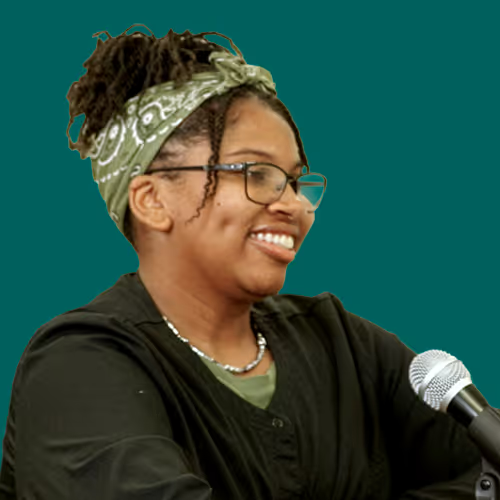
In this episode of Certify It, we welcome Daphne Credle, LPN, an instructor at the Mason Center for Healthcare Education. Daphne shares her personal journey into nursing, from being inspired by caregiving in her family to navigating early-career burnout during the COVID era.
What started as an interest in pediatrics eventually led Daphne to an unexpected but fulfilling role in healthcare education. She discusses why nursing careers are rarely linear, how burnout doesn’t mean failure, and why trying different paths within healthcare can lead to long-term satisfaction.
Connect with Doug:
Learn More about the Mason Center for Healthcare Education
Produced by Grit & Gravel Marketing







0:13 - 0:55
Doug Bryant
Thank you for joining us today on Certify It, the podcast for advancing your career in care. Today, I'm excited because we have Daphne Credle, who is our brand new, well, brand new since what, October? Yes. Just taking a hot minute to get you in the seat because you don't want to do this. Let's just be honest, right? Okay, well, I appreciate the fact that you're finally doing it.
And you have not been coerced into doing this at all. So, you are our brand new instructor, so give me a little bit of background. What made you get into nursing? Why? Education? So tell me a little bit about yourself.
0:55 - 1:01
Daphne Credle
I'll start for nursing my grandma. She was that bound when I was growing up. And she had strokes. So I watched my mom my whole life. My mom was taking care of her, and she’d show me stuff. So I was like, oh, that's interesting. And then the other drives in nursing, I always liked helping people. I always found myself doing more for others. I think I've seen things pretty well as a nurse practitioner, and I held back a little bit for nursing.
1:24 - 1:37
Doug Bryant
So when you did your nursing education, how did you do that? Was it BSN, is it ASN, or was it a certificate? What was that journey like, getting to be fully licensed or registered
1:37 - 1:43
Daphne Credle
I went to TCAT Knoxville, and it was a year. Stressful, but it was fun.
1:43 - 2:52
Doug Bryant
Yeah. Nursing is one of those interesting fields that you can get into in so many different ways. It's not like a cookie-cutter; you have to do this, and then you have to go here, and then you have to do that. There are so many different avenues to be able to get into it. And a lot of people don't understand or know that there are some very affordable avenues to be able to get into it, some that now, if you want to be in healthcare, you can actually start working at healthcare companies.
And a lot of times they'll pay for you to go, to nursing school. A lot of programs. So when you, you know, a lot of people when they go to nursing school, especially if they become registered nurses, they're looking at the, well, the ones that start out, it's usually, oh, I want the trauma, I want the I want to see the blood and I want to see the mangled body parts coming in the E.R. or I want the excitement of the ICU. But you chose education, which is not something that a lot of nurses go for. So how did that happen? And was that what you always wanted to do, or did it find you
2:52 - 2:55
Daphne Credle
Found me, I never thought I would be doing education.
2:55 - 3:02
Doug Bryant
When you graduated, and you were fully a nurse? What area did you want to work in, or that you thought you wanted to work in
3:02 - 3:16
Daphne Credle
Pediatrics, a little bit of the ER. I did have like something in mind, like what nursing was going to be. And then when you get in the field, it's like, which I'm so grateful for. It was a learning curve and experience, and I enjoyed it.
3:16 - 4:08
Doug Bryant
But see, that's the other thing I like about health care too, though, because like my journey I started as I went to nursing school, a lot of people don't know that I went to nursing school and did everything but the clinicals, and then when I got to clinicals, it was like day one of clinicals and they were like, oh, you're going to touch this person and do this procedure.
I was like, absolutely not. We're not going to do that. And I went to my guidance counselor and I was like, what can I do in healthcare that doesn't require me to touch people? Which is how I ended up in the human resources side and the administration side of it. So I don't think your story is that unusual in that this is what I thought this was going to be, but that's just not how we ended up.
So, from pediatrics to E.R. to the excitement of all of that to education. So what was the day or what was the thing that happened that made you think, I would like to teach this to other people?
4:08 - 4:51
Daphne Credle
A little bit of burnout and,
Doug Bryant
Oh, you are preaching to the choir about burnout
Daphne Credle
A little bit of burnout. And then I was just at a point of, what should I do next? Where should I go? But before, like, I wanted to go back to school. Let's get my RN. I just wanted to try everything in the field of LPN and see what I can do. And then, luckily, I saw that opening for the position, which I had completely out of mind of what it was going to be. So when I came for the interview, I was like, oh, education. And I never thought about it. I was nervous at first to accept, and then I just tried it because I was like, why not?
4:51 - 6:26
Doug Bryant
Well, and that makes you perfect for the job. I mean, when you think about it, you were one of those people who didn't, you thought you knew what you wanted to do, and all you needed was somebody to show you all these different paths, pathways that are there that people don't understand, that are there.
So like, hear you from CNA to you teach certified medication aids. What does that pathway look like? You know, can I dip my toe into that nursing world without actually fully committing to a nursing program to see if I'm even going to enjoy it or like it? And then if I like that, then I can, you know, we've got people that can help them advise people and our students on what that next step might look like, and not only the next step, but the most affordable way of taking that next step.
And that's really what we need more of in health care, is people that were meant to be a mentor and not just an educator because you're mentoring the student. And this is what this can look like. This is what it looks like for me and what I have found. And I don't know if this has been true for you, but most people I talked to an educator in health care, none of us are doing what we thought we were going to be doing.
It's this twisted, winding road that we all take to get to what? But the other thing that I've also found in health care, especially in senior living, is that the people who are doing what they're doing absolutely fall in love with what they're doing. So, have you found that to be true about education now that you're here doing the education?
6:26 - 7:14
Daphne Credle
Yes, I do love what I'm doing. But even that, I mean, even the fact that you said you were burned out, I don't think since Covid, that's unusual either. That was right in COVID when I graduated. COVID had just happened. I graduated right before COVID, but when I actually wanted to be in clinics, I started working. It was COVID.
Doug Bryant
Oh, so you came in the middle of the chaos and. Well, no wonder you were burned out. Yeah. So what advice would you give somebody who is burned out? You know, if there's a CNA out there, if there's somebody that's doing a job in long-term care or in senior living, and they feel like they're burned out, would you would I'm assuming your advice wouldn't be leave health care altogether because you didn't.
7:14 - 7:19
Doug Bryant
So what would that advice be to someone who was in the shoes that you've been in
7:19 - 7:49
Daphne Credle
I just took a step back and made sure I really wanted to do nursing or be in the health care field, per se. I had a lot of doubt in myself. But then I pushed through, and I had a great support system, and I found I still wanted to help people. I still wanted to take care of people, just not the way I was doing it. So I just kept trying, and I was determined in myself to try every new possible thing in my field before I, like, gave up completely on nursing.
7:49 - 9:02
Doug Bryant
And again, that's what makes you perfect for education, because you're going to be that person who helps people in your class. That's like, I can't do this. I'm not sure I even want to do this to speak into them and make them believe in themselves.
A lot of times, people who believe in themselves have not always done that. We can look back at somebody who helped us learn how to do that. And again, I think that's what's so great about what we try to accomplish here is it's not just about certifying nursing assistants or certifying medication aides or getting people certified in CPR.
It's about teaching people how to be the best version of themselves so that they can go out and give that version to others and learn how to serve the people that we are entrusted to us, which is probably one of the most precious things that long-term care and senior living get to do. It's not every day that somebody can say, you know, somebody brought their loved one to our company, and we have the honor of taking care of them. So what is your favorite thing about being an educator in health care?
9:02 - 9:10
Dapne Credle
I guess since I've been through nursing school, I like to give the students of some things I thought I needed so more encouragement. Of course. Just breaking it down, making sure they fully understand the material so they can have it in their long-term memory.
Doug Bryant
So if I were thinking about being a student, what are the characteristics that someone needs to have to be successful as a student in a CNA class or a CMA class?
9:28 - 9:35
Daphne Credle
I would just say determination and discipline, and make sure you have a love or desire for it. Even if you even if that's not 100%, if it's still driving you, of course, try and just give it all you got, and you'll be fine.
9:45 - 9:57
Doug Bryant
What are some techniques that you use when you are looking at students? And they have this look on their face? You can tell they're just not getting they're just not getting this material.
9:57 - 10:19
Daphne Credle
YouTube. You know, we're I'm talking a lot or lecturing, so, like, okay, you need to see it. And I like to find videos to help them break it down or I, I let them explain it to me, or if it's something they can write it out on the board, I'd like go to the board and I can see where you're going wrong, or I can see how they're thinking. And usually that helps them comprehend it better.
10:19 - 10:45
Doug Bryant
So what I'm hearing is no matter whether I'm a visual learner or a learner who does better just by listening, there's going to be something for every type of learner in a class that they would take, and you're going to be the instructor to make sure that they do understand the material and are able to. So what is your favorite part of the class that you teach? Is it the clinical? Is it the didactic? The book work?
10:45 - 10:59
Daphne Credle
My favorite part, I would say clinicals, because I took all that knowledge. I've been in the classroom for three weeks and doing skills, and then when they go to clinical, they're like, oh, connects or this makes so much sense now.
10:59 - 11:17
Doug Bryant
So I like hearing that. And they love it. And they love samples. So, can you tell our listeners out there that may be thinking about coming to be a certified medication aid, what a typical day would look like, or how they would need to, you know, how much study time would be involved outside of class
11:17 - 11:44
Daphne Credle
Study every night because the program is really fast. Hopefully, we get a week added to the program, but I would just make sure you etch out that time for studying, and if you like, put in the work study. I do everything I can. I tell them, you can ask me questions, email me, and you'll be fine for the class. Honestly, you just have to make study time.
11:44 - 12:23
Doug Bryant
And lots of things, like the time of the class and how long the class is. We don't even get to dictate that here. Ourselves. We wish we could, because we would have probably already added that extra week. But the state of Tennessee actually regulates how long you can be in class. And they're the ones that have said, you've got to get this done in four weeks and no less than four weeks. We tried to make it five when we got it, when we built it, and they were like, nope, you've got to shorten that.
And I think it was Brandi, the director here at the Mason Center, who was like, they want us to teach everybody the System in Pharmacology in three weeks. So you said clinical was one of the favorite parts that students have. So what does a typical clinical day look like?
12:23 - 13:01
Daphne Credle
A typical clinical day. We'll meet in the beginning. In the building. I give everyone their assignments first. I like to give them a tour. At least tell them where they're going. So, just meeting everyone at first, and then we'll meet the charge nurse of the day and get our assignments.
And then I'll introduce them to their nurse. And they're following the nurse for about four hours. 4 to 5 hours, I believe. And, they're doing their med pass. They're watching the nurse doing the med pass. The first day, they're just observing. And then once they gain confidence and see how everything works, they're hopping joyfully.
13:01 - 13:56
Doug Bryant
And one thing different about the clinical for the certified medication aid is that it is one-on-one clinicals, like you are one-on-one with a nurse. It's not like you're in a group of people with one nurse directing the whole group. Which also makes it, very interesting and while a lot of people don't do the class because they don't have the capacity to be able to do that, so you coordinate the clinical, but then there's an individual nurse with each student will always be with the student.
And normally, the nurses love them by the end of the week. Yeah. And which also means that you get a lot more one-on-one time for instruction. And it makes it a lot more individualized. Now, you just said something that by the end of the week, the nurse really like, so what? And they want their own medication aide to work with them. So why do you think that is as a as a nurse yourself?
13:56 - 14:09
Daphne Credle
As a nurse, they probably just see the benefit of it, like tackling their med pass, of course, they're students, so they can't be off on their own. But just even having that extra person to hold the meds or come in, they or maybe they can catch something they didn't see themselves as always helpful. It always helps for a smoother day, especially when you have about 20 plus patients for a shift.
14:16 - 14:33
Doug Bryant
Okay, so is there anything that you would like to share to any prospective students out there that are watching this and trying to decide whether they want to be a certified medication aide or not?
Daphne Credle
Try it. Join, and you'll get you're going to surprise yourself with it. I love it.
14:33 - 14:45
Doug Bryant
Okay, well, thank you, Daphne, for coming on the podcast today. You made it through. Yeah. Okay. Thank you. You've been listening to Certify It, the podcast for advancing your career in care. Until next time. We hope you enjoyed this episode of Certify It.


