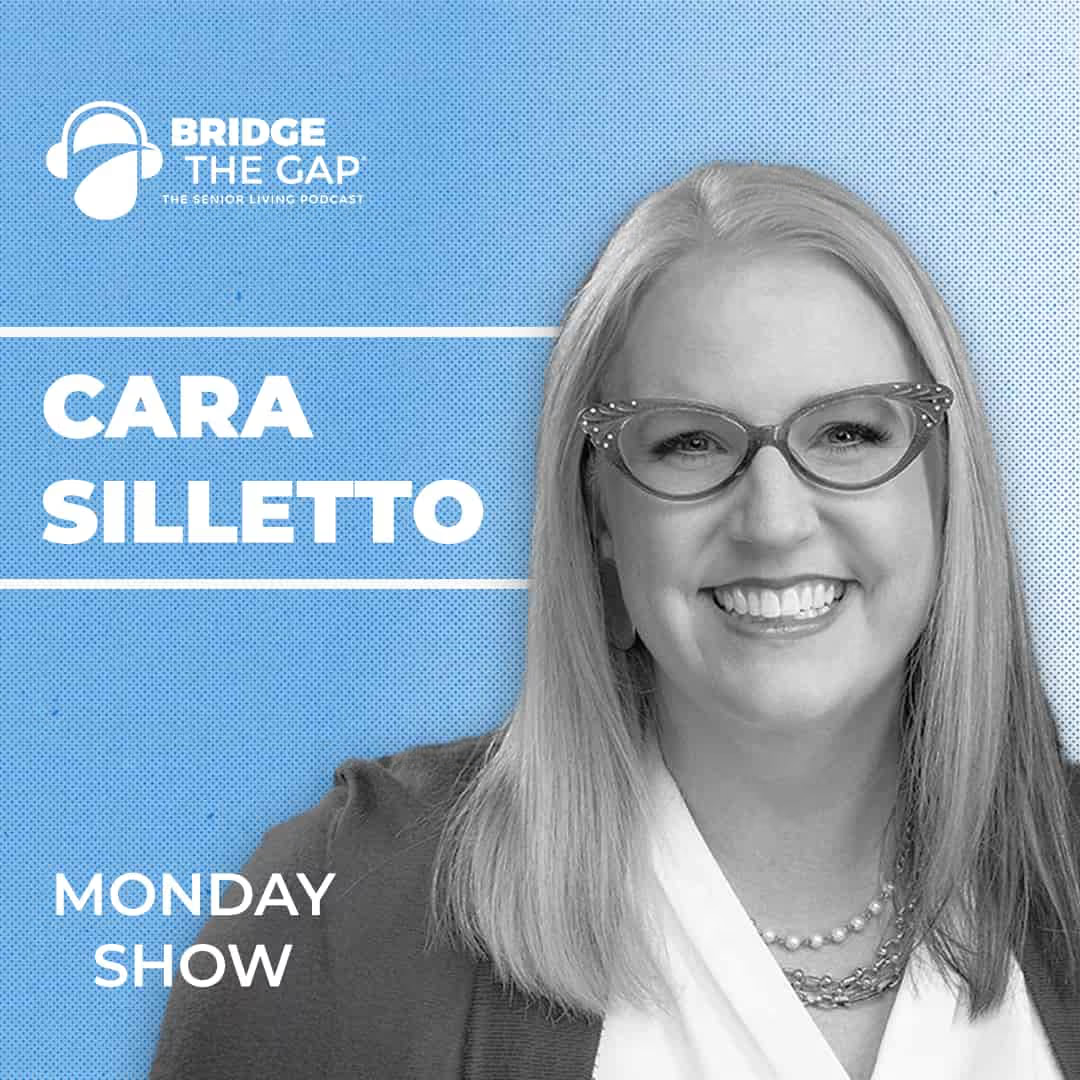
Why do employees leave and how can you retain them? Find the answers on this episode with Cara Silletto.
Gen Z does not know how to leave it at the door. They were not raised that way.
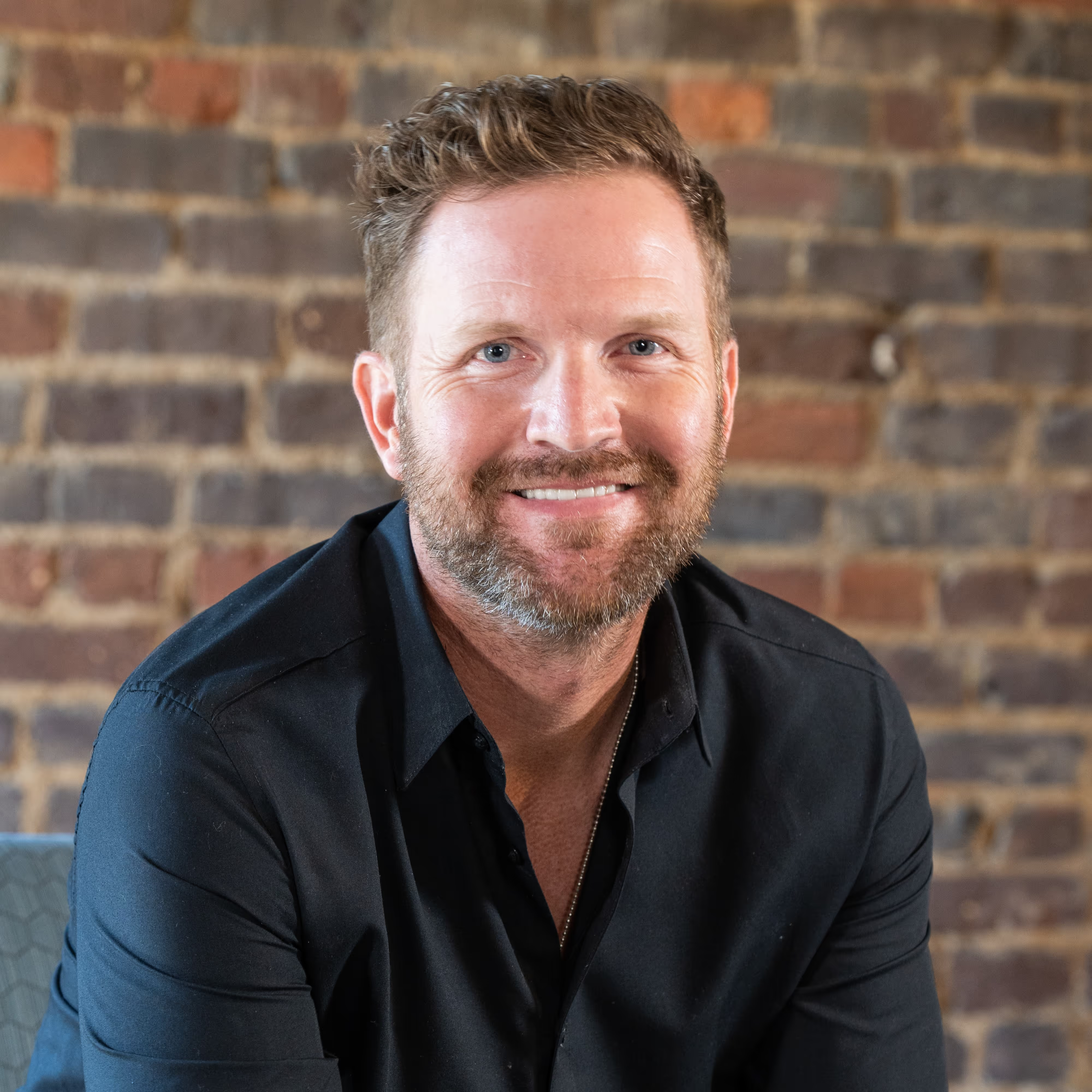
Josh Crisp is a senior living executive with more than 15 years of experience in development, construction, and management of senior living communities across the southeast.
Learn More ▶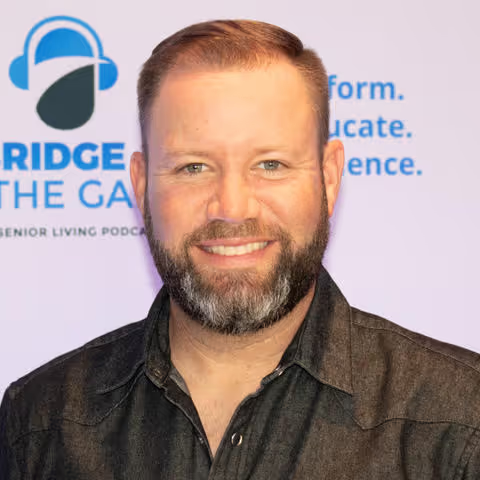
Lucas McCurdy is the founder of The Bridge Group Construction based in Dallas, Texas. Widely known as “The Senior Living Fan”.
Learn More ▶
Workforce thought leader Cara Silletto, MBA, CSP, works with organizations to reduce unnecessary employee turnover by bridging generational gaps and making managers more effective in their roles.
Learn More ▶Typically, it takes at least 18 months, if not up to 24 or 36 months, to see true culture change.
Employee retention remains one of the most pressing challenges in senior living, but according to The Queen of Retention, Cara Silletto, the problem isn’t that “nobody wants to work anymore.” In this episode of Bridge the Gap, Josh Crisp and Lucas McCurdy welcome Cara back to unpack why retention failures are often rooted in leadership, culture, and outdated assumptions. Cara introduces her Employee Retention Ecosystem, a holistic framework that assigns shared responsibility across employees, managers, and executives. Using a simple but powerful gardening analogy, she explains how leaders must individualize care, equip managers, and create environments where people can thrive.
This week we discuss:
Meet the Hosts:
Connect with Our Guest
Learn more about the Employee Retention Ecosystem
employeeretentionecosystem.com
Produced by Solinity Marketing.
Become a sponsor of Bridge the Gap.
Listen to more episodes here.







00:51 - 01:04
Lucas McCurdy
Welcome to Bridge the Gap podcast, the senior Living podcast with Josh and Lucas. An exciting day here at LeadingAge Boston. We've got a returning guest and a great friend. We welcome Cara Silletto back to the program. The Queen of Retention. Welcome to BG.
01:05 - 01:06
Cara Silletto
So glad to be back.
01:06 - 02:09
Lucas McCurdy
It's been too long and there's, a lot to talk about. Big energy here in the room. Very strong 2025. I feel like it's all the conferences and events that Bridge the Gap has been a part of this year. There's finally some good news. It seems like, the industry seems to be kind of climbing up and out of the ditch, so to speak, that there was years ago.
And even though that there's some optimism, there's always challenges. And we need great solutions for that. And one of those big challenges is, the people that are working at the communities. And what kind of culture are we driving? These are kind of the conversations that you have every single day. What is most pressing right now? What's that hot conversation that continues to come up every week with you, the people that you work with?
01:58 - 03:19
Cara Silletto
Yeah. So unfortunately, I keep hearing that phrase, nobody wants to work anymore. And it's really sad to me because it's not true. We have to bust that myth. And oftentimes whether I am on a plane, you know, flying somewhere and meet someone sitting next to me, or I'm with a provider or at one of these conferences and they're saying that the young people today just don't want to work, or too many new hires don't want to stick around things like that.
And then I ask them questions like, tell me about your onboarding. You know, the new hire experience that people have coming into the building. Tell me about your leadership development investment. How much are you really focusing on creating great leaders and supervisors and just different areas about compensation and benefits and what have you updated? What are you doing that's new?
And they continue to tell me, oh, we don't have money for that. There's no time for training. There's not this, there's not that. And then I have to remind them, it's not that nobody wants to work, it's no one wants to work. For an untrained boss who is overworked and doesn't have time for them, that can't mentor them, that can't even communicate effectively with them. You know, there's a lot of gaps that if we look at ourselves as organizations and leaders, we have to ask, like, how attractive are we really? You know, honestly.
03:19 - 03:26
Lucas McCurdy
We don't want to look in the mirror. Nobody does. It's somebody else's fault.
03:26 - 03:53
Cara Silletto
It is, it is. Well, there's a blame game around retention too, that they say, well HR just needs to fix this problem and hire better people. But then it's managers say, well the company just needs to pay better. And then we would lose so many people. And other people say, what's the managers that are talking down to their people, calling them kiddo and sport newbie, and they need to be more respectful and you know, there's all this finger pointing that somebody else should fix the retention problem.
03:52 - 04:16
Josh Crisp
Well, and it's a huge issue. It's going to continue to be more and more and more important as our industry grows because of the aging population. So recently, not really like within the last year or so, I believe you've launched something called the Employee Retention ecosystem. So the why behind that. And then give us some of the meat behind that program. And how's it been going?
04:16 - 06:46
Cara Silletto
Absolutely. So, I've been working on retention and bridging generational gaps, in particular for 13 years. I don't know how I got that old, but, but for 13 years we've been talking about this, and because of that blame game and the finger pointing of everybody wanting somebody else to solve the problem, we finally came up with a holistic model of who's responsibility is who, who has to do what in order to make a place where people want to work.
So we decided to break it down into the different roles. And there are three different roles. The whole foundation of the ecosystem is every employee is a plant. If you think about the variety of house plants from a high maintenance orchid to a low maintenance cactus, leave me alone. You know, every employee has a different care plan, which is not unlike the way we take care of our residents.
Right? Individualized care plans. And so each manager needs to know their people well enough to know. Are you a fern? A succulent of orchid? You know, what kind of care do you need for me as your leader? And that makes each of the leaders the second role in the model. The gardeners, if they know their house plants and they can provide the right care, then everyone will thrive.
And then we took it to the next level and said, all right, well, what are the executives need to do? And they need to establish the right environment. So think almost like a greenhouse or, you know, just a protective environment where house plants can thrive. And then they have to equip those leaders with the tools to be successful.
So they have to give them tools that are not broken. You know, think of a watering can with a big hole in the bottom. How successful is a gardener going to be around the house if they're watering? Can has a big hole. So we broke it down into those three different levels, and then our model actually goes to another layer of 18 action items that have to be done by those three players.
Each one, of course, has their six areas. And if everybody plays their role, if the employees show up, take root in their job and grow with the company, if the managers acclimate their new hires and cultivate their staff, and if the executives establish the right environment and equip the leaders with what they need, then we're going to have a place where people want to work and a more attractive environment. So we just took all of our 13 years of different hodgepodge type of retention strategies that we had been teaching and said, let's, let's put it into a holistic model that works.
06:46 - 06:48
Lucas McCurdy
And some love for gardening.
06:48 - 07:00
Josh Crisp
Well, you know, I was going to say, I think you just uncovered why half of my house plants are dead, because I actually just been give them all the same amount of water and attention there. You know? Yes. I don't know my plants.
07:00 - 07:04
Lucas McCurdy
I've been trying to tell you I need water for years. Josh won't listen.
07:04 - 07:18
Josh Crisp
I'm treating him like a cactus over there. I never give him any water. Oh my gosh. Well, you do make very complex things. I feel very easy. I mean, I'm staring right here at this little employee retention ecosystem booklet. And even how you've broken down, even.
07:18 - 07:19
Lucas McCurdy
You can understand.
07:19 - 07:58
Josh Crisp
Something like that's what I'm saying. It's like retention for dummies over here. I'm getting it. Well, so this sounds like I can't imagine any leader that's listening, no matter where they are in the organization. Like, oh my gosh. Yeah, that's a no-brainer. We need that. But so you've been doing this with organizations for a while. Do you find any patterns that are like, okay, we got it.
We know we need it. We want to start implementing it. Where where does it get tough for organizations? Is it just the the repetition of never letting up and being relentless, or is it is there some part of the adoption of change and implementation that people are where you really hit a roadblock and you got to get over that?
07:58 - 09:37
Cara Silletto
Yeah, I think the biggest roadblock tends to be having a champion that really takes the model and just retention in general, with any initiatives that takes it and not only runs with it, but keeps it consistent. And make sure that especially for our multi-location groups, right when we've got, we want consistency across various locations and various states or cities.
So oftentimes it's a lack of that ownership. And some people have asked us, well, where does H.R. fit in the model? Because it's the staff, it's the leaders, and it's the executives. And they said, where's H.R. Well, HR has two different functions here. As an individual. You fall into one of those buckets. So if you're a CRO, you're in the executive bucket.
If you're an H.R. Manager, you're in that leader bucket. And if you're an H.R generalist, for example, you would be in that everyone bucket. You could still influence your staff and team, but as an individual, you sit in the model that way. The second way that H.R. fits in is oftentimes H.R. drives the wheel. So if you see the model itself, you know that it's kind of this wheel picture and we just tell H.R. you need to drive, that.
You've got to take ownership and start having these meetings and conversations of who owns what to move those forward, and then putting the right policies in place. We've just recently started consulting with organizations on this model because we've been speakers and trainers for over a decade now. I had never done official consulting. It was like kind of part of the conversations, but not in that way. So we're excited now to walk hand-in-hand with HR teams to really put the model in place. They've taken some of those pieces. And now we're going to do it holistically, which I'm really excited about.
09:37 - 10:28
Josh Crisp
Well, you threw another booklet in front of us here. It's called It's Not About the Birth Year, which I think is interesting because, you know, we go to all these events, we podcast. So everybody's talking about the aging population, and we're talking about the boomers that are coming and how we change our services and our products and our housing and how we communicate, how we market and how we sell.
It's like we have that conversation readily to attract the consumer. But are we having that level of intent to talk about retaining our team members? It seems like we're very quick to just be like, hey, no, you know, like, they should just get it. You know, they this is our policy. This is how, you know, they. Yeah, we they should all just get it. And I love how you've got all the different generations here. What's some of the biggest things that we do wrong in the senior housing industry related to retention in this category?
10:28 - 13:14
Cara Silletto
I've been lucky enough to be on Bridge the Gap for years, and I used to focus on the millennial mindset. A lot of people knew me as that millennial speaker, an expert. And now, of course, we're talking about Gen Z. This is the new generation that's come in, and I am 44 years old now, y'all.
I'm a millennial in my 40s, which feels very weird, but we're not the young generation. And so what we're out teaching leaders now is about the Gen Z priorities and mindset and upbringing. They are coming to work with their whole selves. You guys, they are bringing their whole self to work. And right now, mental health challenges are very much at the forefront for this group.
In fact, there have been studies by a lot of different groups inside senior care and outside senior care that say that this hourly workforce is disproportionately and sometimes exponentially more likely to come from traumatic childhood. So if you think about folks who are looking for lower wage, hourly workforce jobs, they often came from poverty or near poverty, many times are coming from violence in the home or domestic violence with a partner and different things like that.
So food insecurity, those types of things, and we're trying to teach these leaders in senior care that have this workforce, we have to provide a lot more wellness support, holistic support, for that whole person, what are they struggling with at home? And then a lot of the managers over this past year or two, we heard managers say in our classes, I'm not a therapist.
I don't know how to deal with their toxic mom. You know, I was told you leave that personal drama at the door. You don't bring that in. That's not your boss or your company's problem. And now Gen Z does not know how to leave it at the door. They were not raised that way. And also they absolutely believe that their boss should be a support person for them and their team, and everyone should support them as a full person, not just as an employee.
So we are teaching managers now how to balance empathy with accountability. You can't just say, oh, I'm sorry that you're not feeling well. You can just go home, you know, I'm sorry your anxiety's running hot today. You can just go home. We can't do that. We're typically still short staffed or will be if they walk out. And so we're trying to teach managers. Now that balance of I do care about you and I want to support you. And here are some resources. But we still have to get the job done if we want to provide great quality care.
So they've got a they've got to learn to balance that. And some managers usually are on one end of the spectrum or the other. Naturally they're either a very empathetic person that needs to learn more accountability skills, or they're a very accountability-focused leader that needs to learn more empathy. So we're having a lot of those courses and conversations now.
13:14 - 13:41
Josh Crisp
Yeah. So such a complex environment as an employer, as an organization, because you've got to be adaptable and know how to take the proper care of that Gen Z. But then, gosh, it's not like you can just employ one age group. So then they've got it all figured out how to work together and that sort of cross-functional, cross generational, whatever the appropriate term is. Lucas it's complex. Man.
13:41 - 13:57
Lucas McCurdy
I know there's a lot I have to learn as a as a like. I'm like, sometimes, you know, as a parent, look and say, I don't want to be the daddy right now. Right. Sometimes as a business owner, I think I don't want to be the business owner right now.
13:57 - 13:59
Josh Crisp
Sure. Yeah,
13:59 - 14:46
Josh Crisp
Yeah, it's not easy. And so, we've been blessed to have you on the show for a lot of times and a contributor, we might could twist your arm and get more contributions out of you on a regular basis. We're definitely talking about that. But so many opportunities. So for a realistically for a team, you know most of the operators were coming in contact with, they are you know, the top stakeholders in the industry.
They're regional teams. They're struggling in all of the different aspects of business, towards quality. What do you have to be ready to do from a commitment standpoint, from a time commitment? If you want to put in the employee retention ecosystem, what does that look like for? What are you what are you going to be ready to commit to?
14:46 - 16:23
Cara Silletto
Yeah. So you're going to have to have the commitment of everyone needs to realize they own a piece of retention. So everybody has to be on the same page. You do have need to have kind of a champion owner that drives those meetings and conversations, like I said earlier, but the executives need to quit pointing fingers and say, okay, what's my role in this plan?
So everybody on the senior leadership team has to be willing and able to be a contributor to the model. You do need to have an owner of that and then you're going to need time. Typically, it takes at least 18 months, if not up to 24 or 36 months to see true culture change. If you are not where you need to be and you have to make a major shift for that, you also have to be willing to get folks off the bus that are not on track.
And that's a difficult conversation that I have to have with some groups saying, look, there's one senior leader or this one manager. Even on a team, is holding everything back from getting you where you really need to be, and they're actually causing more of the turnover rather than being a retention champion. So it takes a lot of time and effort.
But the good thing is, when you put retention as one of your top focus areas, it reduces a lot of the other headaches that you had that churn. A lot of the money that's walking out the door from turnover costs and a lot of operational inefficiencies from having new hires, you know, always on the floor and making mistakes, sometimes deficiencies, you know, those types of things. When we can get the staffing stability, we're looking for, it reduces so many other nightmares.
16:23 - 16:54
Josh Crisp
Yeah. Well that's a great point that you made. This is a definitely a long term commitment. It's a culture change commitment. And you know, in the microwave society we live I think a lot of times you just want to zap things. And you want to see it impact your bottom line immediately. But the commitment. And so it's great to know that you're out there and our industry has the resource, to help, organizations. Lucas, I'm going to send her over your way. I feel like you need.
16:54 - 17:05
Lucas McCurdy
I need it. Trust me, I need I'm taking plenty of notes, and I'm going to be reading through these books. Even I can understand these and read these on the plane ride home. So, Karen, where can people pick this, these, pamphlets?
17:06 - 17:38
Cara Silletto
Sure. So if you want to learn more about the ecosystem, you go to employeeretentionecosystem.com. You can watch some videos and download the little book that they're talking about. And then if you want access to our hidden treasure trove of all of our digital mini books, you can go to magnetvault.com. So our company Magnet Culture, our website, magnetculture.com has information about the programs that we offer. But that magnetvault.com is your secret hidden area of a bunch of downloadable tools, templates, videos, and all of the mini books that you can share with your leadership team.
17:38 - 17:40
Josh Crisp
Made me want to go on a treasure hunt there.
17:40 - 17:43
Lucas McCurdy
Super valuable. Cara, thank you for your time today. Really appreciate it.
17:44 - 17:45
Cara Silletto
Thank you guys. Great to be back.
17:45 - 17:57
Lucas McCurdy
And to our listeners you can go to btgvoice.com. Download this content. So much more. Pick up those resources from Cara and her team. Have a great week and thanks for listening to another great episode of Bridge the Gap.
Thanks for listening. To Bridge the Gap, a podcast dedicated to informing, educating and influencing the future of housing and services for seniors. This show is powered by our sponsors Aline, NIC MAP, Procare HR, Sage, Gibson Insurance, Hamilton CapTel, ServiceMaster, the Bridge Group Construction and Solinity and produced by Solinity Marketing. Connect with the network team and use your voice to influence the industry by visiting btgvoice.com.


