.avif)
What would happen if you began to treat your residents like partners? Listen as Traci Taylor-Roberts shares her results.
The customer we're taking care of is completely different than the Greatest Generation.
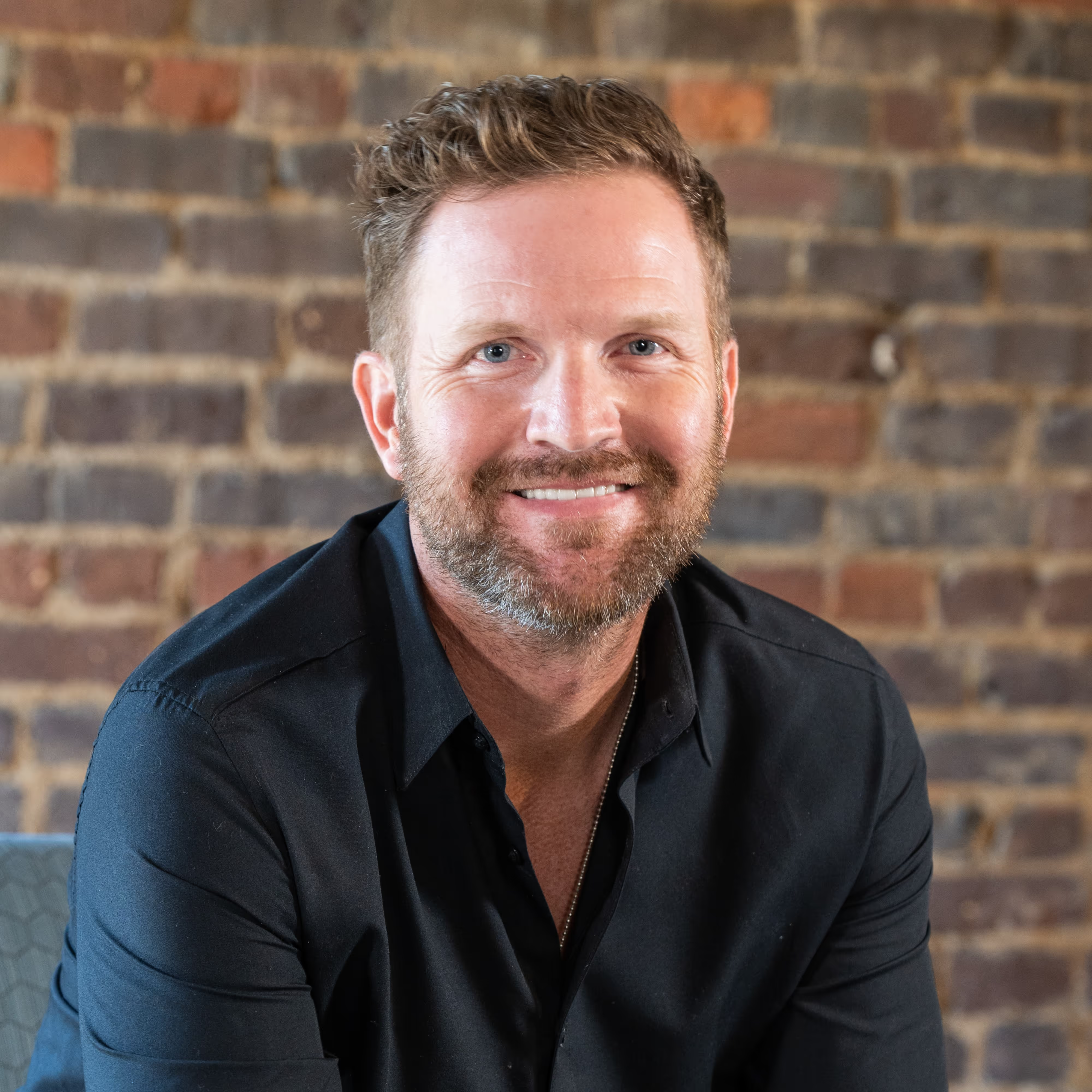
Josh Crisp is a senior living executive with more than 15 years of experience in development, construction, and management of senior living communities across the southeast.
Learn More ▶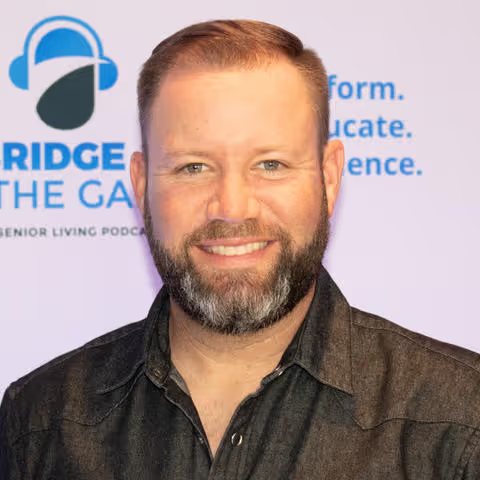
Lucas McCurdy is the founder of The Bridge Group Construction based in Dallas, Texas. Widely known as “The Senior Living Fan”.
Learn More ▶
Who can sell a community better than your resident?
The senior living industry is at a pivotal turning point, and this episode of Bridge the Gap captures exactly why. Josh and Lucas sit down with returning guest Traci Taylor-Roberts, newly appointed CEO of Harmony Senior Services, to discuss leadership transitions, portfolio growth, and, most importantly, the changing expectations of today’s senior living customer. From resident advisory boards and technology feedback loops to customization in design and resident-led programming, this conversation highlights how listening to residents is becoming a competitive advantage.
Key Topics:
Meet the Hosts:
Connect with Our Guest
Produced by Grit and Gravel Marketing.
Become a sponsor of Bridge the Gap.







00:41 - 02:53
Lucas McCurdy
Welcome to Bridge the Gap podcast, the senior Living podcast with Josh and Lucas with a great friend, returning guest. We want to welcome Traci Taylor from Harmony Senior Services.
Traci Taylor-Roberts
Hello. How are you guys?
Lucas McCurdy
So good to see you. It's been a little while. You've been up to a lot. There are a lot of changes.
Traci Taylor-Roberts
I've been up to quite a bit in a very exciting year.
Lucas McCurdy
So you just transitioned to CEO of Harmony Services based out of Charleston. How are you, liking Charleston?
Love Charleston. Who wouldn't like Charleston? It’s a great city.
Lucas McCurdy
Well, Texas misses you, but I do look forward to coming and visiting you in Charleston.
Traci Taylor-Roberts
So you guys should come down anytime.
So let's talk about footprint. Just even off mic, we were, talking about, you know, Harmony Services. I was, in general, unfamiliar with the company. And of course, since you've landed there, of course, I've done some research and seen you all have 50-plus buildings. It looks like a very much footprint. East coast. Talk us through kind of the the history.
Traci Taylor-Roberts
They're Owner Operator. They do all their own development. They have 50 communities right now. We're in 12 states. So primarily I would say like North and East. We're in Tennessee, Indiana, and Ohio. But then we're also in Pennsylvania. Delaware. You know, all the way down. To Florida. We're not in Florida. But we're to Florida. So we kind of had that whole area northeast, East.
Lucas McCurrdy
Georgia, Carolinas.
Traci Taylor-Roberts
That's right. Yeah. Yeah. Whole area.
Josh Crisp
What are the communities like? So, size and what type of care do you provide?
Traci Taylor-Roberts
So we have IL, we have independent living, assisted living, memory care, and they're around. They go from anywhere from 150 units to 180 units. So, yeah. They're large.
Josh Crisp
Yeah. And so you were telling us you've been very busy. So, I mean, you've been there for a couple of months now, and, you know, some of the things that some of the high points of stuff you've been working on that you saw as immediate needs structure.
02:53 - 08:11
Traci Taylor-Roberts
I mean, I see that a lot, putting in better structure. It's a funny thing, in some areas, there's too much. Too many people, too many processes, too many systems. And you have to simplify. But then, you know, if you eliminate some people, you typically are making that up with technology. And so I think the owners have invested a lot of money in technology and platforms and things like that to help the company.
But you also have to have people who champion those processes and help drive that forward. So really, the first 30 days were making sure our technology was rolled out correctly. Getting the right people in the right seats in the bus, rolling out, bonus programs, and then just needing residents and staff and getting feedback from them on what we do differently and better? So it's been a very busy, almost 60 days.
Lucas McCurdy
Well, you know, Josh, Traci's well known, and I've actually been afforded the opportunities to walk through communities with Traci, and anybody that's been a part of Traci's career knows how well she is loved when she walks in the building by the staff and the residents.
She knows the residents' names. She knows the staff's names. It's really fun to see. And, you know, that's quite common in our industry. People are, in general, very connected. And so, Tracy, talk to us now. You've been there again. You know, 45, 60 days. Have you had the chance to meet residents and kind of start that process?
Traci Taylor-Roberts
I've met a lot of residents. Had a lot of town hall meetings. I think, you know, the challenge and the opportunity is when you have 50 communities, how do you get to people in a fast amount of time where you're available to everybody? Everybody feels heard, and then you can take back whatever they have to tell you, and you make changes.
And so that's a little different because it's just a really, really big company. So I put together an advisory board where every community got to kind of nominate one spokesperson from each community. And they did that. And we put together this advisory board where I can meet with their spokesperson, every month, and then we'll problem solve, like one issue could be dining, could be something on a technology platform they don't like, or they don't understand.
Could be physical plant issues. But we'll kind of keep to that agenda or problem-solve that. Next month, we'll move to a different topic. But I think it helps give every community a voice. And it also helps as a company to get whatever you're doing back out to the communities. And so that's what I'm trying to do to get to people, and everybody feels heard in a short amount of time.
Josh Crisp
Well, that's really interesting. And so it is, virtual or is it like a town hall setting? You go to the community and meet 1 to 1, or how does that happen? That's a lot of people to meet with. A lot of people.
Traci Taylor-Roberts
I've done town hall meetings. I'm going to continue to do this, but this is actually going to be virtual. So they'll get on to a team meeting with me at a set time. And it's really like a business meeting. That's really what it is. It has a very set agenda. We stay to specific topics and they're a part of the problem-solving process. It's not like a venting, you know, or that type of thing. It's like structured, where here's the topic, here's what we're here to do today.
Here's what we're going to problem-solve. Next month, we'll move on to a different topic. Well, and you even said that it's been very different already. That and a lot of the residents are bringing technology ideas to you, which is very different than what you've been used to. Right. It's a new thing for me in my career.
I mean, I've been in senior living for 35 years, and what I love about this group, I love the I loved, the generations I've taken care of before, my greatest generations. But what I'm most excited about is that this generation is in the past, you know, you would go to the community, you would try to convince them, hey, we're going to use this technology, and this is how it's going to benefit you.
And you're almost like talking them into it. First time in my career where I go into a town hall and they're telling me about technology they like they've seen or technology that we're using, but maybe not to its full capabilities. And they're saying, listen, we're using this, but we want to see we want to see this part on our phone. I need an app. Where's my app for this? Never have I heard that. And they're giving you feedback. They're giving me feedback on surveys. We have an icon. We hit this. We filled out the survey. But here's how we think you could do it better. I love that. I mean, these are business-minded people, sharing with you how you can make your business better. I think that's fascinating. Yeah. I mean, I think that's the greatest thing ever. Love it.
Josh Crisp
And I think we're going to have more and more of that, I think, with this next generation. So, outlook for you guys. You know, this year and beyond, or are you mainly focused on just streamlining existing, or do you have growth plans through acquisition development?
08:11 - 13:50
Josh Crisp
What's on the horizon for you?
Traci Taylor-Roberts
So we typically will develop, you know, 3 to 4 communities a year. I think we're on target with that. So yeah, I mean, improving our processes and current structure. Sure. For the 50, but also we're still developing, and predominantly we're in the regions where you are you growing across the country, or now we're looking, I mean, we're kind of looking at, you know, staying with where we're at and growing within that.
I think that we feel like that's where our teams are at. We already have regions there. So I think it only makes sense that we can stay in those areas. And, we haven't been too interested in kind of going any further west, really, than Tennessee. And that's Memphis, I think, is our furthest west property. And I think we're okay with that.
Josh Crisp
Well, so many people are operators talking about trying to get ready for things like value-based care, that there is going to be another big development. Boom. It sounds like you guys have been really successful in keeping the development going, when a lot of people couldn't get deals to pencil. But what are you most excited about, and what do you think is the greatest opportunity for you and for senior housing over the next few years, as we're starting to see this next generation of seniors come in?
Traci Taylor-Roberts
I think the most exciting thing is that it's not anymore. Just like you're taking care of our customer, it's almost like more of a partnership where if you really leverage the relationship with your residents, I mean, leverage it. Like, listen to what they have to say and be respectful. Like you're not just listening to a resident, but you're listening to people that we're CEOs, attorneys.
I mean, these are some very educated, very smart business people. So for me to be able to take care of people like that, but also listen to them from a business perspective, and talk to them about, you know, what do you see that we're doing? Well, where do you see the opportunity, and you have people giving you feedback on your technology? This is great to use. This is too cumbersome. This is too hard. I think that the most exciting thing is to be able to partner with that group of people and build communities based on what they want and what they need, instead of us all having the best ideas. Go to the customer and start talking to them. So I think that's exciting.
Josh Crisp
I think so too. And I think it goes back to, you know, for so many years, I know I've talked about it, but we, everybody, you want the residents to feel like they have a sense of purpose and remind them of that. But this is what I mean, you're partnering with them.
Lucas, it reminds me of what we talked about, and I can't remember the name of the community, but we talked with someone on our podcast, maybe a year ago, and I was amazed that the residents were doing some of the marketing for the community. So I think that's another great opportunity because you have this generation that they are all on social media.
They can be your influencers doing the user-generated content and things like that. And so there's so many opportunities, and I think taking them on that journey makes them feel very part, a thriving part of the community. So that's exciting.
Traci Taylor-Roberts
Well, who can sell a community better than a resident? But who can lead activities better than your residents? So, I mean, even when you're utilizing some of our life engagement platforms, and they go in now, and they can tell, like what people like to do or who they were, what their hobbies are. And now you have the technology to group those people together. Well, then you can group people together. Whether it's a resident-led activity, this person's identity, this group over here is doing, you know, they're taking photos, or this one's interested in architecture.
You can have multiple things going on in a community, truly based on what people like to do. I think that's exciting. That's all technology, all driven by that. So I think the sky's the limit in the future. There are so many things that we can do that we haven't been able to do in the past.
Josh Crisp
Well, and I know you guys have worked a lot in the past, Lucas has been in so many of your communities and in a lot of folks' communities. Do you still see that as an opportunity? I think you all have been developing for a long time. So is it still a big focus to try to keep things fresh at the existing communities? Is that a constant effort, or is your property still so new that that's not really come into play yet?
Traci Taylor-Roberts
There are some that we have that I think when they hit the 7 to 10 year mark, you know, that I'm calling somebody up like Lucas, then, okay, I think we need to refresh this or we need to redo this. I mean, I feel like things move so fast anymore, especially from like, a design perspective, that really, you hit that 7 to 10 year mark, and then you kind of are looking to refresh your properties. You just need to, you know, whether it's carpet or just paint or the design is no longer where it needs to be, and you're just looking for something new.
Plus, we have so many new builds that come into all the markets that you're also trying to stay relevant. And it's important. So I mean, yeah, I think even if you build your own properties, you still have to do that. Yeah. It's just the way that it is.
Josh Crisp
Well, and I'm wondering if with the new consumer that's coming in, the new resident, the new member of the community, just like you're saying, they're telling you what they want. You know, we've typically just had an interior designer, you know, pick out everything. It's kind of the same in every apartment. But I'm wondering how much of that is going to change to where, you know, they're coming in with, hey, I kind of want this finish and I want this finished. Do you think we're going to have to be ready to adapt to that as well?
13:50 - 14:15
Traci Taylor-Roberts
Yeah, I do, I, I've seen that already, an independent living where people come in, and some might want carpets, some might want vinyl planking. Kind of depends on where your community is at or where people were raised, and what their norm is. Sure, you have people that come in, and they have a different color preference or palette that they want on walls because of where they lived before, or even people on the cabinetry, white cabinets, dark cabinets.
I mean, that's all preference, sure, but I think people feel like when they're spending a lot of money and all of our, all of our communities are private pay. So when they're spending a lot of money, I very much think it in you're saying this is your home. Yeah. Then people are like, all right, this is my home.
Then I want to be able to design it as if it's my home. So I think you already see that now. Yeah. People come in and say, and they're even willing to pay for changes themselves if you're willing to make it. I see that already.
Josh Criap
Yeah. Well, I'd say you've got to be ready and have your partnerships in place to do that quickly.
Because, you know, these folks, when they're coming to you, they're ready to make a decision. And if you stutter at all, they're on to the next community. That's right. So what an opportunity, Lucas. Are you seeing that as well?
Lucas McCurdy
Yeah. You know, and what it brings to my mind is the not-for-profit side of the industry. I am afforded the chance to work on both the not-for-profit and the for-profit side. And that's been a longstanding thing. You know, you see these, you know, entry fee, life, planned communities. And obviously, the few structures are completely different. And so the services are different. And so I think there's that operators on the for-profit side, I could have to balance that.
Of course, you don't want a patchwork quilt around your community and have different cabinets and different lights and all these different things, because that's a turnover nightmare for maintenance and everything else. But I think that there are smart ways to approach it. And I think the bottom line is if the consumer wants it and we know they do, be smart enough to work out a template that makes sense for both the owner operator and the resident.
Josh Crisp
Yeah, absolutely. Well, this is exciting. I couldn't be more excited for you. I'm always excited, to have people like you willing to sit down with us, and busy events like this in such a busy time for you. I know you're just running like crazy. And what an exciting opportunity for your company. Look forward to hearing all the love stories.
And thanks for being an ambassador. You are a great ambassador. For us, for the industry, and such a great time here in Arizona.
Traci Taylor-Roberts
I'll be an ambassador as long as you guys have me.
Lucas McCurdy
And we will keep you. Yes. For our listeners, the ambassador program, we run that every single year on our platform. Traci's been an ambassador for a couple of years. And, what is a takeaway from being a Bridge the Gap ambassador for you?
Traci Taylor-Roberts
Well, it's a great group of people, so I think it's a great resource. So when you stumble upon something you need help with, something you can reach out to this entire group of people. There will be somebody on there who knows somebody or can help you with something. And it was super helpful for me the last few years. You know, we're different things came up and I want to reach out to people, and I've gotten a lot of help, a lot of backing with that. It's just a good, good group to bounce ideas off of and things like that.
Especially in senior living. Things are changing so fast. I don't think you can have enough friends in this industry. So I've enjoyed working with all of the people.
Lucas McCurdy
Well, Josh and I were just talking about this. So you've been in the industry 35 years, and Josh 20 plus. Yes 25.
Josh Crisp
We don't have to count that high.
Lucas McCurdy
So 17 for me, and we're just noticing a lot of new faces. You know, we come to these conferences, and we've all lost count of how many times we've been to these conferences, seeing a lot of new faces, which is wonderful. The industry is changing. There's a lot of attention on the industry.
You know, just to your point, you've got to make friends.
Traci Taylor-Roberts
You do. I mean, there's a lot of younger people in this space. I'm thrilled to see it because there are a lot of fresh ideas. And, you know, people come in with a different way to do something. And I think that's needed because the customer we're taking care of is completely different than the greatest generation.
And what they want is completely different. So I love sitting around listening to people talk about things that are trying to be completely outside of the box ideas, and they're great. So I love seeing all the new faces. I mean, I think it's wonderful. I don't really see senior living as a group of a lot of competition.
I just see, everybody's got something for somebody. And so we're all trying to serve seniors, and I truly believe there's just a lot of great operators out here that are very good at what they do. And we're all just slightly different, but really good. So I think it's great to surround yourself with people like that.
Lucas McCurdy
Well, Tracy, thanks for taking time to sit down with us and updating us on your new role, new status, brand new in this, brand new role. And we're going to follow your journey, rooting you, along the way and look forward to having you back on at a later point to pick your brain some more about what you have found out.
And, the new things that you've learned at Harmony Senior Services.
Traci Taylor-Roberts
Thanks, you guys, for having me. I appreciate it.
Lucas McCurdy
Great. And to all of our listeners, you can go to the show notes, connect with Traci and Harmony there. And you can go to btgvoice.com download this content, and so much more. Thanks for listening to another great episode of Bridge the Gap.
Outro
Thanks for listening. To Bridge the Gap, a podcast dedicated to informing, educating, and influencing the future of housing and services for seniors. This show is powered by our sponsors Aline, NIC MAP, Procare HR, Sage, Gibson Insurance, Hamilton CapTel, ServiceMaster, the Bridge Group Construction, and Solinity, and produced by Grit and Gravel Marketing. Connect with the network team and use your voice to influence the industry by visiting btgvoice.com.


