.avif)
Get an exclusive look at the upcoming Senior Living 100 Conference from Jim Kovac.
Senior Living 100 is really about leading with intention. Not just information.
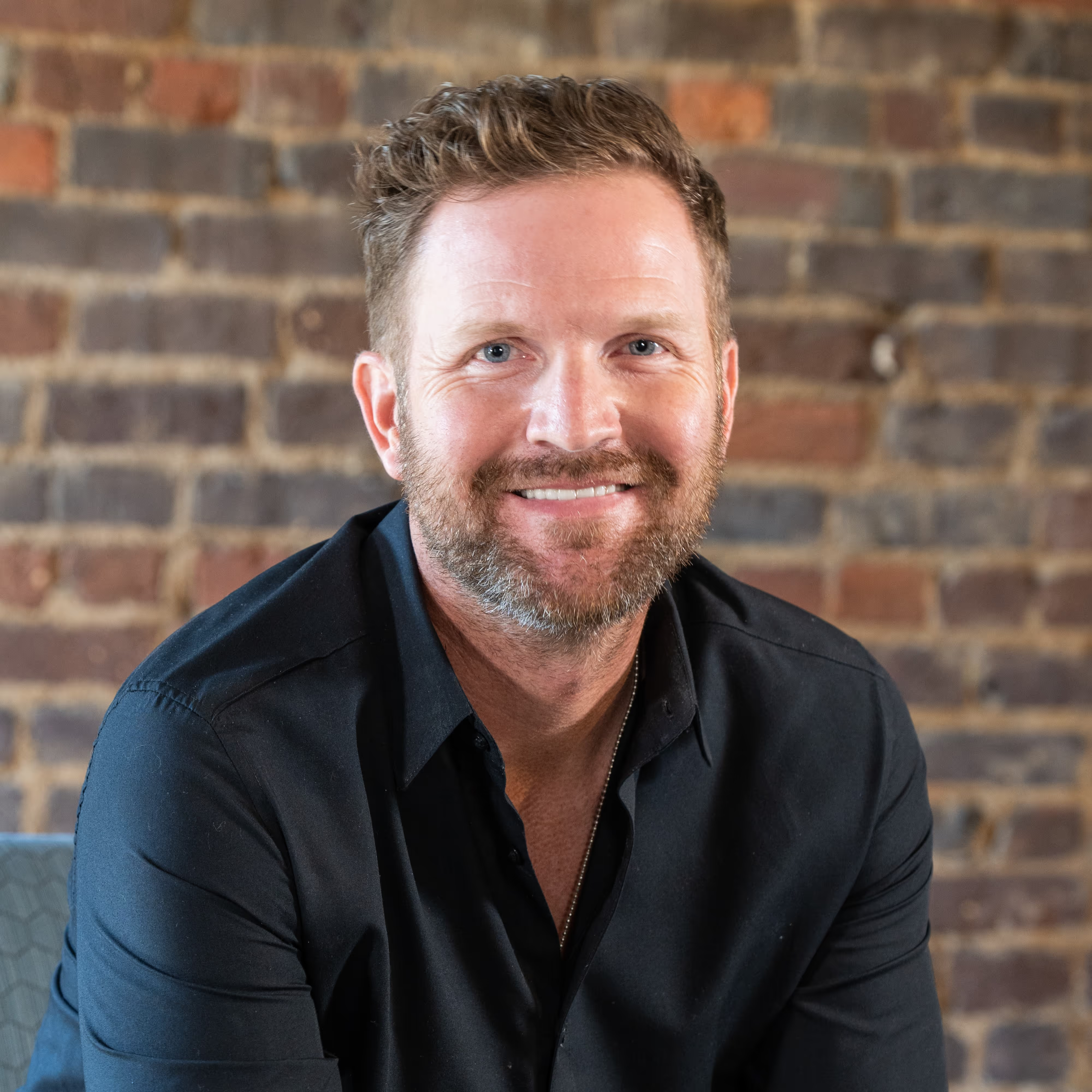
Josh Crisp is a senior living executive with more than 15 years of experience in development, construction, and management of senior living communities across the southeast.
Learn More ▶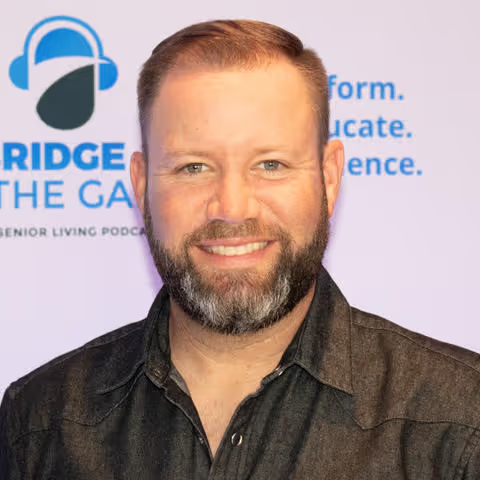
Lucas McCurdy is the founder of The Bridge Group Construction based in Dallas, Texas. Widely known as “The Senior Living Fan”.
Learn More ▶
We think senior living really isn't a one-size-fits-all.
In this episode of Bridge the Gap, Jim Kovac joins the show to give an exclusive look at this year’s Senior Living 100 Conference, where they’ll tackle why the industry must shift from playing defense to confidently claiming its “longevity advantage.” We dive into the conference theme “The Future Is Personal: Macro Thinking, Micro Intent,” unpacking what it means for leadership, workforce engagement, and resident experience. If you’re an operator, investor, or innovator in senior housing, you won’t want to miss this episode.
Key Ideas
Meet the Hosts:
Connect with Our Guest
Learn More About SL100
https://www.seniorliving100.com/
Produced by Grit and Gravel Marketing.
Become a sponsor of Bridge the Gap.







0:23 - 06:29
Lucas McCurdy
Welcome to Bridge the Gap podcast. The Senior Living podcast with Josh and Lucas. We have a great episode on deck for today. As you know, if you are a listener of Bridge the Gap, you know that Josh and Lucas are conference extraordinaire. We have been there and done that, and one of the best conferences that we have attended in the past, and we are looking forward to attending. March 8th through 10th is Senior Living 100. Welcome, Jim Kovac, Managing Director, to the show. Welcome, Jim.
Jim Kovac
Thank you both. And, really appreciate being here and appreciate what you guys do for the industry. Inform, educate, influence. I know, it's your, you know, kind of your mission. And we're right on board with you there. That's, you know, I think we're well aligned in terms of mission and focus. So just appreciate the opportunity for being here and appreciate what you guys are doing for the industry.
Lucas McCurdy
Likewise, Jim. And it's a great way to introduce this conference to our listeners. For those that don't know about Senior Living 100 and don't know about your upcoming conference in, California, March 8th through 10th again. What can they expect?
Jim Kovac
I would say innovation, strategy, and insights. Really, really a lot of things that we're working on right now to help move the industry forward. And I think, you know, the kind of sum that up. Our theme this year is, is an interesting theme. We're calling it the Future is personal macro thinking, micro and tap. And in the end of the day, what we're looking at is, is the industry.
And really, the world as we know it is moving really quickly from a technology standpoint. You know, to, you know, a lot of challenges across, you know, the globe. But when we think and pull that back into senior living, we think about senior living. It really isn't a one-size-fits-all. And this is true for many industries.
But when we want to really think about the leadership, leaders really need to start thinking broadly about the strategy while thinking about those decisions that they're making, how they're touching people personally, whether that's the workforce or the residents. So that's where we kind of go from this. The future is personal. It's really a lot of data and opportunity out there to get more personal, but also thinking about the macro level.
So the big universal strategies that we're looking at and the micro intent, what that impact is directly on, whether it's your workforce or the residents. So really kind of, bringing it back to this, this broad, this broad perspective on, visionary content versus actionable content, you know, at the, you know, at the workforce level and at the resident level.
Josh Crisp
So, Jim, how is it that you guys sort of differentiate this event? Obviously, there are a lot of events in the industry. But you guys curate a pretty special experience. Can you give us a little bit of your background on your why and kind of your philosophy on how you do that and how that leads up to these, these big macro, thinking ideas with the micro, emphasis?
Jim Kovac
Well, I'll actually, you know, talk to you guys a little bit when you talk about inform, educate, and influence, which, you know, you guys use as your mantra, we similarly think about that with one addition. And I think you guys are very well aligned with this, but it's a community. So, you know, so if you think about, inform, educate, influence, and community, for us, we're really thinking about how do you leverage the relationships, how do we leverage the community of thinkers, whether it's the folks that are already leaders in senior living or looking externally from outside the industry?
To think about who can I who we can reach out to, to adopt change into senior living. But a little bit more, you know, kind of the nuts and bolts of it as a company. We're a small company. We've been in business for about 25 years. Our founder, David Ellis, started this, you know, our company with something called LTC 100 for those of the folks in the audience who will know LTC 100, because it's the skilled nursing equivalent of Senior Living 100.
So we kind of operate in the entire ecosphere of senior care. We have senior living 100, obviously, for the private pay market, LTC, 100 for the skilled nursing market, and then home care 100, obviously, for the home care market. And the reason I bring that up is that it helps us see the ecosphere of senior care services. It also helps us differentiate by bringing in knowledge from these other related sectors, that are, you know, that either intertwine with senior care or the private pay side, or, you know, we're moving back and forth.
We've also run the hospital system conference for a number of years. We do a lot of work with private equity, you know, so we've got a lot of levers to pull from a content perspective because we're a small company. We're nimble. We have, I would say, a small, you know, small operational footprint, but a large impact, because we're touching a lot of people across the senior care industry.
So that enables us to really take advantage of a deeper pool of content that we can pull in, and we can think a little bit differently about how to apply, you know, strategic changes, innovations, insights that will move the industry forward. I'd also say that we're mission-focused, even though we're a for-profit company. We take a very in this. You know, this is kind of crucial to our founder. When David started the company, he always wanted us to be really driven by a mission. And for us, it's really to inspire excellence and leadership strategy, and innovation through exceptional insights and exceptional communities. So we're trying to drive the insights by a lot of internal research that we do. We really focus on getting out there and getting to know people, and developing those relationships and developing those communities of leaders so that we can pull insights that'll be actionable for the operators, you know, that come and participate in the conference.
Josh Crisp
So speaking of participating, your model, is it invitation only, or how does that work?
06:29 - 10:52
Jim KOvac
So it's an invitation-only conference. We the conference. And a lot of people ask us, they'll still say, what, you know, 100. What does the 100 mean? And senior living 100. It's not a specific list because a lot of people are like, oh, it's at the Gentium Top 100. What we do is we use the 100. It's really kind of a loose moniker to refer to 100 companies that are future-looking, large operators in the segment.
And the idea of using 100 is that we still want to keep it relatively intimate. It's getting big. I mean, we're trying to, you know, balance growth. We've got a lot of growth we've been growing for about 20% the last 3 or 4 years, you know. So we're trying to balance that growth with the intimacy we want at the conference.
And the intimacy is important, you know, because that enables the operator, executives who we're focused on, to network with each other as much as they want to network with, you know, other industry partners. While at the conference. So the invitation only is important in terms of selectivity. It's also important to get the right cohort in the room.
You know, we want to be able to have the right cohort of executives that are able to talk, you know, talk, shop with each other from an operational standpoint. But we also balance that sometimes it's not just size, it's also innovation and a new outlook. So while it's primarily large regional and national operators, we're also sometimes bringing in some smaller folks that might be doing something that's really unique, you know, really different.
And then we want to focus on, you know, what those unique innovations are in the industry. Well, and I know this year in particular, you're previewing quite a few different models that are emerging and interesting. Tell us a little bit more about the thought process there and what that's going to look like for those attendees.
One of the sessions. So we break down a lot differently. We kind of start the conference off, and we change this up. A few years ago, as we saw, I wouldn't even say I saw the emergence. What we saw was, frankly, a gap. And I think a lot of folks, you know, in the audience, you know, both on the partner and the operator side, would acknowledge it's kind of the gap that senior living has on the technology front. We've closed that gap to some extent, but there's still a lot of room to go. So we've started to structure the conference, where the first day is really focused on innovation and strategy. This, sorry, innovation and technology in particular. The second day is really about strategy and leadership, and the third day is about our new model innovation.
And this year in particular, there's an emphasis on this, not just on new models, but also on the wellness ecosystem. And I can get into that a little bit more. But to your question, we have a specific session called Bespoke Models. And in fact, Josh will be on that, actually looking forward to it. The Solinity model that's coming up in Virginia with mixed generation public-private, you know, really speaks to what we're trying to look at with some of these new models out there.
There's some really interesting work that's being done, you know, both from operators and some folks that are coming in from, I would say, adjacent industries. There's the Art Pharmacy. Pilar with the Longevity Day club, Connected Home Living, WellPoint, and again Solinity. Really doing some interesting things that are really providing new models, in the senior housing space, for not just housing but care.
And in the case of Solinity, you know, we've been trying to tap into a lot more, not just intergenerational, but mixed generational and things that are really change the the mindset shift on what it means to be in senior housing as opposed to, you know, we've talked about it before when we talk about isolation as one of the challenges, but there's also a demographic isolation that happens in senior housing, you know, in the traditional model senior housing.
So it's important to look at what those new models are. We're not saying that everybody has to go out there and, you know, start up an intergenerational model. But what are some models that people can look to like what you guys are doing with Solinty? You know, who also knows what some of these folks are doing, like our pharmacy bringing in some nontraditional, non-pharmacological treatment options for seniors. So some really interesting stuff on the bespoke models.
Josh Crisp
Yeah, I think, you know what I'm looking forward to, hearing from all those different models is as I heard it presented to me, like a great, awesome opportunity to not only talk about the model and what's working and traction, but also some of the obstacles that are ahead for those models and that have been overcome.
10:52 - 18:06
Unknown
Because anytime you're trying to do anything new that there's not a footprint for, there are so many question marks. Right. And so I think that to meet the challenges of this next generation of senior housing professionals coming together is really what is going to make it happen. You also mentioned something about wellness. So there's an emphasis on wellness at this event. Talk about that.
Jim Kovac
I mentioned the overall theme. We have some subthemes that are going to run throughout the course of the conference. One is putting senior living on the offensive. And what I mean by that is, you know, for a number of years, senior living has been playing defense. And we see this really because we run the home care conference.
You know, we've seen, you know, there's an intrinsic desire, obviously, for all of us to want to stay in the home as long as possible. And in many cases, you know, senior living is kind of taking a little bit of a backseat to the home care world. And that comes, you know, partly in marketing, you know, marketing, but also from a programming standpoint, you know, where a lot of times it's like, yeah, you can stay in the home, the home as long as you can.
Then, when you're ready for senior living, come on in, as opposed to being more proactive in our marketing and our outreach and communicating and educating, and the way wellness ties into this is that you cannot provide the level of wellness in the home that you can in senior living and wellness is the longevity advantage. And we're trying to put senior living on the map, not just go on the offensive.
We want to claim the longevity advantage as that true value proposition to the consumers that are out there in the world, whether it's the adult children or the actual aging seniors. You know that longevity advantage is what senior living can claim. And really, you know, take advantage of and to operationalize that are the all these wellness opportunities. For a number of years, wellness was thought of as, you know, kind of a line item on the balance sheet or a program like, oh, well, we've got, you know, some, you know, some swimming classes or things like that, as opposed to thinking of wellness as part of the strategic plan.
And a number of operators have been doing it. And we're seeing it become more prevalent. But it's also, and actually, Lynn Katzman brought this up last year. We talked about this quite a bit at the conference. The actual wellness industry is a ginormous industry. I mean, when you look at the, you know, the opportunity and the growth that's taking place in wellness as a whole, there's just a lot there, that Senior Living can capitalize on, not just from the traditional amount of senior housing, but also in some of the adjacent services and potential extensions on the revenue side for wellness, whether it's cognitive health, you know, certain diagnostics and pharmaceuticals, although
We're trying to move away from some of the pharmaceutical things, but there's a lot of opportunity from a revenue stream diversification standpoint on wellness, in addition to just the basic benefits of focusing on wellness as a strategy rather than just programs.
Josh Crisp
Yeah, that well, that's really cool. So, you know, you've talked a little bit about the why and the who's going to be there and even teased us a little bit with some of the really cool content. But, you know, Lucas, one thing that we love is, man, do they know how to put it together in the best package? That just makes it so enjoyable, right? So what about telling us a little bit more about the audience? A little teaser on the destination and more of that atmosphere that you create that cultivates that really great relationship building.
Jim Kovac
Yeah, that's a great point. And it's, it's critical that the on site experience just as much as, like, all the, you know, all all of the, you know, kind of pre-planning and things we do leading up to the conference, you know, makes for what we like to call here Nirvana. And we use it kind of as an internal ball where it's like when somebody gets to the conference, we want it to be like Nirvana.
I don't have to worry about like, oh, I don't got to go print out a badge and I'll go, you know, go put a lanyard on something like, you know, we try to work in much more of a concierge focused atmosphere, so that when people are coming to, in this case, the hotel del Coronado. Yeah, it's a fantastic environment.
We do pick our, our locations based on the service level of the organizations, you know, so Four Seasons in this case, Hotel del Coronado or Ritz. You know, we do a lot of those, a lot of those locations. But with the Hotel del Coronado, it's just a fantastic location. They went through a renovation about a year ago, but we went out there a few times to really get a sense of how their service is on site.
So we wanted to make sure that the service jives with our service, this idea of nirvana, so that when you get there, the operators, the partners, everybody there can focus on learning and meeting and not have to worry about just the basic logistics of like, oh, I got to get to the conference, I got to get a badge, I got to do this instead.
It's, you know, you walk in, we'll be there to greet you. We'll be there to help you out. We'll be there to make sure that we stay on time. That's a big thing for us. We want to stay on time with our sessions. People, sometimes when they first start to work with us, as far as, you know, speakers, you know, sometimes they're surprised how many planning calls we do, but that's because we're trying to drill into the content, not only so it stays on time logistically, but also so that we can move quickly through the sessions and still extract the actionable items for the operators in the audience.
As opposed to sometimes, you know, you might spend the, you know, sometimes you go to some conferences, and a lot of times there's maybe a little too much time spent on intros or too much time spent out, some kind of back and forth. We want to dive right in and get to the meat of the content. And also really foster the engagement on site so that people are, you know, not just listening in the sessions, but active with each other.
We do this year, we're actually doing three different work groups. One each day, we're doing Sunday is kind of a partnership, a new way to think about innovation with a, you know, with industry partners. Monday is a middle market workshop, you know, where we're going to dive into. How do we start to make the middle market work? And how do we look more broadly at the middle market, whether you're a luxury operator?
You know, what elements of the middle market can you tap into? And then on Tuesday, we're looking at a value-based care workshop. So we're trying to get interactive, so that we can make sure people are not only, like I said, thinking from this Nirvana standpoint of I don't really have to worry about the logistics when I get there because everything's taken care of for me.
But also putting people to work in a way that's going to get them to have strategic priorities they can bring back to their teams and our organizations and actually have an impact on their business.
Josh Crisp
Well, Lucas, I know, we are looking forward to seeing so many of our friends and our colleagues seeing your team, their Jim, Bridge the Gap is going to be there on site. I can't wait to hear, so many of, the speakers and presenters that you have lined up, plan to always learn a lot. And who doesn't want to visit San Diego in the spring, right, Lucas, this is going to be great.
Lucas McCurdy
It's going to be fantastic. And, Bridge the Gap is going to have the studio set up.
18:06 - 19:44
Josh Crisp
Being able to capture some of these great thought leader conversations to share with the network, and that's, you know, really shows. Well, on you, Jim and your team, to come alongside the Bridge the Gap mission, which is also your mission, to share this content. And we really appreciate it. It's going to be a good time.
Kind of an art and science, right? Great content mixed with great experience. I think it's going to be fantastic. Jim, any final words?
Jim Kovac
Just looking forward to seeing as many of you folks as possible out in Coronado. As you guys mentioned, March 8th through March 10th. Looking forward to it. Excited to have bridged the gap on-site.
Maybe we can get a little music going with, may we get Lucas up there for, maybe a song or two? We'll see. But really, I would say just parting words. Senior level 100 is really about leading with intention. Not just information, really about leading with intention, and trying to have a positive impact, you know, on a on, on care, and services for seniors. And just looking forward to, to seeing everybody out.
Lucas McCurdy
That sounds good. I know our listeners now are going to want to learn more information. Scroll down in those show notes, and you'll see the links to connect with Jim and Senior Living 100. We want to see you there. You can go to btgvoice.com. Download this content. So much more. Jim. Thanks for your time today. Appreciate it.
Jim Kovac
Thank you very much, guys. Really appreciate it. And thanks again for all the great work you do in the industry.
Lucas McCurdy
And thanks for listening to another great episode of Bridge the Gap.
Thanks for listening. To Bridge the Gap, a podcast dedicated to informing, educating, and influencing the future of housing and services for seniors. This show is powered by our sponsors Aline, NIC MAP, Procare HR, Sage, Gibson Insurance, Hamilton CapTel, ServiceMaster, the Bridge Group Construction, and Solinity, and produced by Grit and Gravel Marketing. Connect with the network team and use your voice to influence the industry by visiting btgvoice.com.


