.avif)
Join Josh and Lucas as they sit down with Ryan Spalding of Gibson Inusrance to discuss the ROI of good risk management.
Insurance is going to be a top-three line item, but it's always at the bottom of your mind.
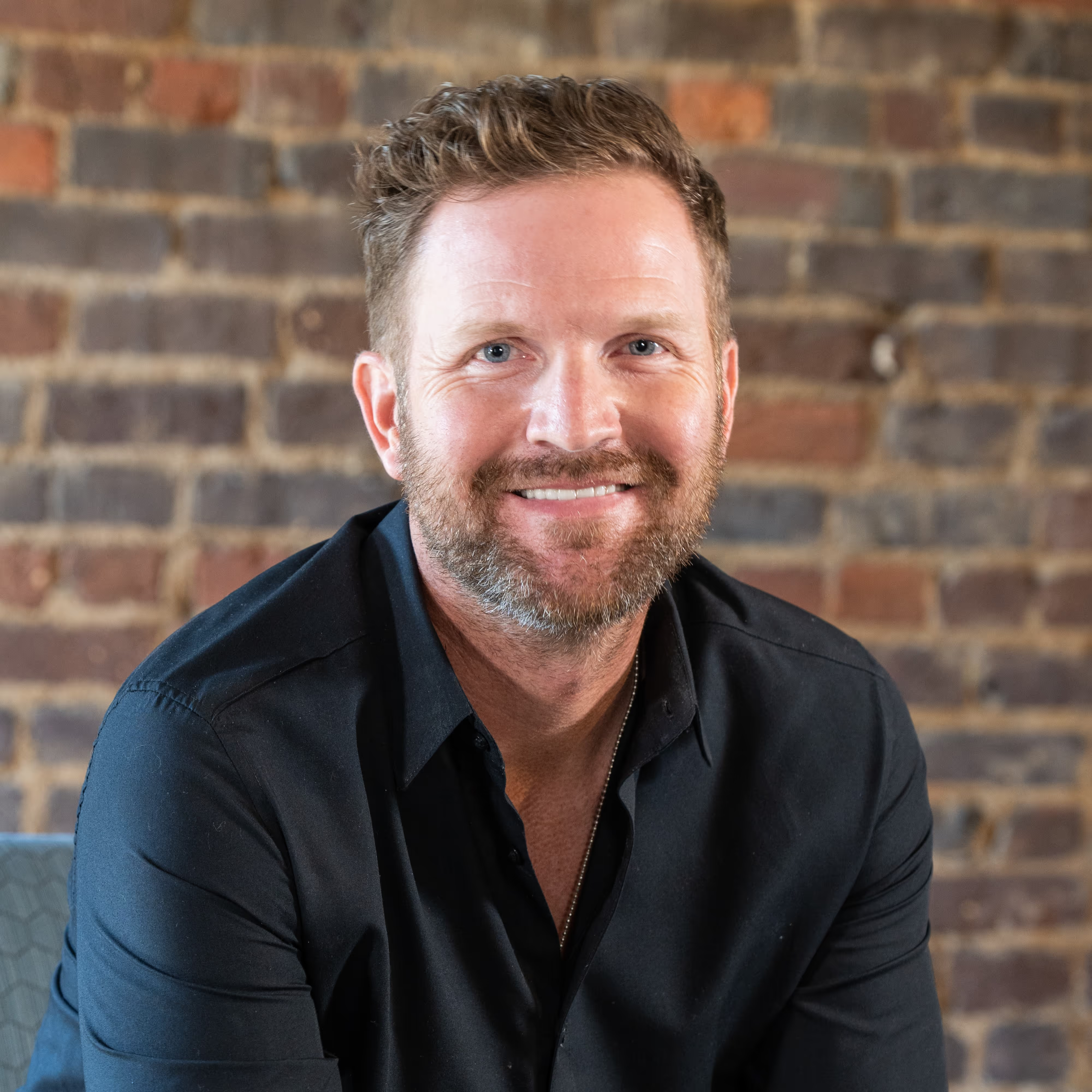
Josh Crisp is a senior living executive with more than 15 years of experience in development, construction, and management of senior living communities across the southeast.
Learn More ▶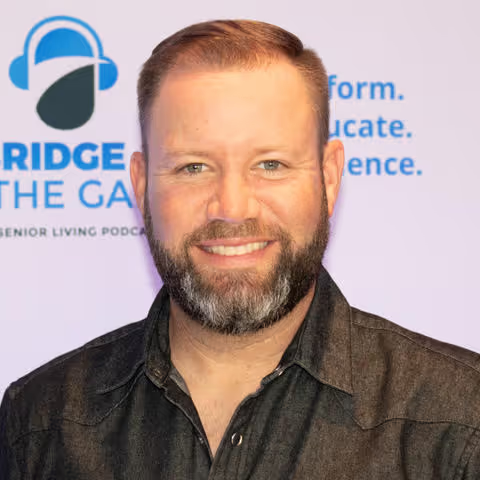
Lucas McCurdy is the founder of The Bridge Group Construction based in Dallas, Texas. Widely known as “The Senior Living Fan”.
Learn More ▶
If falls make up 60% of litigation, and we can reduce those by 80%, then this is a game changer for what it means for long-term premium stability for operators.
On this episode of Bridge the Gap, Josh and Lucas sit down with Ryan Spalding of Gibson Insurance to unpack one of the most overlooked, but critical, components of senior living operations: insurance and risk management. Ryan shares a behind-the-scenes look at the pressures operators face today. He also highlights real-world operator strategies, including creative staffing solutions and embedded technologies that reduce falls and claims. If you're a senior living operator, owner, or executive, this episode offers practical insights into reducing risk, controlling costs, and turning insurance from a pain point into a strategic advantage.
Key Topics Covered
Meet the Hosts:
Connect with Our Guest
Learn More about Gibson Insurance
https://www.thegibsonedge.com/
Produced by Grit and Gravel Marketing.
Become a sponsor of Bridge the Gap.







1:00 - 04:45
Lucas McCurdy
Bridge the Gap in three two. Welcome to the Bridge the Gap Podcast, the Senior Living podcast with Josh and Lucas. A Beautiful Day SL 100, San Diego, California doesn't get any better than this. With a great friend and a great guest and our supporter and Bridge the Gap ambassador, Ryan Spalding of Gibson Insurance, welcome to the show.
Ryan Spalding
Thank you for having me. You know, I shared with you guys before we came on what an audience you've built. The way you guys communicate to this very special, community of operators and supporters, is incredible. And, I'm very, very excited that Gibson, understood that when we came out and said we wanted to do a big, promotion with you and sponsor these, events that you guys go to and do whatever we can to help to support, you know, those operators and let their voices be heard.
Lucas McCurdy
We appreciate it because, I mean, our listeners know we can't do it. We can't do Bridge the Gap without guys like Ryan and Gibson helping to underwrite the cost and expense of producing the show. And so, thank you for coming alongside us. And not only that, but being a Bridge the Gap ambassador. What's that been like?
Ryan Spalding
Oh, it's been great. Some of the people I've met are some of the most talented people. You know, you come into this, and you get a little bit humbled, you think, you know, a lot of people, you show up to the same trade shows, you understand what their value propositions are, what their offerings are. And I've met some folks through that ambassador program that I had no idea they existed.
I'm going to tell you that, like, Melinda, out of Iowa, who does some executive coaching, has been a rock star for a human to know, understand a true connector of people. Dawn with utopia Eperiences is probably the coolest thing that I've seen from, and activities offered in the senior living space.
Lucas McCurdy
Dawn is amazing, and we can probably post in the show notes.
I can't remember which episode number it was, but we have a great episode that we recorded with her at ASHA a number of years back. She's got a great story. It isn't it just like, so inspiring.
Ryan Spalding
To see people take an idea, that they think is just the right thing. And whether they were going to make any money on it or not. That wasn't the mission. The mission was how do I support the seniors? How do I support individuals that are going through difficult times of transition in life and then create an experience that's really unique and cool? And so to to be inspired by somebody like her and having conversations with her and see what she's, she's built, it just makes you know what I do in the insurance space. Really, really boring. Sadly necessary. But boring,
Lucas McCurdy
You know what? But that's what makes the world go round here. Is that that I think that's what's unique about the senior living industry, is that we get a chance to meet all of these different people and really lean in to not just focus on, well, what's our product, what's our service.
And they got a pitch, pitch, pitch, pitch. It's like we get to meet all these people who have a common goal, a common thread to make older adults lives better. Right. And that's what I think we all share. Yeah, very, very true. So, like you said, insurance is necessary. This is a highly risky business. I actually posted on LinkedIn, a week or so ago, I met with another entrepreneur who's a provider in the industry.
And, you know, I see that there's so the business is very entrepreneurial. And, I really take my hat off to people. Guys like Josh, guys like other businesses, other entrepreneurs that really take the risk to go out there and try to make a go at this because it's not easy.
04:45 - 09:47
Ryan Spalding
Yeah, very, very difficult. And it's what's transpired over the last couple of years has been really, really interesting. I remember the first week of COVID hitting, and, we'd actually hired a PR firm to represent all of our clients because the messaging was that basically, they're actively helping seniors get killed in these facilities. And the virus that was attacking the entire world, and we couldn't get a handle on. Right. And so then all of a sudden, it transitions a little bit into their health care heroes, right.
First responders. And that messaging was awesome. You know, I remember sitting downtown Chicago and the lights flashing on and off, you know, like 8 p.m. at night. And it was a really, really cool experience to show your support for things. It seems like Covid ends. And then next thing you know, all of these organizations are under attack again, through aggressive plaintiff firms that are looking for, I'm gonna say a handout.
They thought they had an easy victory. Hey, how dare you know. Grandma, grandma, be in that facility, contract the virus and die. You didn't do everything in your power. And now we're going to file litigation against you. We're going to drag you and your team into depositions, take you away from the care that you're providing and the resources and, that are required to do that are already limited to begin with.
So it was interesting to watch things transpire. Back to, you know, an environment that I don't think is very friendly for health care operators. When we have like a 2 to 3 month window where the entire world is seemed to rally around them and, you know, God willing, hopefully with, you know, you guys continuing to do this, we can continue to share the message of all those caregivers, all those operators that go do the unglamorous work in society. It's not glamorous.
Josh Crisp
Well, and we're so glad to have you and your team as partners because, you know, obviously our, our mission is to inform, educate, and influence. And this category, it is a necessity for every single operator. It's probably not something that you hear enough about. So I think it's going to be good.
Hopefully over this year, we have time to talk with you more and more about all the different areas of risk mitigation, because it's everything from the real estate side to the operational side. It's such a huge part of any proforma or any budget. And candidly, you know, as an operator and talking with a lot of operators, sometimes it can be one of the most frustrating things.
And dealing with insurance and dealing with brokers and dealing with claims. But, you know, I've heard you say maybe that's not the way it should be. So I'd love to unpack that a little bit with you today and maybe start with some of the common frustrations that you hear. You've been in this business a long time. As you're as you're talking with operators.
Ryan Spalding
Yeah, I think the number one frustration is the amount of time and energy that it takes to get things right. Starting with the insurance application process, it can be 15 to 17 pages, and they send you this application and ask you a lot of questions that are regulatory, starting with the beginning. We actually understood that when you took a 17-page application, we could find all but six questions that were publicly available.
Outside of that, I think the market conditions have been pretty brutal. And for senior living operators and long-term care operators, we just went through the hardest property market that we've probably ever experienced in society. So, all of a sudden, you might have been looking at a $100,000 property premium with 5 or $10,000 deductible, and now you're experiencing a $200,000 property premium with $100,000 deductible.
And so your entire business margins that are thin to begin with had to be completely revamped without also harming the business by having to go out and charge the consumer more. Who needs the care? And senior living's are too expensive for that. So but how do you transfer those additional insurance expenses, not to mention what's happening in the liability market with plaintiff firms that now view senior living as their new golden goose?
They used to attack hospital systems, nursing home chains, and now they realize that there's this whole other bucket of money that they were missing. So whether the lawsuits frivolous or not, you're spending a lot of time dealing with it. Sitting in a deposition could take 4 to 6 hours. Imagine that. You have a team of administrators, and CNAs that all have to go through that process.
You've lost a lot of time, energy, resources. So it's a frustrating experience because it's nonstop. And I feel like there's a lot of people that are attacking this specific segment of, our population and the industry that serves it. And so how do you come alongside your clients to help them walk through stuff like that? Yeah, try to be as proactive as possible.
Try to have, as many conversations about, why things are happening. You'd be surprised on how many times we would ask somebody a question and say, hey, we need this piece of information, and then we get pushback, why do you need this piece of information? And what I would share with them is, here's the reason why we're here to tell your story to the marketplace.
09:47 - 13:00
Ryan Spalding
Put yourself in an underwriter shoes. They've get 200 to 250 opportunities a month. Those opportunities might consist of like 10 to 15 pages of application on top of the supporting documentation, such as loss runs, resumes of key personnel and other state surveys, you know, when required. Now all of a sudden, they only have the same amount of time in the day that we do.
So how do they select which accounts they're actually going to underwrite? A lot of that starts with a broker relationship. They are going to work on their favorite brokers first. Underwriters will claim not to have a favorite broker, but we all know they do. Like, I've been invited to weddings for some people, and I know competitors might have been invited to weddings of others.
Right. So I know that in that process, everybody's got their favorites. So the second thing that they're going to look at is the most complete submission. Where is all the documentation provided? Is it organized? Is it labeled for ease of use? Is there a story? What have they done in the past? What things are they working on?
And then ultimately, like where can the insurance company help you? One of the things that I'll tell anybody is like, I could give you the exact roadmap, how to knock a lost control phone call out of the park. I could coach you and I can make it perfect, but perfect doesn't help prevent injuries that could be preventable if we just have open and honest conversations.
And, we took that philosophy from. There was a book called The Best Places to Work, and there was a little chapter about it that talked about a health care system out in Boston where there was, a shift where a bunch of litigation occurred, and there was never any complaints from the staff, and there was never anything to be worried about.
Now, on the flip side of things, there was another shift that there was constant complaining going on from the staff, but there was never any litigation. And we ultimately, as an industry, determined that the root cause of that was the more open communication prevented the next injuries. So if you're going through a loss control visit, I can tell you what to say and you'll sound great and the underwriter will buy it.
But ultimately, that means that we could be hiding things that we could prevent in the future. And so I think the most critical component of that is I just tell you that right off the get go, like, be vulnerable, they want to help you. They don't want you to do things and hide things. They want you to have those, honest thing, honest conversations.
Hey, we're trying to get better at fall reduction. We're trying to get better at allotments. What resources can you do? They might send a consultant out to your building once a quarter and help train people. They might review your safety committee meeting notes, something that we do on a monthly basis for our clients. So there's little things that we can do to to help build your story, but then also improve the operations and be a true partner for you in the long run.
Lucas McCurdy
So it's not just, signing up at the annual renewal, and then they'll hear from you next year.
Ryan Spalding
No, no, I talk to clients too often. And most of the conversations I actually have are between 7 and 11 p.m. at night. Drives my wife crazy a little bit, but I also can appreciate that somebody that's operating, 10 to 20 locations, and they've got a thousand employees and they've got a thousand residents every single day.
13:00 - 17:52
Ryan Spalding
They're dealing with things a lot more important than insurance. Insurance is going to be a top three line item, but it's always at the bottom of your mind. And it should be, so I'm going to be available at 7, 9 o'clock when you want to call and discuss something. You know, I'm copied on everything from an email perspective.
So I've got a great team that surrounds me, clinical nurses, claims professionals, the head of our health care unit, Sarah. But ultimately, they're not going to take those phone calls at nine, 10:00 at night, nor should they. That's my job. But I always want to be in the loop of what's happening around me and in any client that I'm dealing with.
Well, and to get in the weeds a little bit of that, to give some examples of that, I've heard you talk about, obviously the senior living, employee turnover has such a big impact, but you guys have some creative ideas that you share with your operator, partners and things like that on how to reduce those kind of things and share the wealth of information that you've gained through the years.
Josh Crisp
Give us some examples.
Ryan Spalding
Yeah, I'm great at stealing ideas from smarter people. And I actually think that's the benefit of being a niche insurance broker in any space, whether it's construction, senior living in manufacturing is that when you're talking to your clients? Actually, most of my conversations have nothing to do with insurance. They might express a frustration and then, maybe a solution they came up with.
So, the coolest thing that I ever thought was an operator that took over nine locations in the Chicagoland area, very, very difficult placement. And, they were going around and they actually worked the night shift, every single one of those locations for a week. And they were interviewing all of the line staff and having great conversations with them.
One of them, they was told, was a poor performer, and the poor performer was only a poor performer because they would show up eight minutes late every single shift. He starts having a conversation with the individual and it's just like, hey, what's your deal? Well, the bus schedule doesn't run at the times that I need it to run.
So very simply, he moved back the shift eight minutes, and then he created a corporate Uber account. And anybody at any point in time could utilize that corporate Uber account to get wherever they needed. And so that took a hard situation. He then thought of a great idea to create that corporate Uber account, which we wouldn't shared with everybody.
Same thing here. You're getting staff members that are consistently late. Here's an idea of something that you can do because retention is so difficult. And, the hardest part about this industry is that you're talking about individuals that are doing grunt work, and they're cleaning people and they're cleaning rooms, and they can do that for 20, $25 an hour.
Or they could go to the Walmart or Target and that local community and do the same exact thing for the same wages. So it's like the people that are in this world to begin with are doing it out of the kindness of their heart, but they're also able to go leave and go down the street for maybe $0.50 or a dollar more an hour.
And that's a big difference in their life. So you have to retain people. I think the industry statistic is that employee turnover cost you about $19,000 per, per new hire by the time you do the recruitment, retention, training. And so when we're talking to people about employee benefits, we're talking about if you offer this, they won't leave.
And yes, it might cost you more in the front end. But let's let's look at your turnover. Last year you had a 27% turnover which would be low in this industry right. Here's what that actually cost you. And we're going to have educational conversations about why a robust benefits package might make the difference of retaining that employee. Because they don't have anything out of pocket.
And you might think that that's a terrible idea until we actually lay out the math. So you've talked a little bit to me, I've heard some of your talking points about semi-exclusive programs. Can you first just kind of explain what you mean by that, and why that is such a big differentiator in your opinion? Yeah. So the insurance industry, specifically in the senior living niche, only wants to work with brokers that can talk the language and educate the clients about the claims handling process, the risk management, the loss control.
And so there's certain insurance companies that will only work with select brokers, and they go out and develop these specific insurance products. Two of them that we're fortunate to represent. One of them is called promote. Promote comes with an embedded risk management platform called How’s Mom, which helps with staffing hours and communication for senior living communities.
The other one is called Care Agents. That comes with a couple of platforms. One of them called Virtue Sense, which is a fall prevention tool, roughly about 80% reduction in fall prevention, when utilized properly. And then the other one is called wound rounds. So both of those products were developed by very brilliant underwriters who saw a need in the market that, hey, if we go in bad risk management, we can differentiate ourselves from the competitors.
17:52 - 21:22
Ryan Spalding
They go out and they find select brokers that can represent them in the marketplace, and they only appoint limited brokers because they don't want everybody calling on everybody's stuff. And they also want to realize that they're dealing with experts. There's a lot of difficult conversations that you have to have with operators. And if my dad did a senior living home, back in the day and, he completely mismanaged the entire process.
And I think about it right often. And, he's just like Ryan. I didn't know what I didn't know, and that's the reason, you know, he had avoided that, from an industry because he didn't know how to do it correctly. And that's why an insurance company wouldn't have given him that appointment specifically.
Josh Crisp
So in, in sort of just the vernacular of an operator, we obviously have these programs and systems that, you know, we're getting, I guess, pitched all the time in our communities to help manage or mitigate risk. But you're saying there's some, depending on which ones we select, that actually can lower our insurance premiums.
Ryan Spalding
Big time, big time. So example in the promo program, if you install, which they pay for actually out of pocket themselves, house mom, they give you a 5%, premium discount right off the get-go. VirtuSense and the wound Rounds program are embedded in the care agent platform.
That comes out like a an expense about 13, $14,000 per facility. But what it is is that care agents very, very, common sense approach have we don't have falls and we don't have wounds and pressure injuries there. Then we're not going to pay out the same in claims. And so we're going to offer to pay for them.
We're going to ask for you to implement the technologies. And then when the technologies do what they are supposed to do, we don't have to charge you nearly as much in the long term. So, I'm being I'm on the care agents website when that program launched in 2022 and, and I went through it with Brian Baird, their, their CEO, and he's explaining things and I'm seeing the CMS data, for what virtue senses.
And it's like an 82% reduction of all's well if falls make up 60% of litigation, and we can reduce those by 80%. This is the this is a game changer for what it means for long term premium stability for operators. And so I think the quote was like Brian Baird is going to change the insurance industry for senior living. And I still stand by that today. He is.
Josh Crisp
So reasonable. Expectations. For a senior living operator to expect from their broker. It seems, you know, in my 20 year career, I worked with a few different brokers and, and services are not always identical, but what is the reasonable expectation communication they have?
Ryan Spalding
First off, they pick up the phone. They call you back, they respond to your emails within hours. They're always available to answer difficult questions. Hypothetical questions? I think that's the bare bone minimum. You'd be surprised how few brokers actually meet those. And a lot of times that just becomes because of revenue thresholds. There's a lot of operators that think that they're hundreds of thousands of dollars as big expense to them.
Well, it is well, you might be the thousandth largest, largest client of theirs. Right. And so you're not going to get the same resources that a Brookdale is going to get if you're operating in 10 to 12 facilities. So I think bare minimum, communication. The problem in the senior living world, too, when it comes to the underwriting, is it's a little bit of a game.
21:22 - 24:43
Ryan Spalding
And since there's so much competition and there are large premiums, what'll happen is the underwriters wait till a week or two before the renewal to release their quotes. And because at that point in time, they're worried that there's going to be the negotiating tactics, we're sharing things back and forth. What we do is 30 days out, we'll send you the complete marketing list of everybody.
We approach the current status, but we'll flat out tell you this isn't final and best. This is where the current status is. But we're also having those proactive conversations, every 3 to 5 years. Bring this to a competitor of ours, give us our top five market relationships, not top five markets in that venue. Give us the relationships because relationships matter.
My underwriter relationship gets deals done. That's fact. I have competitors, as I mentioned earlier, that have better relationships with other companies and then go take this out to somebody else and see if they can do better. And I think that sometimes kind of like when a coach lose his locker room, if I keep sending the same things to the same markets every year over year, once every three years, that market might actually not believe they're getting the best opportunity because they're not the incumbent.
They might get the submission in from a different broker and now feel like there's a real opportunity, because at the end of the day, I'll be honest and transparent. I always give the incumbent or the incumbent marketplace last look. I think that's the right thing to do for a longevity of the relationship between the insured and, continuity of the business, how the claims reporting goes and all those things. So I just think that sometimes people are too afraid of competition, and we encourage it more, more often than not.
Josh Crisp
Well, Lucas, this is important conversation. I feel like we've not talked about this topic enough through the last nine seasons.
Lucas McCurdy
Absolutely. And you know this. You've figured out a way to make, insurance interesting. And I think the that connection to just the, you know, you understand the personalities and the passion and the mission of the industry. And so, any final words, to to our audience?
Ryan Spalding
No, I think, one thing I came here to kind of discuss more than anything is that we just launched a new, revenue generating prospect for the senior living community that, I think can help with, the NOI and everybody's return. I understand this is a business.
So the name of the platform that we're just launching is called risk ROI. And it's a tenant legal liability, product that operators can actually insure that their residents are covered with renter's insurance, and we can transfer a little bit of the liability. And then there's some revenue that they can make, which only increases the valuation on their properties.
Also gives them some more capital that they can do to reinvest into things. So I think that with insurance, you know, one thing people don't realize, it's a math game. And once you get to a certain scale, you can get very creative to, to improve cash flow and also kind of minimize the risk on things. But, yeah, it's an interesting it's definitely an interesting industry to do this in. There's a lot of claims and a lot of things that you really, truly do need an expert to guide you through those things.
Ryan Spalding, Gibson Insurance, thanks for being on our show today. My pleasure. Thanks, guys. And to our listeners. You can go to btgvoice.com. We're going to connect with Ryan and Gibson in the show notes there. Check them out. And thanks for listening to another great episode of Bridge the Gap.


