.avif)
Will new tech cut out the human touch of care? Andrew Gall joins the show to share how there's more of a balance than we think.
Human connection and human touch matter.
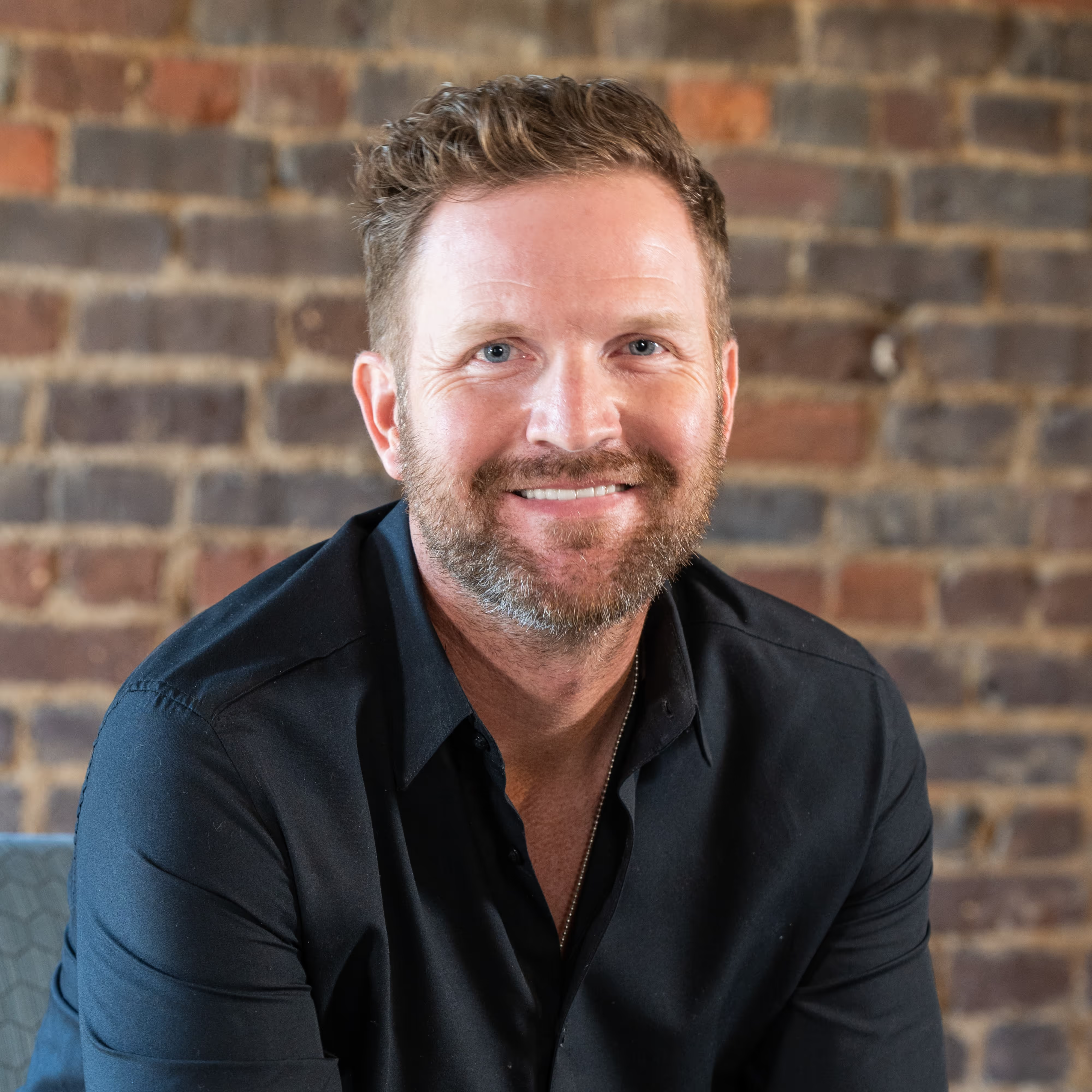
Josh Crisp is a senior living executive with more than 15 years of experience in development, construction, and management of senior living communities across the southeast.
Learn More ▶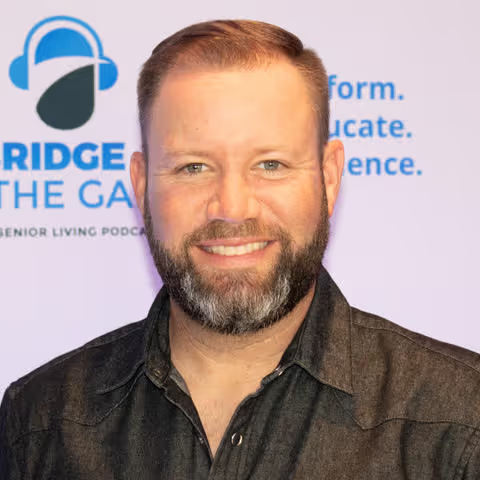
Lucas McCurdy is the founder of The Bridge Group Construction based in Dallas, Texas. Widely known as “The Senior Living Fan”.
Learn More ▶
If it doesn't work for them to make their lives easier and make care better, I don't think it works full stop.
On this episode of Bridge the Gap, Josh and Lucas sit down with Andrew Gall, Director of Customer Growth at Nobi, to explore how technology is transforming senior living. Andrew shares a unique perspective shaped by both operations and tech and dives into the opportunities of integrating technology into caregiving environments and the challenge of maintaining human connection.
Key Topics Covered
Meet the Hosts:
Connect with Our Guest
Produced by Grit and Gravel Marketing.
Become a sponsor of Bridge the Gap.







00:50 - 05:31
Lucas McCurdy
Bridge the gap in three, two. Welcome to the Bridge the Gap podcast. The Senior Living podcast with Josh and Luke is a beautiful Arizona morning here. Kind of brisk, kind of cool. At the Asia winter meeting here with a good friend, Andrew Gall. He is Director of Community Customer Growth at Nobi. Welcome to the show, and Andrew, good to see you excited.
There's a lot going on in the world of tech in its relationship to senior housing and you have a very unique perspective of being on the operations side for senior housing and now being on the, provide a vendor provider. Side with a tech company, Nobi. What do you see currently for 2026? What's the big relationship with tech and senior housing growing up in the industry?
Andrew Gall
I remember taking buildings off of paper charts. And, you know, for the first time, we're starting to record stuff digitally and figure out how all of that works. And I think we're at a really pivotal time right now where we're seeing tech come into every single part of that resident journey and that customer journey for senior living from the sales side all the way through that, you know, entire relationship.
And I think the big question that we're all asking is, how does this ultimately affect, you know, things like care or things like that human relationship, human connection. I think it's exciting to watch the ways in which it's making care better. But I think this year is going to tell us a lot about who really finds that way, to keep that human relationship at the forefront while using all of these tools that are showing up in the marketplace.
Josh Crisp
Yeah, and there are impacts, obviously, on not only the residents, but the caregivers, pretty much everybody that's part of a community. And while we talk about all the positive things, which is really what we want to focus on, I think it's, wise to also think about what the negative could be so we could mitigate that. So do you have thoughts on that?
Andrew Gall
We talk a lot about, you know, the burnout around dashboards and alerts and alarms. And I don't think there's a caregiver out there anymore that doesn't have some kind of smart device on them. And, you know, as you're trying to provide care, you're trying to make sure that you build those relationships in a resident apartment. You're also mindful of the fact that every time something beeps or goes off, that could mean, you know, a problem or something that you've got to address.
I think you're right on the money there that we need to be thinking about, not just the impact to the business. Certainly, I think that's top of mind, but the folks that are providing this care are the ones that actually have to use the tool. And if it doesn't work for them to make their lives easier and make care better, I don't think it works full stop
Josh Crisp
When you start talking about some of those things and problems, challenges that operators, managers, administrators and their teams are going to face, how much of that responsibility to to mitigate those things and to solve those challenges, do you think is on the operator versus where do you think a technology partner comes into play on being a true partner and helping them not only solve some of those when they're happened, but to foresee some of those things and maybe mitigate it before it happens.
Andrew Gall
When I was running buildings, you know, the cardinal rule was we don't make promises like, mom won't ever fall while she's here. You know, we're we're always going to keep that safe because the liability surrounding guarantees like that was impossible. I think the shift to the expectation of some predictability and some preventative measures has been, you know, just complete for the entire industry. Not only do our investor partners have an expectation that we are preventing risk as much as possible, but our customers do, too, you know, and when we have a much more educated consumer in senior housing than we ever have, they have access to all the same information that we do as operators.
And, and when they come in, they know the questions. They know the answers that they expect. So as tech partners, I think we have to be thinking about ways that we can equip operators to be forward thinking, to be proactive in care. And I think it's a really exciting time to be doing that. You know, I remember being awake and getting that phone call in the middle of the night and just knowing, like, what am I going to walk into?
And and what terrible thing has happened? And then after you've solve that crisis thinking, man, how could I have gotten in front of this? What did I miss, what didn't I? And technology really gives us that magnifying glass into the lives of our residents, into their environment, into the lifestyle that's affecting all of these risk factors when it's done really well?
05:31 - 08:41
Andrew Gall
Going back to that caregiver, I think not only do we give them a way to keep track of all of the amazing care that they're providing, but we equip them with the tools to be really proactive in the safety of their residents. And, you know, we always talk about the fact that very rarely is there a bad caregiver, right?
Intentions are always the best possible. We want to keep our residents safe, and they're the experts in our building. They know our residents better than we ever will because they're in those apartments, you know, six, seven, eight hours a day giving them the insight and, empowering them to actually take the steps to keep their residents safe, I think is is going to be the magic bullet.
Josh Crisp
Well, and I think you started to touch on it a little bit. So we're in senior living, caring for people, 24 over seven, this becomes their home. And so many aspects of human connection and human touch matter. We talk about it so much that culture can be the main difference in these communities and the residents' experience, and how that drives so much. So, where, you know, for an operator that's looking at so much tech that's coming in, it's going to continue to emerge. Where do you think some of those boundaries and guardrails are to make sure that we don't lose the human connection in all of that?
Andrew Gall
You know, when we talk about things like dignity and a quality of life, I think that's got to be a really hard line in the sand for us. The more that we add technology to a care environment, I think the closer we get to that institutional feel of, you know, again, alarms going off and things beeping in the corner and things like that. And that can take away from all the investment that's been made into these really beautiful home like communities. So when operators are thinking about how they deploy technology, I think the first question they should be asking themselves is what's going to be the impact to, you know, Andrew's dad, when he wakes up in the morning, does that still feel like home?
Does it still feel like a place where I can in not just exist, but live my life and live it fully and experience the same kind of dignity I would if I had just stayed at home. I also think, you know, going back to the point that we made for our caregivers, we've got to be making sure that we're putting tools in place that make care easier, more accessible and more efficient.
At the end of the day, we want technology to put our caregivers in front of residents as often and as much as possible. And the more that tech pulls them to a laptop or a screen or a device, we're just creating work for the sake of it. And we've really got to be asking if we're actually enhancing our residents lives and enhancing our caregivers lives.
I mean, you know, this is the conversation that I don't think we'll ever end for us in senior housing, but maintaining our staff, keeping those, shifts fold, trying to keep agency out of our communities is top of everybody's mind. And when technology enhances the quality of life for our residents and for our caregivers, I think there's a really winning strategy there.
Mid-Roll
Most brokers say senior living insurance is harder than ever, blaming social inflation and nuclear verdicts. Gibson senior living team sees it differently. They show up when others disappear and focus on the details that drive outcomes. That approach gives them access to semi-exclusive programs with built-in tools like Virtue Sense and How’s Mom that help to stabilize losses and improve renewals. Most brokers explain the market. Gibson works to change it. Go to the GibsonEdge.com to learn more.
09:11 - 13:00
Josh Crisp
Do you have any insight on a challenge that I've seen creeping up through the years, as more and more tech is coming into senior housing? It seems like every tech platform, every software, first of all, has gotten a lot better on their dashboards, kind of interpreting the data, to help make decisions.
But it seems like there's so many different systems that aren't integrated together so that you know, your caregiver, your end user, whoever that may be, is having to have so many widgets or so many different dashboards that they're logging into or that they're checking or that they're getting notifications on. So it's kind of frying them a little bit, you know, do you ever see sort of an integration to where, you know, you can have best in class of all these various softwares to, to where it ultimately just kind of in one dashboard or it's, it's integrated in a way. Do you see like a trend going that way?
Andrew Gall
Certainly, I think the HR side of our industry really needs to be leading the charge with how those integrations work. At the end of the day, our operators need a single source of truth, and that single source of truth needs to provide all of the data that they need to not only make business decisions, but clinical ones as well.
Right. And then all of that is going to have a downstream effect to our residents quality of life, their lifestyle, etc.. I think as an industry, we need to start trusting our operators more. You know, the forward thinking operators are creating their own data environments. They're bringing this information and they're building the dashboards that matter to them.
And as technology providers, I think we need to make that as easy as possible instead of, you know, trying to, build a sandbox around our own data and gatekeeping that we need to say, hey, you're the guy who's making the decisions and providing the care. At the end of the day, the data that you decide matters most is what matters most.
And that's the end of the sentence. So how do I get that to you? As quickly and easy as possible? And I think if we do that well, the operators are going to tell us what that looks like in the next couple of years. They're going to inform us about which dashboards matter to them, what kind of data matters to them.
And they're going to show us in real time how they use that data to make decisions that are good for the industry. So I think as tech partners, we really need to have an element of trust and say, hey, you guys are the ones out there doing that. We're here to support and we're here to help.
Josh Crisp
So you touched on maybe one of the leading roles, one of the leaders in that could or maybe even should be the EHR platforms. Do you think there's enough incentive out there for them that they're out there? There's providers that are working on that, or is it going to take some kind of a, a monetary, you know, enablement, to get that on their dashboard, to invest those dollars to make that happen or is that already happening?
Andrew Gall
Yeah, I think right now what we're seeing is the operators are talking with their wallets, and the EHRs that are willing and open to saying, how can we play with as many people in the sandbox as possible? And you've got to think about the entire tech continuum here. You've got to think about things like safety products. But those lifestyle enrichment programs, the, things like your point of sale and your dining, technology, things like accu shield, that entry, you know, that that, records all of that data, all of these things factor into the kind and purpose of decisions that our providers are making.
And, you know, speaking firsthand, coming from the HR side of the business after a couple of years, I can tell you that if we're not listening to what our customers need, they will walk down the street, and as they should, you know, at the end of the day, when you talk about that single source of truth and you talk about everything that goes in, not just from a pure data standpoint point, but from a compliance and regulatory standpoint, they need to use a tool that's functional for them.
13:00 - 18:48
Andrew Gall
So I think we need to follow the market when it comes to that. I think we need to let them show us exactly what they need, and we need to listen and listen fast. We've got to be flexible. We've got to be agile and, and ready to, to follow their lead.
So my final question. And Lucas, you can tell me to shut up. But, I'm curious. So, obviously our name is Bridge the Gap. We try to bridge a lot of gaps in communication, but one of the things that I hear a lot, you know, there's roughly depending on what statistic you're looking at, probably 40 or so percent of our industry is still, relatively small operators, secondary tertiary markets doing quality work for the most part.
But I hear a lot as we're out and Lucas, you probably do too, talking with these that they feel like, obviously the cost of care continues to go up, on all fronts and supplies and labor, and a lot of them are feeling like while they would like to integrate, some of these technologies, but they just seem like too high of a hurdle.
Either they're too costly on the front end or in they're trying to weigh, okay, what are my efficiencies versus what am I going to have to pay for this? Is there a bottom line difference? So really struggling to keep up I guess you would say. And it seems like that's a a big gap in the market that we need to have solutions for, to ensure that those people have the same level of quality, access to care and things like that.
Do you think technology is going to continue to enable, quality of care to be delivered more accessibility and at affordable price? Or do you think some of these providers are just going to get priced out and, and fold because it seems like that's a real challenge for the smaller markets?
Andrew Gall
Yeah, you're not wrong. And I think the regulatory environment is going to play a huge factor in that. Especially from, you know, senior living, assisted living, independent living. We've always kind of had this, separation from that more federal oversight piece. And as we get closer to 2030 and the requirement for value based care and, you know, risk bearing agreements, I think that's going to get harder and harder to maintain that autonomy. And as those regulations are going to come in, it's going to force some decision making.
Because so much of that requires, a data environment that lets you show your work, so to speak. With that being said, and not to beat a dead horse, I think operators will continue to tell us what matters most to them. And that mid-level market is always going to be where senior housing rises and falls. It won't be the flagship operators and it won't be the one offs.
It's going to be that mid-level market, and they're going to really drive this industry forward, I think, for the next few years and show us what what it what is important to them. So from a technology standpoint, to answer your question, I think we need to be able to approach people where they're at. And from a pricing standpoint, if that means having a variety of offerings, it says, hey, you know, this isn't necessarily what's accessible for you, but we can make sure that we help you meet your need on this.
And that's going to be important. And then, you know, let them. Yeah. Apologize. We need to be able to show our outcomes. We need to be able to demonstrate how we're driving ROI and how it matters to operators. You know what keeps the communities full? What helps them build strong relationships with their referral partners in the hospital and skilled environment, and then what helps them drive efficiencies for their staff, keep staff happy, keep them at work, keep their shifts full.
Josh Crisp
Yeah. And I think that's value beyond just the the tech itself. Right. And so it's awesome to have a great alignment with great partners. Thanks for joining us today Lucas. It's it's awesome to have providers and partners like this on the podcast.
Lucas McCurdy
It is. And this is a great conversation because of Andrew's background on the operations side, your deep background in the operations side. And now you've you've really made that switch, Andrew, over to the tech side, and now you've got all of this really specialized industry knowledge. As we close out, you know, nobody is coming in to provide a unique service and solution. What are your goals in 2026?
Andrew Gall
You know, keeping residents safe is top of mind, and we want to be able to do that in a way that continues to focus on that dignity and quality of life for the residents.
You know, there's a lot of safety technology out there, and I think it's all important and we're all doing the same work. We're trying to keep residents out of the hospital, trying to keep them in their home, trying to keep them safe. The way that we approach that, I think matters. And I think as we continue to look at the long term of our industry and making sure that we're providing a product to the marketplace that feels like home, that doesn't feel that institutional environment showing up in the right way is going to be an important part of the conversation.
And, you know, that's been our bread and butter with Nobi from day one is providing that, level of safety and peace of mind in a way that focuses on dignity for the resident. And, you know, we want to we want to stay focus there. We want to build strong partnerships. I think you touched on it.
Having operators involved matters. And, you know, we're really excited that no need to have a really deep bench when it comes to operational background. We've all run buildings. We've been in the environment, we've been caregivers. And, I do think it provides a unique perspective into how we show up on the tech side as a partner.
Lucas McCurdy
Well, y'all are making waves and had a lot of big announcements, toward the end of last year. And we know that there's going to be many more in 2026. One of them being your, beginning support for the Bridge the Gap network. Very excited to have you on board and your team on board. Thank you for supporting our network. And thank you for supporting the industry.
Andrew Gall
Glad to be here, man.
Lucas McCurdy
Well, if anyone listening would like to learn more, go down the show notes, click those links to learn more. Go to btgvoice.com. And thanks for listening to another great episode of Bridge the Gap.


