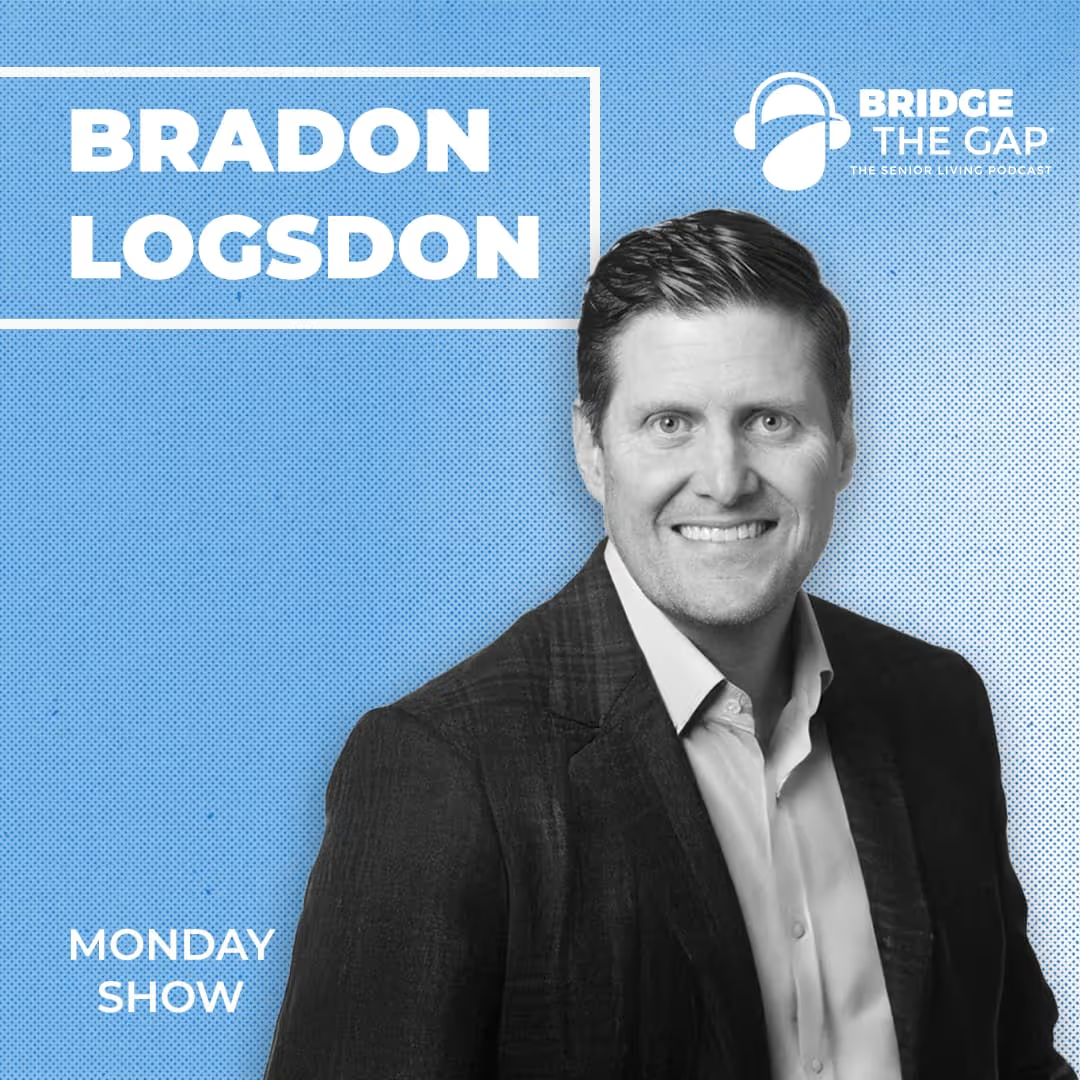
How do you participate in tech evolution without causing a revolution? Brandon Logsdon joins the show to share his thoughts.
I don't want AI interacting with my resident.
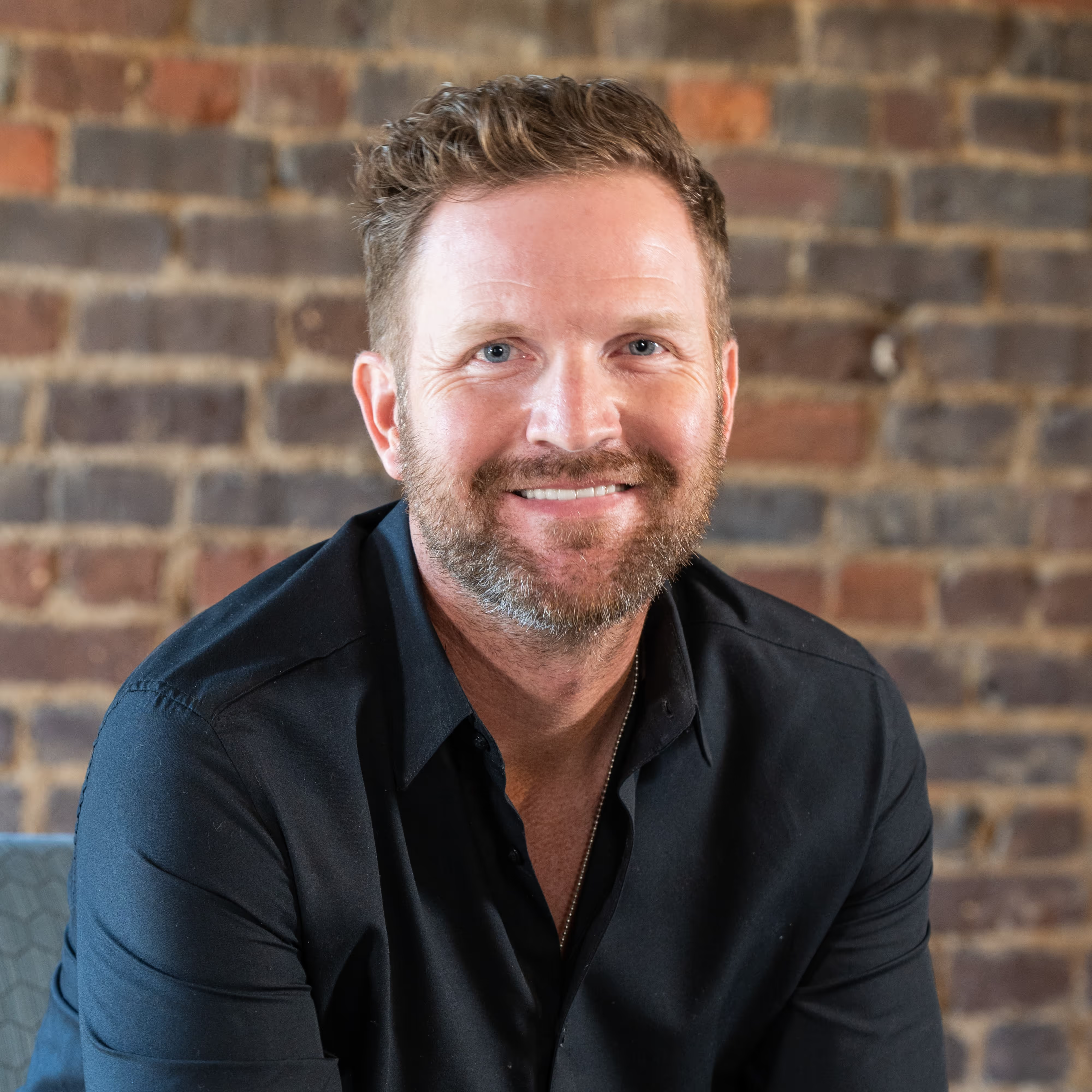
Josh Crisp is a senior living executive with more than 15 years of experience in development, construction, and management of senior living communities across the southeast.
Learn More ▶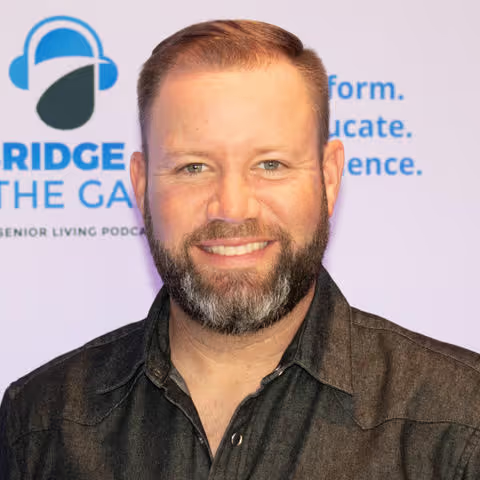
Lucas McCurdy is the founder of The Bridge Group Construction based in Dallas, Texas. Widely known as “The Senior Living Fan”.
Learn More ▶.avif)
We're innovating, but not just innovating for the sake of innovation. We innovate for impact.
On this episode of Bridge the Gap, hosts Josh and Lucas sit down with Brandon Logsdon to discuss how technology, AI, and operational alignment are shaping the future of senior living. Brandon reflects on his first year leading Aline and shares how the company unified six separate organizations into one cohesive culture focused on “elevating the aging experience.”
Key Ideas:
Changes at Aline over the past year
Building company culture after merging six organizations
Defining the senior living technology ecosystem
How dining technology impacts resident experience
Reducing waste and improving operational efficiency
Evolution vs. revolution: Brandon’s philosophy on AI
Three major AI initiatives happening at Aline
Meet the Hosts:
Josh Crisp: https://www.linkedin.com/in/joshcrispsocial/
Lucas McCurdy: https://www.linkedin.com/in/lucasmccurdyseniorlivingfan/
Connect with Our Guest
Brandon Logsdon: https://www.linkedin.com/in/brandon-logsdon-325481212
Learn More about Aline
Produced by Grit and Gravel Marketing.
Become a sponsor of Bridge the Gap.







00:23 - 04:13
Lucas McCurdy
Bridge the Gap in three two. Welcome to Bridge the Gap podcast the Senior Living podcast with Josh and Lucas. An awesome day here in Nashville, Tennessee. And we've got a great guest and a great supporter. We've got Brandon Logsdon, CEO of Aline. Welcome to the show.
Brandon Logsdon
Hey, thanks for having me. It's great to be back. It's, it was almost a year ago that I was here for the first time.
Lucas McCurdy
So next year, this time, 2027. You’ll know everything. Then you knew nothing.
Brandon Longsdon
I think I used to joke that I was a wily veteran that day. Like, second week on the job, tongue in cheek. Maybe now, like, like maybe starting to become, like, I can spell of can put a V in there, but I, you know, looking for the rest of the letters of veteran.
Lucas McCurdy
Yes, yes. Well, thank you for letting us kind of joke with you here, but you have had a lot of opportunities now since our last conversation, to really kind of dig in, you know, and there's been a lot of changes in our whole industry. And I imagine with the line you guys are pivoting and shifting and and taking that feedback and providing that, that product and services to our industry. So what has changed? Can you kind of peel back the veil and tell us what the new initiatives are? You know, start with some cultural things.
Brandon Logsdon
You know, we, you know, new CEO coming in company had, you know, formed in October of 2022. I came in at the end of March of, of last year and really had to focus on, you know, how do I make sure that people understand what I'm all about?
I listen and learn and understand what they're all about, what's the mission of the company, and then is there something we can do together to maybe reframe, reshape and and create a little bit more ownership culturally? Because align is an interesting story where the intersection of six different companies coming together. And so you think about, you know, every company has kind of their own tribal mentality around their brand, around the culture.
And so how do you break down those walls and create a culture that we own as a line? And so we went through an internal process. Bottoms up. The the employees kind of, we led them through a process, but the employees created sort of our cultural ambition. And so we recast our mission statement. We recast our values.
We decided our our mission. We exist to help elevate the aging experience. And, and how we do that is by helping our customers better connect, care, operate and serve by delivering more simplified software. And so that was a pretty cool moment. Happened about three months into the journey here. And, you know, it's driven a lot of change in the company now about how employees come to work every day and show up both internally for their peers, subordinates and for most importantly, our customers and the residents they serve.
So that's pretty cool. So that'd be one thing. And then the second thing is really how we how we think about our software, how we think about the ecosystem, our opportunity in it, who we're going to serve, how we're going to serve. And, and maybe more importantly, how we're going to connect all of these disparate pieces and parts.
Because as we talked about last year, this is a big opportunity. It's a big industry. It's a thriving it's a growing industry. And it needs more technology and more technology providers align and all of kind of the vendor community to just continue to innovate and bring new solutions. Such a huge undertaking. And congratulations on what all you've achieved over the last year.
04:13 - 08:32
Josh Crisp
You know, you mentioned ecosystem. That's obviously a curious word. You know, describe that ecosystem a little bit more for us and what you mean by that?
Brandon Logsdon
Well, we think I mean, one, we love the brand Aline because we really do think it's kind of a through line of the resident journey, whether they start in independent living, kind of graduate to assisted living.
Unfortunately, sometimes they have to go into memory care or into skilled nursing or other, higher kind of acuity areas. But when we think about the ecosystem, it's across that total line. And, it starts with sales and marketing. Once the resident moves in, it goes into the care continuum. You have to present a bill to a family individual because somebody has to pay for this.
There's nutrition and dining. There's a whole experiential side of it. But what happens in the community and so that ecosystem are all the pieces and parts where software can improve what operators are doing to deliver a better resident experience.
Lucas McCurdy
Well, you know, you mentioned dining and that. And you know, that's a really big deal in senior living. And that's commonly known, I mean, three times a day.
That's their time to interact with other individuals and, opportunity to obviously get nutrition and have an experience. How are you all approaching that?
Brandon Logsdon
Well, first of all, it's the second-highest cost of operators behind human capital. So is food. And so we're approaching it from a couple of different sectors. One is making sure that the food that is being served in the community has the right taste, texture, nutritional value, etc..
We have three dietitians on staff. And so that's very important is making sure that the food quality, the ingredient quality and the recipe itself is right. Once you've got that right, then it's about how do you now make sure that we order the right quantities. This is where the the cost piece comes in. It's not uncommon for there to be a lot of shrinking waste.
And there are ways to mitigate that using our software to make sure that with the menu now that's been selected, the proper amount will be ordered based on consumption rates in the community. And then the last piece is just the guest experience. So we have a point of sale product that allows operators to then, you know, facilitate transactions, whether it be in a dining setting, whether it be delivered to a room, whatever it might be in the, in the community.
And so, and then integrating that into now back to the ecosystem, into our broader software platform so that, the bill is accurate based on what the resident consumed. Right. And if there's any issues there, our software is able to, you know, see the issue and quickly resolve it through reporting and other exception checks and even into the care component, right.
Where maybe, maybe a resident is having a problem with their jaw, with their teeth. And so we need to make sure that they're what they are served at. That next meal is different than maybe what it was last week. That's really important. And so we're able to track all of that.
That's really interesting. I mean, that's you make that sound simple. There's no way that that simple. I'm sure there's some sort of learning process or AI that's involved in this. Can you talk to us about how AI is kind of woven into all this?
Brnadon Longsdon
It's an interesting time right now with AI, right? I, my dad once told me a lesson, he said, and he was quoted on this by another guy who wrote a book about business, and he said, you know, you always want to pursue evolution, but watch out for revolution.
So because in revolutions, the difference between that and evolution is evolution just kind of happens. Things naturally get better. And in a revolution you got to be careful, right?
Lucas McCurdy
Because it happens quickly, happens quickly.
Brandon Logsdon
It can get a little messy. And I think, you know, I'll take a step back on the AI question just to say this. Like, that's kind of how we're thinking about AI. We're pursuing it aggressively, and we're also trying to be very measured and controlled and how we're pursuing it so that we can make sure that we deliver a solution externally that really works and isn't just, you know, kind of playing check the box buzzword bingo. So that's kind of one Phillips, philosophy that we have at align.
08:32 - 11:48
Brandon Logsdon
The second is we got to, you know, kind of, you know, do it ourselves before we can expect to do it well for others. And so we kind of have three AI initiatives happening at align. One is what I'll call, you know, engineering, AI. This is the one that I think is most commonly talked about on podcasts like this everywhere right now about the software factory floor changing overnight.
And that has been pure revolution, right? Where today developers are no longer developing code. They are directing an AI instrument to direct, to build the code for them, and then they're simply human in the loop. Testing it like that is demonstrably different than it was a year ago. We're doing that right. And I think that becomes kind of table stakes and software.
Second thing, and then is a what I call AI for the enterprise. So that's non coders like me using AI. I mean if you haven't checked out flawed code co-work and the plug ins for Microsoft Suite, I mean it's crazy like maybe I feel bad for like I think about my own kids, like coming out of college with a finance degree, trying to get a job to be a financial analyst, which was my first job out of college.
I mean, that job is almost like, how do you envision it happening going forward? Because now in Excel, I can do the work on my own with Claude that I otherwise would have used not only one, but maybe a team, a financial analyst. So I for the enterprise, how do you use it in the business for business people to be successful?
And then thirdly, how do we put it in the software, which that's really your question, but I just wanted to kind of frame the, kind of how we're thinking about it and putting it in the software is features, what we can do differently now than we could yesterday, last year, it's really about workflow automation, making making things simpler and then predicting better based on the interaction of data sets.
So back to your point on like say dining very complicated. You're right that interrelationship historically between what happens in a community that could be value based outside of the monthly rent, and how do you make sure you can capture it, whether it's in care or whether it's in dining? And then how do you make sure that the bill is accurate and there's no loss?
That's always been a really big challenge for this industry and industries like it. I now can really help us tie together some of those elements by looking at the data 24 over seven, looking at the data, not just when somebody in the office eight hours a day. And frankly, it's oftentimes better at finding the errors and then giving you suggestions about what to do about it.
And so we have a platform we call Align Compass. That's pulling all of the data together and helping, helping tie everything into a more streamlined, simple interface so that an operator doesn't have to go to their CRM screen to then their care screen, and then their leasing and billing screen to then their dining system screen brings it all into one screen, one dashboard with AI doing some predictive analytics and recommendations across it.
11:48 - 16:11
Josh Crisp
That's really, really cool. So, in the align ecosystem, your team is working with hundreds and hundreds of operators, managers, executives, that are doing the work, for the community on this topic of AI. What are what are the questions that are kind of continually coming up? What kind of pressures are you getting from operators that they want to know where things are going, how they're part of it?
Is there consistent themes? Yeah, there really are. And I think, you know, it's not always rosy, right? Like, I mean, I think that's the other thing. Back to the evolution versus revolution and back to kind of being measured. It's, you know, a 1-to-1 question that comes up often is, hey, wait a second. I don't want AI interacting with my resident.
This is a connection journey that we're on in senior housing and so let's not disconnect that reality, which I fully support, agree with. So I think that's one nuance to this industry where you can't automate everything. And there are certain things that maybe even if you could automate, we don't want to because it's really about connection with the resident, how we serve those residents.
So that's one theme that comes back. The other is compliance. Is it HIPAA compliant, is it data compliant? You know, all the things around, just our health care system and, and regulation and governance and making sure that that's right. And then thirdly, how do you know, Brandon, that the AI is accurate. How do we know. And so I think our answer to that is we don't do anything where we don't have the right audit checks and the right human in the loop experience to make sure.
Because again, that goes back to this revelation content. Right? I mean, I think if you're not careful right now, we can all propagate a message of AI that sounds so great on a podcast or in a book or on a white paper, but in reality, it could really bite you. Yeah. And, and so I think that's a lot of what we hear from operators is they want it, but they want to make sure that the partners they're working with are thinking through unintended consequences.
Josh Crisp
Well, I like the way you phrase that, Lucas evolution versus revolution and NIC Spring, I mean, that's been a big theme. The excitement around the demographic, the boom that's coming, the opportunity for our industry. But this caution around, what AI going to do? I know that's been a big topic for you in the conversations. For sure.
Lucas McCurdy
Sure. Well and very well said, Brandon. I mean, so as we kind of round out the conversation, 2026, any final thoughts about the goals for you and align this year?
Brandon Logsdon
Part of the end of this recast of our mission was also a recast of our values. Right. And so, back to we love the brand Aline. We think it's very representative of this industry. And so we taught our values to that, that brand. And so, you know, we're accountable to our outcomes. So it's making sure we live our values every day connected to our mission. It's making sure that we're learning relentlessly. That's a really important one. Every day starts with something new to learn.
We're innovating, but not just innovating for the sake of innovation. We innovate for impact. And I think, you know, that goes back to a lot of the AI and and other things that we're working on, making sure that it truly makes an impact, navigating as one teams of active and the tribal nature of how align started and really getting to a one team, one dream philosophy.
When we do that, we elevate aging. And so we've tied our our values into our mission. 2026 is about now showing and proving that we are really serious about living those values every day, and how we serve our customers, and bringing connection to this ecosystem through software so that it truly simplifies the communities we serve. And then we're measuring that through regular touchpoints.
Customer advisory boards on a regular basis, getting the feedback, how are we doing? Here's what we're trying to do for you. How are we doing? And so 26 is what I'll call a kind of a, a show me year about how align is bringing all of this together, the elevate aging and really stand behind that built to connect tagline that we recently introduced an exciting event around the corner to.
16:11 - 18:00
Josh Crisp
You want to tell us about that? You guys put on a heck of an event for for your partners and the industry. Thank you. It's, the Align Innovation Summit. Last year was right here in this hotel, so it's good to be back. This year, it's going to be in Dallas, Texas. Actually, Frisco, a little north, at the Cowboys star facility.
And so, there's an Omni hotel there, and, we're excited about that. It's May 11th through the 13th, and we're trying to get as many operators and ecosystem vendor partners there as possible. We think it's, again, that the residents we serve is all about connection, this industry. And boy, you guys told me this last year, you.
Right. It is all about connecting at events. Connecting with folks doing great work like you all and other operators and developers and you name it. So, it's all about it. Events bring people together and connect and and learn.
Josh Crisp
Well, congratulations on a year of success and many more. Thanks for supporting our industry, our partners. We couldn't do, the content that we do without partners like Aline.
Lucas McCurdy
That's right. And, you know, Erin and Luke, you know, we've been supporters of our podcast for years and years and years, and we're so grateful that you have continued that, in your position, legacy, supporting this content and education back to the industry.
Brandon Logsdon
Really appreciate it. No, thanks. And I couldn't I wouldn't I wouldn't know half the people I know right now if it wasn't for Erin Hayes. I mean, I think she knows everybody. She's so gracious with, introducing me. So it's been great. She's beloved, for sure.
Lucas McCurdy
Well, thank you so much. And so for our audience, we know that they're gonna want to connect with you guys. We'll put that in the show notes, and and connect there. Thank you for your time today .Really appreciate it.
Brandon Logsdon
Yeah. Thanks, guys. Really appreciate it.
Lucas McCurdy
And go to btgvoice.com download this content so much more. Thanks for listening to another great episode of Bridge the Gap.


