.avif)
The demand for senior living is growing. But can everyone afford the care they need? Find out how Bethesda Senior Living is closing that gap.
Culture is as much about what you're trying to build as what you allow.
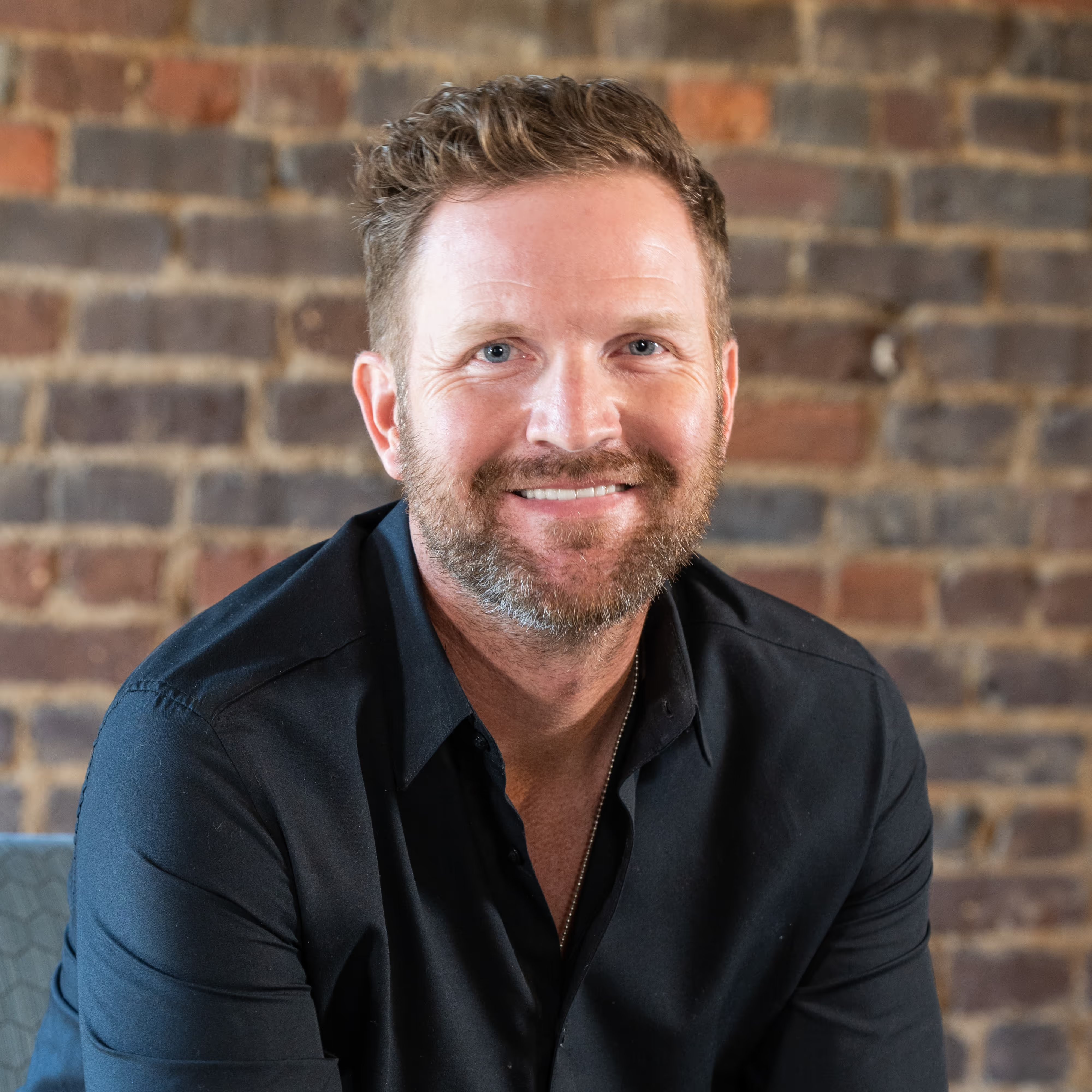
Josh Crisp is a senior living executive with more than 15 years of experience in development, construction, and management of senior living communities across the southeast.
Learn More ▶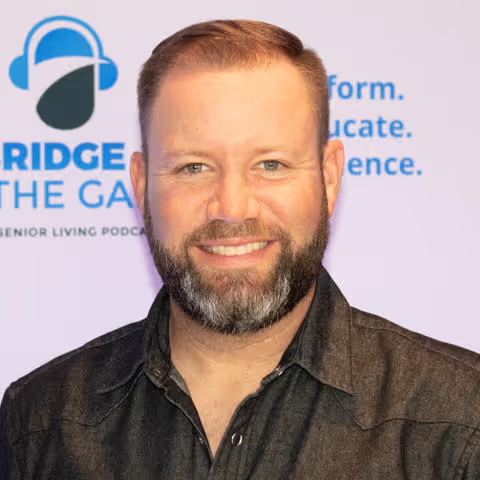
Lucas McCurdy is the founder of The Bridge Group Construction based in Dallas, Texas. Widely known as “The Senior Living Fan”.
Learn More ▶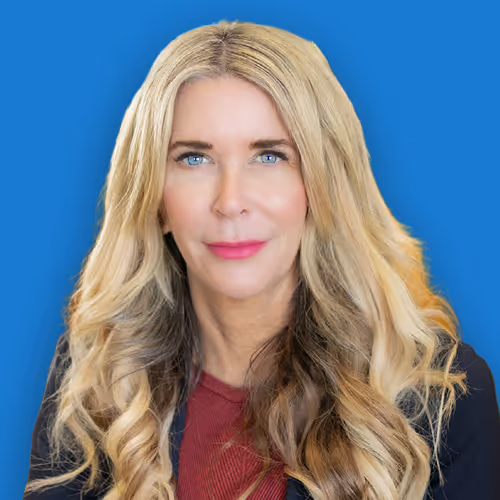
At the core, people just want to be loved and cared about.
On this episode of Bridge the Gap, Josh and Lucas sit down with Kimberly Erickson, COO of Bethesda Senior Living, to explore the future of attainable senior housing and the role nonprofit operators can play in serving the growing middle-market population.
Kimberly shares insights from her transition from the for-profit sector into nonprofit leadership, highlighting how mission, culture, and compassion shape operational decisions at Bethesda. The conversation dives into middle-market senior living strategies, charitable care programs, affordable housing models, labor and staffing realities, and why culture cannot be reduced to buzzwords or technology platforms.
Key Topics
Meet the Hosts:
Connect with Our Guest
Learn More about Bethesda Senior Living
https://www.bethesdaseniorliving.com
Produced by Grit and Gravel Marketing.
Become a sponsor of Bridge the Gap.








00:53 - 04:09
Lucas McCurdy
Bridge the Gap in three, two, one. Welcome to the Bridge the Gap podcast, the Senior Living podcast with Josh and Lucas. Here at SL 100 with another great guest on our program today, we want to welcome Kimberly Erickson, CEO at Bethesda Senior Living. Welcome to the show.
Kimberly Erickson
Thank you so much for having me. I'm happy to be here.
Lucas McCurdy
Yes. We're excited you came all the way from Colorado. What's the weather change like from Colorado to here in San Diego?
Kimberly Erickson
Well, fortunately, my daughter and I came a day early, so we missed the snow. We were happy to be sitting on the beach on Friday, as it was snowing in Denver. But I think it was like 70 degrees yesterday. You know, the weather is like, "wait a day" in Colorado.
Lucas McCurdy
But not around the Pacific Ocean.
Kimberly Erickson
We do not have the ocean. We are pretty landlocked in Colorado for sure.
Lucas McCurdy
You know, that's one thing I like about this event, though, is you can bring your family. Josh brought his family. You brought your daughter. It's. It's a great time of year to come and spend a day or two. Absolutely beautiful. Beautiful place to be. Kimberly, you've worked at quite a few really big operators and have a ton of experience and skills, and this was just a great opportunity to bring you on our program to pick your brain about your newest venture on the not for profit side.
And we're going to be talking about the middle market today—attainable middle market. That's a huge conversation. And frankly, I've never heard anybody really solve that problem. So we'd love to hear your thoughts. First of all, the differences that you have seen from working on the for-profit side and the not-for-profit side, and then unpack for us the whole middle market.
Kimberly Erickson
I would love that. It's been just a pleasure and I'm super grateful to be at Bethesda. It's been 18 months already. Time goes by quickly for sure.
Josh Crisp
Yes. So what is the biggest shift going from a for-profit world to not-for-profit? What's been the biggest change for you?
Kimberly Erickson
I think two things that come to mind are, you know, you're still trying to run a business, right? I think a lot of misconceptions are that because you're not-for-profit, money isn't as important a necessity. But as an organization, we still look at margins, expenses, labor, and all the things that I was used to looking at in the for-profit world. So I think that's similar. I think the difference is a couple of things.
One, decisions are made just a little differently. We are very collaborative and take decisions to our board. I'm not used to working as closely with a board of directors as I have at Bethesda. And also just the ability to, as we're talking about, really serve the middle market and what that means.
And it kind of is different depending on the state that we operate in. But I have loved just the opportunity to learn that side of the business, feeling like in my experience in senior living, just serving a different type of resident. I think my experience has been more on the luxury side. So I was really happy to understand what that means at Bethesda and really feel like we've been successful at being able to do that.
04:09 - 09:08
Josh Crisp
I'm assuming, with that change and as you mentioned, it's not that the money is not important—it's always important to every organization, and margins are important—but do you think the nonprofit world and the model that you're part of now positions you all to be able to have leverage to deliver a quality product at a more affordable rate that is more attainable for a lot of people? I do.
Kimberly Erickson
When I think it matters because, again, from my experience, when you're looking at a building as an example, you're moving into a community, right? And we always say, "You know when you walk in." Right? And I feel like the commonality is you love your residents, and we do, like nonprofit or for-profit—you're going to care for your residents the same way.
I think the difference might be for our company is we're 65 years old. And so some of our buildings are older. And so I think what we've had to do is really invest in some of the physical plant and the capital side of the business to ensure that we continue to make improvements in our buildings because they are older buildings.
They're not new builds like, you know, as I've been used to serving. So I think that being able to do that and make those improvements yet still care for residents and maybe your rates can be a little bit lower because the buildings aren't the, as we say, the new shiny penny in the market. But really, at the end of the day, you're still loving and caring for your residents, which is what people want.
Josh Crisp
So explain this: obviously across the industry, we're hearing all the favorable data points where occupancy is improving and rents are improving—all these things that are wonderful things for a nonprofit organization. Where is the challenge, or is there a challenge at maintaining margins while balancing that missional aspect of delivering a more attainable product and service? So do you find there is friction there where you're conflicted—where you want to drive more margin, but you've got to keep it within a certain attainability?
Kimberly Erickson
I think for me, it comes down to a lot of the labor and staffing challenges that we all talk about in our communities. And I think that, again, for me, it's when I look at the physical plan of the buildings and when you're walking in. Again, if I'm looking for my mom, who's 80, and I will be soon, we're like, "Do I feel the love?"
Do I feel the care from the staff? And maybe it's not like a new community, but it feels like home and what's important to her. So I just need to know my mom's cared about. So when we do things like setting rates and looking at comp analysis and things like that, we know that we are not going to be the highest priced in the market, nor do we want to be. That's not our mission, you know?
And part of our mission is charitable care, meaning we do things like financial needs applications for our residents. From the for-profit world, I think about it in a way of offering a discount, right? So maybe you want to waive a community fee or something like that. We have a specific process at Bethesda that we go through with the residents and their families where they fill out applications and we look at finances and things like that to make decisions.
So charitable care is important to us as a nonprofit. Roughly 25% of our residents are on some type of charitable care. So that's kind of the difference for us, too—while we have residents that can pay the full market rate, we also have those residents that need a little financial help or may run out of money.
Where in my experience in for-profit it's like, "How are you helping them find another community?" at Bethesda, we're really taking into consideration evaluating their finances or moving them into smaller apartments and things like that. One of our communities in Colorado, as an example, has shared apartments or shared suites that have four residents. So or 3 or 4 or two or whatever it might be, but they are separate apartments that share a bathroom.
So I think something to consider as an organization if you're trying to hit the middle market is you might need to evaluate and do some construction on those unit types to really be able to serve those residents in a more companion-type setting. We found that to be very successful for us, as they can live in our communities and still have their own bedroom and space while being a part of the community.
09:08 - 12:18
Josh Crisp
Well it seems like, with the growing demographic that we're all hearing about that we know is coming—is beginning to come—and with your positioning for that middle market, which seems to be the largest sector for which there are not enough solutions, you are positioned to grow. What are your thoughts on growth? What is the growth trajectory? Where are your strategies looking for the next several years as this demographic hits? What are you all hoping to do?
Kimberly Erickson
Well, we definitely want to grow. We recently purchased a property in Texas and we've been able to evaluate the footprint of that; it fit our portfolio.
But I think part of it, too, is we've done a recent merger with Rocky Mountain PACE. I know there has been a lot of conversation in the industry on the PACE kind of idea. And for us, it was just a good fit in Colorado Springs in that particular market, as we were already serving seniors in our communities and had several Rocky Mountain PACE participants living with us.
So I think that is an idea that I felt like I've read about a lot in the industry that people should explore just as an option. I mean, obviously the idea is to keep residents at home, but at some point they need a place to live. And so if you're willing as an organization to work with a PACE organization and negotiate rates, and you're able to figure out the footprint of the unit type, it really has financially served us well and we get to serve more seniors, which I think is ultimately our goal. Yeah, and our strategy is how do we continue to support our mission and serve seniors in the future
Josh Crisp
With that growth? On the housing side, are you all looking to acquire or are you looking to build new or a little of both? What does it look like for you?
Kimberly Erickson
Great question. Acquire, I would say. We're really probably not as interested in doing ground-up development, but as properties come to us, as the one in Texas did recently, I think we would certainly welcome that. Absolutely. We would love that. Again, whatever we can do to serve more residents and, you know, care for them and love them, then that's the plan.
Lucas McCurdy
So, I have question about that. So, on a not for profit side that's trying to acquire, are you looking at for profit buildings as well. And then you're going to reposition.
Kimberly Erickson
Great question. So prior to me coming to Bethesda, we did an affiliation with a company in Arizona that was nonprofit, but the property in Texas was for-profit. So we are able to make that work financially. So we are certainly open to it, but again, it really has to fit us. So when I walked into the property in Texas, you know, as an organization, you kind of know what that feels like.
Again, it's the feeling. But you really know what that feels like with a little TLC. That property in particular just needed some physical plant adjustments and improvements.
Josh Crisp
And I think you said, do all of your campuses have sort of a continuum of independent living, assisted living, and memory care, or do some campuses only have one type of care? How's that?
12:18 - 16:11
Kimberly Erickson
Well, that's a great question. So Bethesda started really in the skilled nursing environment and then sold that side of the business and restarted in assisted living and memory care. So most of our footprint is assisted living, memory care, and independent living. But I'd say a majority of our units—and we have 2,100 units total and about a thousand employees—are really serving that assisted living and memory care resident primarily.
Josh Crisp
So, exciting times for you, being part of continued success in our industry and moving from the for-profit to the nonprofit. Personal goals for yourself—speak selfishly for a moment. You know, I know we're talking about the growth of your organization, but where are your personal initiatives and how are you applying those to your organization?
Kimberly Erickson
I appreciate you asking that. You know, I've been in this business for a long time. Many of us kind of fell into it when we were younger. I was in a CNA-type role in the business, and I love it as much now as I did then. It's just really been incredible for me, the different roles that I've been able to have and the different companies I've worked for.
So personally, I have a counseling background, and so I always wondered if someday I might be in a nonprofit organization, whether it was senior living or some other service-related business. So I feel like God just brought me right where I need to be at Bethesda. I feel really, really grateful to be able to serve the mission of Bethesda and be very God-focused in the work that we do. It's good being with people in your organization where that common thread is our mission.
And being a faith-based organization has really—I feel like it just kind of puts you where you need to be when you need to be there. And that's how it's felt for me being at Bethesda.
Josh Crisp
Well, it's interesting you say the counseling background, because I can tell you as when I was a young administrator, dealing with all the challenges that you're never prepared for—nothing in school or your training programs prepares you for sitting in the seat and dealing with families and all that.
I have felt like I needed a counseling background on many occasions, so I bet that has really well equipped you to do a lot that you're doing on that trajectory. I mean, can you share a little bit about that?
Kimberly Erickson
Yeah, I was getting my master's degree in counseling while I was working in senior living, and my thought was, "I'm going to open my own practice and be a counselor."
And as I went through my program, I just really loved the work I was doing. And I just frankly couldn't leave. I thought, we're talking about caring for people, really, and understanding the psychology of people—our residents and our staff, obviously. I think if you care for your staff, they're going to care for your residents.
Right. So I think through the years, I've just decided maybe when I retire—I don't know—I'll put my sign up and be a counselor. Но I do think it's a people business, right? I mean, we care about people, whether it's our staff or our residents, and you really need to know how to do that.
And you hope that people just innately know how to do that. But certainly education and counseling and understanding that has helped me. I would hope that it would, and the people that I've worked with would feel that way about me. So, yeah.
Josh Crisp
Well, I'm sure it has. And I mean, we've talked so much about the opportunity that any senior living professional has, and the plethora of opportunities you have to minister to and impact positively the lives of your team members every day, the residents, the partners that come into your community, and the families that are entrusting us with their most valuable asset, which is their loved one.
16:11 - 20:59
Josh Crisp
So, having that kind of background, I would imagine—I've never thought about that as a prerequisite to senior living, but I could see that being extremely beneficial because so many people come to us at a very desperate time.
Kimberly Erickson
I think at the core of what we do, it's about relationships. It's 100% like the relationships you have with your team, the relationship you have with yourself, and with your family. I think that our business just kind of becomes who you are. I'm the same person at home as I am at work, and I think that's—I don't know. When I started at Bethesda and I was nervous coming into a new company, a very dear friend of mine just said, "Just be you. Don't try to be anybody else."
Just care for the people that are around you. And that's the impact that you make. And I think that's our work, right? We know that in senior living we need margins and expenses and all of that. But at the end of the day, you need to care for people before you can do any of that. You need to select the right people and be with them.
Lucas McCurdy
Well, that's a great segue over into culture as we round out our conversation. How have you, over the years of your experience—especially now coming into a new company—developed that rapport and created that culture that fits the organization?
Kimberly Erickson
Yeah, culture. That's a good buzzword, right? Everyone's always talking about culture. And does culture matter?
And I don't know, I do a lot of reading. I have a lot of favorite authors that I follow, and I think that one of the things I say is culture is as much about what you're trying to build as what you allow, right? So part of culture is just ensuring the right people are in your organization.
And sometimes it's okay that they're not right. And you need to have those honest conversations with them because you want the best people caring for your residents and caring for each other. So I do think culture matters. And I think Bethesda's culture—ingraining God into the conversation. What I've loved is this:
It's the ability and, frankly, the expectation in our organization to pray for someone or pray with them, whatever that means and whatever their spiritual journey is. But at the core, people just want to be loved and cared about, period. And so if you can do that and do that well, I think everything else falls into place.
But I think if you don't focus on that and you focus on the financials and all of the things that are really important in our business, it's going to be hard. I think you just really have to kind of put your arms around people. And in our company, one of the things we do is we just show up.
You know, when I say things get hard, just be present—like physically present with people and be together. That's one of our core values: togetherness. And I think the people that work with me now know that. Okay, we need to come together and be together in a room, particularly with COVID and the times when we're remote working and all the conversations around whether you are in the office or remote. We're in a business that you need to be out in, right?
You need to be in the community, you need to be with people. So even in my role as COO, it's really important to me to still be present like that. That's where the magic happens—in the community. So I don't ever want to get too far from that in our community. So it's important to me; we just need to be together in whatever way we can do that.
Josh Crisp
Well, you know what? I'm hearing you talk. Culture is a buzzword, and you always have to unpack what you mean and what you do and all that. But what I'm hearing you talk about sounded very simple. You made that sound super simple, right?
And you're like, sometimes I wonder if we put too much pressure on ourselves as leaders because you hear "culture" and it just feels like almost you're like, "I've got to lead culture." And so your shoulders can tend to slump because you feel the pressure of it. But a lot of what you just said is just being good humans, embracing people, loving, and not being afraid to pray.
And sometimes nowadays, we're afraid to even say that, which is unfortunate. But we have a tendency with all of the technology and tools and data points and everything to almost sterilize culture, too. It's a formula or it's a data point, or you have to do this enrichment tool or this engagement tool, and you have to have all these bells and whistles, but you can have all that and still miss the point, right?
20:59 -
Josh Crisp
Yeah. So, it's very interesting. You were about to say something?
Kimberly Erickson
Well, no, you brought up such a good point. I mean, being here at this conference, right? It's amazing. And you hear all of it. And I think what we can't get too far away from is just the human touch, right?
Just, frankly, again, loving your residents and the families. And they want that, but it needs to be in the background. Like if we're leading with that, I think we're making a mistake. You're like, "I want my mom to have the fall prevention and all of the things," right? But I want you to know, are you going to give her a hug when she's having a bad day?
Right? Are you going to lead with love? That's important. And it needs to be running in the background, and you need to have that as an organization for sure. But like statistics show, people just want to feel cared about. They want to feel in conversations—like we do lots of surveying with our staff and our residents.
And that—I mean, I hate to simplify it, but I do think it... if you can figure that out. You have to be strategic about it and you have to measure it, right? Like, is it working or are we doing the right things? It's not the pizza parties. We know that, right? It's like, what are the love languages of our staff and our residents?
And that's how, when you get really personalized with it, I think you can figure it out. Yeah. We have not figured it out, by the way. We're working on it, you know, but when you say what's personally important to you, that's personally important to me because that's how we figure that out.
Lucas McCurdy
So maybe culture is not an arriving point; it's the journey.
Josh Crisp
Absolutely. And you know, so it comes through; I can feel your heart. Bethesda is lucky to have you. It's really awesome. And I think it's a great opportunity. Senior living is no longer a vanilla box or a vanilla product or service or one thing. One thing I'm hearing at these events that we're going to, and very true here at Senior Living 100, is that there are so many different emerging models and organizations that all will have a place to grow in senior living. And it's a great opportunity that you all have at Bethesda to meet a huge growing sector that has needs. They need to be cared for, but they need to be cared for appropriately with love and a great culture. So congratulations on the move and on all you're doing. That's exciting.
Kimberly Erickson
Thank you so much.
Lucas McCurdy
Okay, so a final word to that young person out there that may have stumbled across Bridge the Gap on Google and is looking at a career. And they're saying, "Which direction do I go? How do I take my skills and talents? I want to feel like I'm actually contributing to something." How would you pitch senior housing to them—to a young person?
Kimberly Erickson
Yes. This is ironic because I have a 14 and 16-year-old, and they're working in a senior living community—my husband's community—as servers. Now I understand that not every teenager can work in a senior living community, but I think the exposure—to see them grow and come home with the stories and just the understanding and the patience—you hope that has an impact. If they're going to be in senior living, I don't know.
Right. Sо I think just the respect that goes along with it and the understanding of older adults... for me, it's exposure, whether that's volunteering with your own family or a job like they're in. That's my goal: just to expose them and let them figure it out. And maybe they'll end up in senior living—I'd be kind of happy about that if they did.
Lucas McCordy
So what are their names?
Kimberly Erickson
Jack and Allie.
Lucas McCurdy
Okay, yeah, we're rooting for them.
Josh Crisp
And I think we need a pipeline of counselors lined up to come serve senior housing. That's my takeaway from this as well. So the background, I think, and preparation has done you really well in that.
Lucas McCurdy
Awesome conversation, Kimberly. Thank you so much for your time today.
Kimberly Erickson
My pleasure. Thank you so much. It's been great to be here.
Lucas McCurdy
And to our listeners, if you want to connect with Kimberly and Bethesda, go to the show notes and click those links. Go to btgvoice.com. Download this content and so much more. Thanks for listening to another great episode of Bridge the Gap.


