.avif)
Senior living is entering a historic era. Find out how to make the most of it from Aron Will.
We're the most recession-resilient.
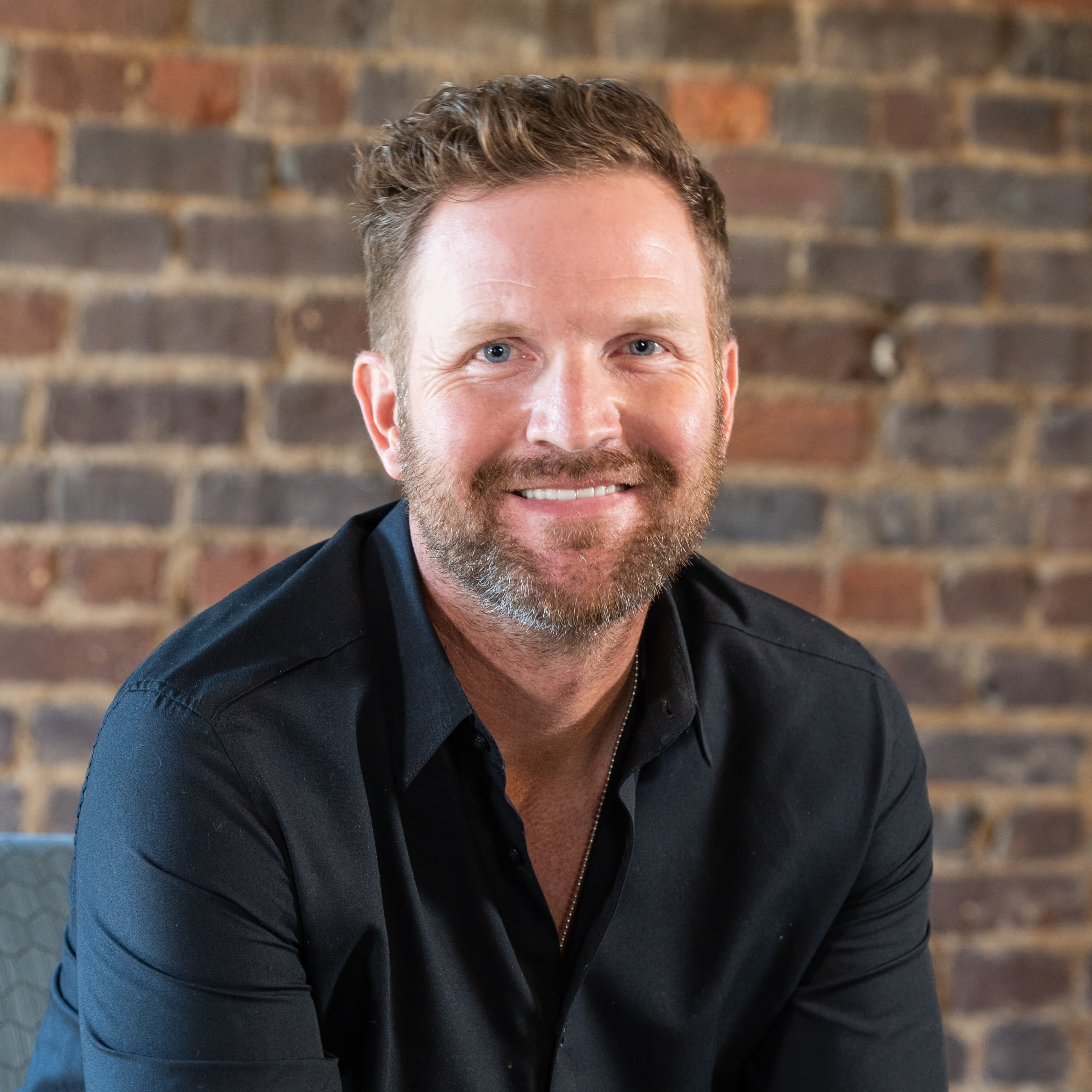
Josh Crisp is a senior living executive with more than 15 years of experience in development, construction, and management of senior living communities across the southeast.
Learn More ▶
Lucas McCurdy is the founder of The Bridge Group Construction based in Dallas, Texas. Widely known as “The Senior Living Fan”.
Learn More ▶
The wealthiest demographic is turning 80 every day.
Senior housing is no longer a niche asset class; it’s become one of the most talked-about sectors in real estate and institutional investing. On this episode of Bridge the Gap, Aron Will returns to break down why senior living is entering what he calls a “historic growth cycle.” Aron explains the powerful convergence of demographics, limited new development, strong occupancy growth, and increasing institutional capital flows driving unprecedented momentum in the sector.
Key Topics
- Why senior housing is attracting institutional investors
- The demographic wave driving demand growth
- Occupancy trends and rental rate growth in senior living
- Why development has slowed dramatically
- Construction costs and replacement cost challenges
- The difference between real estate value and operating business performance
- Positive leverage opportunities in senior housing
- Risks of irrational exuberance in the sector
- Why senior housing is more insulated than office and multifamily
- Capital markets outlook for 2026 and beyond
Meet the Hosts:
Connect with Our Guest
Learn More about the CBRE
Produced by Grit and Gravel Marketing.
Become a bsponsor of Bridge the Gap.










00:55 - 06:22
Lucas McCurdy
Bridge the gap in three two. Welcome to Bridge the Gap podcast, the senior Living podcast with Josh and Lucas here. Spring NIC Nashville. What a great spot to be and we're super excited to have a good friend and a returning guest back on the pod. Welcome, Aron Will from CBRE. Welcome to the show.
Aron Will
Thank you. Thanks for having me.
Lucas McCurdy
Very excited to have you back. So one of the pleasures we have with Aron is that anytime we sit down with Aron, we get some past, some present and some future. And, today we're going to focus really more on the present and the future. But senior housing, obviously we're in the space. We've been talking about this a long time, but now everyone is talking about senior housing. Can you give us some context, as in some data to as the reasons that would be it's people.
Aron Will
Having done this for 20 years. I've been waiting for this moment. And I think all of us have been waiting for this moment for our entire careers. Right? When we were a couple of years ago on the precipice of something special. And it's really a here and now. And the reason people are so enamored with our asset type is, it's pretty simplistic, actually, if you think about it and break it down for one. The operating fundamentals are second to none in real estate, right in really, we're the most recession resilient, right?
So with all the geopolitical noise, we can talk about that and how that impacts a lot of different things. But, you know, we are, the most, prone to not be impacted, right? Given, the baby boomer age cohort, the magnitude of, of that age cohort in relation to, you know, to greatest and, talent generations, you know, so far as the quantity, of them and then the wealth that they have. Right. And dispensable income that they have. And these people want what they want, right? So even if a home values are down, public equities are down 20, 30%. You know, in a draconian scenario here in the next year, who knows how this plays out. Our sector is far more insulated than most. The second thing is, you know, we're now building as an industry 15, 20,000 units, right?
That's just what the empirical data shows, right? We need to build 115 to 120,000 to satiate the demand function. The issue is, until recently, there was not enough empirical data, with construction costs having escalated through the roof during the Covid era, through the banking crisis, to support trades at or above replacement cost. We've now got a lot of trades that we're involved with, and a few of our peers that are nosebleed, you know, 750, well into the millions of dollars a door, in certain markets, very high barrier to entry and so on and so forth.
But those are few and far between, right? There's not a lot, there's a lot of people that would rather buy cash flow and buy quality cash flow, right, without a lot of supply coming into the marketplace. If you compare and contrast senior housing to, say, multifamily, that on a national level is at, you know, flat at best, you know, with marginal operating fundamentals, we're, we're seeing rental rate growth between four and a half minimum.
You know, and I know, Nick, we show 4.5%, but that's a lot of you know, data sat with a lot of functionally obsolete products included, quite frankly, to, you know, eight, nine, 10%. Right. And a lot of people are underwriting 5 or 6% for at least the next three years because the supply demand imbalance. And we're poised for an environment whereby we're now at 89.5%, roughly occupancy.
Right. The compounded cash flow growth that we're going to get from senior housing assets, if you buy a cash flowing asset in a good primary, secondary market, let's just say is truly remarkable in relation to the rest of, real estate with really no meaningful supply on the horizon, with the wealthiest demographic turning 80 every day, you know, 46 to to 26.
So we're at this like like there's a confluence of factors. It's like kind of all come together at the same time. No product, tremendous operating fundamentals, huge wealth and creation. Vis-a-vis the baby boomers that are now actually here and now residents, as opposed to the adult children of residents. And we're starting to see capital flows in the industry.
And I'm I want to elaborate on this, you know, from, you know, true core capital people that are competing with real estate investment trusts head to head. They couldn't spell alternative real estate, literally could not spell it 2 or 3 years ago that now are investing thematically Odyssey open ended core funds into senior housing and deploying capital at low teens levered returns.
So it's not just the magnitude of the capital flows and senior housing coming into its own. It's the quality of the capital flows. And it's it's really changed so dramatically in the last, you know, 12, 18 months. For debt capital and for equity capital, it's, it's it's hard to keep up, but, it's all overwhelmingly, all overwhelming positive.
06:22 - 10:42
Mid-Roll
This episode of bridge the Gap is sponsored by NIC MAP. For 20 years, NIC MAP has been the trusted source for senior housing data providers, investors, developers, operators and policy lenders with insights they need to make informed decisions. Now, Nick Knapp is expanding its coverage by 50%, adding 74 new metro areas and reaching 214 markets nationwide, with data on up to 3000 properties and 175,000 units.
NIC MAP continues to set the gold standard for senior housing intelligence. Learn more at NICMAP.com.
Josh Crisp
So, Aron, to pull out a small section of what you just talked about, the deficit between new construction, where we are now and and what we would have to get to that big number. What do you see steps. That is going to have to happen before we start making progress on that? And do you have any instinct on timing of that?
Aron Will
Yeah. I mean, the development spigot, to me, you know, a lot of commodities, suburban development, you know, for IL, AL, MC at costs where it it, you know, doesn't make sense because you can buy still you know, for cash flowing assets and participate in, in meaningful cash flow growth.
Right. You know, in the present and not take development risk. That doesn't, you know, in, in, in great quantity doesn't make sense today. Makes more sense and like higher barrier to entry markets where you have a demonstrable track record for a developer or owner operator with, you know, ten, 12, $14,000 rents that operate five within an MSA where you say, I understand what apex is in a given market, I understand it's going to cost me $900,000 a unit to build it, which is infinitely more and maybe 50% more than the last cycle to build it.
But, you know, we you have to have enough data to support this asset type, being a yield driven asset type as opposed to price per pound focused right. And I've talked about this previously on our prior podcast and a lot. But so many investors in our sector were myopically focused on price per pound okay. And because they could buy when our operating fundamentals were suppressed, senior housing on the cheap.
Well, you can't buy senior housing on the cheap anymore because of the overwhelmingly positive operating fundamentals that we have in this asset class. Exploding so far as the the, the growth, the investment into the sector, so on and so forth. And so because of that today, you're going to need to have, you know, a lot of investors, really look at replacement cost as a metric, but not the arbiter of their investment decision.
Does that make sense? So what are the unlevered and levered returns? Okay. When you invest in senior living, like what's the yield on cost. How does that relate to a less operationally intensive asset type. And what's the risk associated. Right. And when you when senior living my entire career 20 years doing this has been a yield driven asset type.
Anyone who knows anything about this asset type trades like real estate. But there's an operating business embedded, right? That's why you can have two assets email memory care on main and main ones. At a 32% margin, one's at a 47% margin with two operators with the same requisite 20 years in the industry and AUM and so on and so forth.
Is that the real estate or is that the business embedded? You tell me. Right. But at the end of the day, today, when you look at why development isn't getting done, it's because the cost is extraordinary in relation to the investment opportunity that you have for stable and light value add deals in our sector to make good to generate what they perceive to be outsized returns, given the rental rate growth with stability on the side.
10:42 - 14:19
Aron WIll
That used to be a huge variable. Yeah. You know, in the in the years leading up to the present. And so I don't see that changing for another 12 or 18 months at least. And if you think about the gestation period of development in our sector takes, you know, several years to entitle a deal oftentimes, and then it takes 18 to 24 months to build it, you know, and then it takes, oftentimes 2 to 3 years to lease it.
If you don't give away rate for the sake of occupancy. Right. Because there's, there's, you know, incentives not to do so. Right? Because it's a death spiral, if you do. Right. And so, given that the length of stay in particular and independent living and so because of that, if you think about that and you distill what I just said, we're not going to see development meaningfully in the numbers for five years at least, at least.
So there's a runway here, barring a cataclysmic event, economically or otherwise, in our sector, we're we're poised for unprecedented growth. There's there's really people ask me all the time like what could be a disruptor at this juncture? What could it be? I mean, is, is artificial intelligence replacing incontinence care? You know, I mean, I'm not trying to right, know is is is, you know, there's nothing the difference.
You know, if you think about a sector like office, you know, and how disrupted office was, office never came back in the same way post-Covid that it it changed forever. Right. There's a lot of employers, you know, Jamie Dimon and and and you know, so forth can beat the drum back in the office. But it's a certain type of highly amenities office space to attract the workforce back in the office space.
A lot of these people that were working with 20 person marketing firms and class B and C office space are now working in their own work. Yeah. These there's there's not a need for this office space at all that that space. It's kind of like nine over 11 with commercial travel office never went back to the way it was, quite the way it was.
It's forever changed. Nothing fundamentally outside of op x in in construction costs going up that applied to every heavily staffed asset class and building anything in real estate changed about our industry and about the care of elderly, you know, caring for elderly seniors, which is really remarkable about our sector in relation to, say, office. So I don't know if that answers your question, but I don't see any development in scale happening for 12 to 18 months.
We're starting to capitalize. We're working on a couple of debt and equity assignments now for high profile developments with really terrific sponsors, multiple hundred million dollar total capitalizations, and we're getting them done, you know, with various creative capital structures, whether they be common equity or whole loan solutions at 85 plus percent, plus or minus the stack in a variety of different ways or common equity.
The 9010 JV format with lower leveraged construction bank, you know, financing and so forth. But, you know, if we're only having a couple options for terrific sponsors like that, what does that tell you about the rest of the market and common equity? Right. Just for average sponsors it's challenging still for developed.
Josh Crisp
That's a lot of positivity. That's exciting. So flip that over just a minute. What do we need to guard against. What do we need to be cautious of in this type of environment? From your opinion.
Aron Will
Where I get nervous is, in the words of, our friend Alan Greenspan, irrational exuberance. Okay. When I say that, what I mean is when a sector starts to become so hot where people start to make irrational investment decisions, or they're motivated to put out capital for the wrong reasons, not because they like the intrinsic value of the real estate, or they believe in the partnership with XYZ operator, and so on and so forth.
But because they're they're putting capital out or just allocating to allocate, and it's kind of late cycle, you know, stuff. Right. And people talk about all the time like if you just I just want to compare where we are today in relation to say, 2017, 1819 in our sector, because people say, oh, well, gosh, Aron, cap rates were 5% for the best of the best stuff in 20 1819.
Well, number one, debt was free from the great financial crisis to the banking crisis at 22. So let's start with that. And number two, you had a lot of people, including public non traded rates that you know had a 14 you know, 12, 1,314% load that were investing into the marketplace that were inflating values. There were huge swaths of the M&A market at the time.
So the quality of the capital today, if you look at it in totality with publicly traded sophisticated reads and private equity capital, I mean, these people didn't fall off a turnip trap. These are really sophisticated investors allocating dollars into our space. And, I don't see people underwriting deals where the underwriting is irrational today. So when you start to see that, it gives me pause.
Negative leverage gives me pause. Here's another thing I like about where we are in the cycle right now for senior living. And I think another reason people are enamored with it, quite frankly. So if you think about best of the best senior living deals, you know, coastal deal, East coast, West Coast deal that today on in place numbers may be trading in the fives with rental rate pushes of 6.5%.
You may be you know, six or low whatever. You know on year one because of significant Rav4 growth okay. Well, even with the geopolitical crisis and the craziness in the Treasury market, okay, in the last few weeks, you can still positively leverage. Because if you look at, as an example, a Freddie Mac credit spread in relation to conventional multi, it's maybe 25 basis point differential.
Okay. If you look at a like kind multi-asset on the West coast or East Coast, where would that trade. It's like a 4% cap rate. You're not buying that asset. You cannot rationally invest in a multifamily asset at a 4% cap rate. When you cannot finance it with any fixed rate debt instrument, even with agency rate buy downs with accretive leverage, not even in year two, buying really, really high quality stuff.
So we have positive leverage that exists in a residential asset class still with where yields are. So the equity gap may be 150 or 75 basis points, but debt is only 25 even with debt funds or on down the line. Right. So there's this positive leverage opportunity that exists today, which is another reason that I believe a lot of institutional investors are so inherently comfortable.
And they should be, as a moment in time, investing in our space. So, that's something, though, that as equity spreads continue to compress, you start getting into negative leverage, or when you start getting wildly like 25, 50 basis points in an operationally intensive asset type like senior living, that starts to give me a little bit of pause.
18:36 - 20:45
Aron Will
But we're not we're not there.
Josh Crisp
Is this the first, master class of 26 season?
Lucas McCurdy
It is. When we get Aron on, I know we're going to drink from a firehose. We're going to get the best, best information, in the marketplace. So we know we need to keep Aron on time. He's stacked with meetings. Final thought.
Aron Will
‘26 is going to be a great a great year. There's obviously a lot of uncertainty macro now in the economy broadly. But you know I think if as I reflect back on my, you know, career again, having trafficked in this space since I was, a run, you know, we're poised again, to be more insulated, set aside everything that I said in the operating fundamentals and and why it's so positive right now, in economically challenging times, because of the consumer, in somebody who's in their 80s.
And at the end of the day, has created their wealth or has long term care insurance. Like who independent or, you know, just say assisted living and memory care caters to principally upper middle market and upper market consumers. That's by and large who the industry caters to. Just calling a spade a spade. These people have kind of made their their mark and are much more insulated in these type of economic, you know, times.
And so, do they affect, you know, do broad based economic, you know, challenging times affect every industry? Again, when public equities and home values and everything else are down significantly? Of course they do. But, I sure like where we stand in relation to every other asset type.
Lucas McCurdy
Well, we love that optimism. And Aron has been bringing that optimism since last season and it's continued to ring true. And so Aron, thank you so much for your time today. We really appreciate it.
Aron Will
Very welcome.
Lucas McCurdy
And so for our listeners out there, if you want to connect with Aron and his team, we'll put that in the show notes and those links are there. Go to btgvoice.com download this content and so much more. And thanks for listening to another great episode of Bridge the Gap.


