.avif)
Bobby Guy returns to give his perspective on the current state of the industry and the changes that have to happen for sustainable growth.
Change always creates winners and losers.
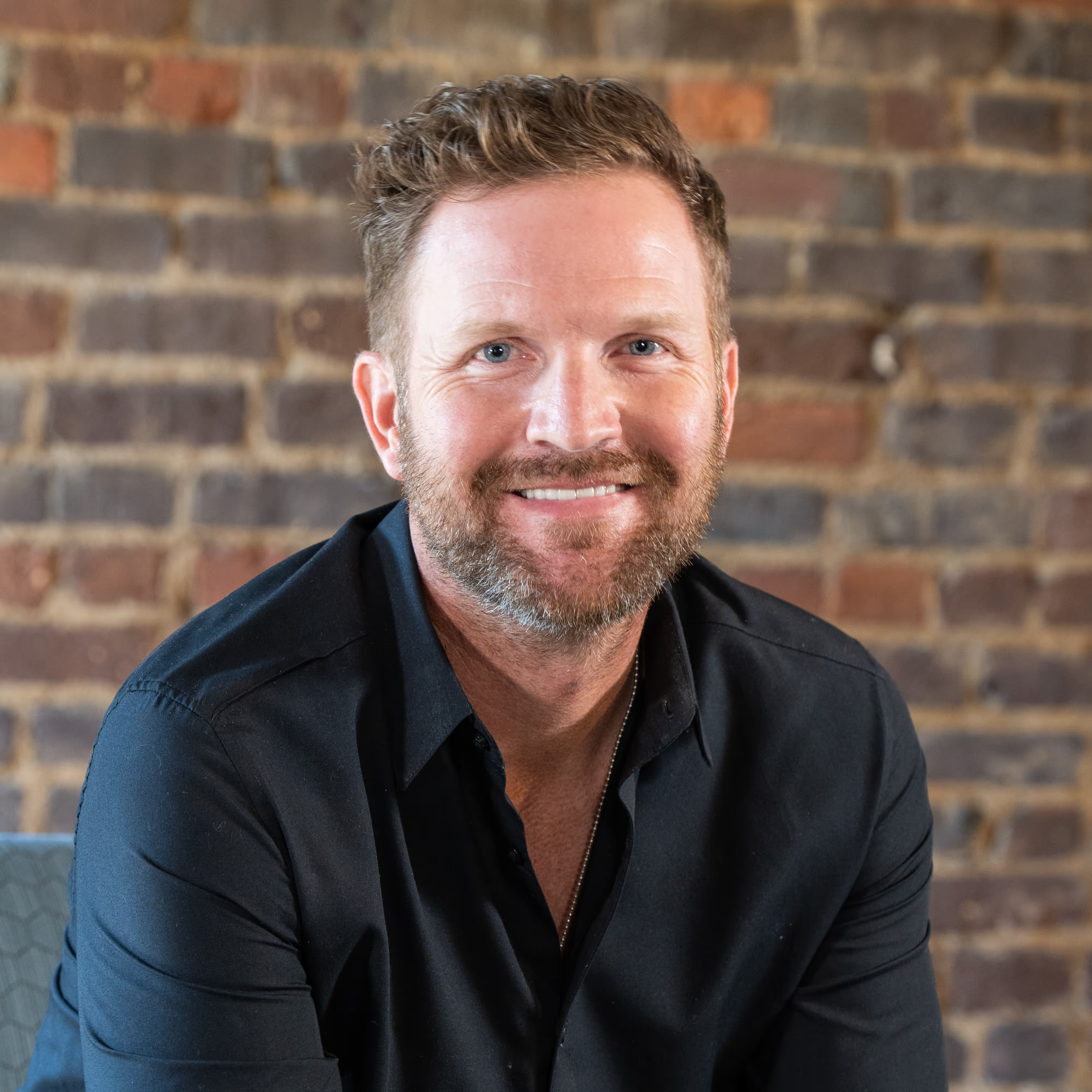
Josh Crisp is a senior living executive with more than 15 years of experience in development, construction, and management of senior living communities across the southeast.
Learn More ▶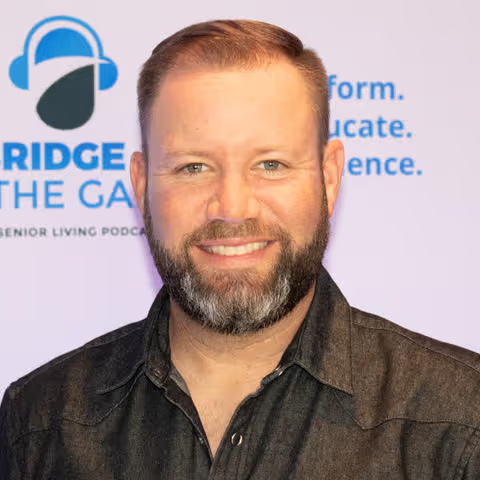
Lucas McCurdy is the founder of The Bridge Group Construction based in Dallas, Texas. Widely known as “The Senior Living Fan”.
Learn More ▶
You don't need to take private equity out. You need to bring the public company dollars back.
On this episode of Bridge the Gap, hosts Josh and Lucas sit down with Bobby Guy to unpack the massive changes happening across senior living, healthcare investing, and capital markets. Bobby shares why senior housing M&A activity is reaching record levels, how demographic shifts are reshaping the future of senior care, and why the industry desperately needs innovation aimed at the middle market, not just luxury communities. Bobby argues that healthcare innovation requires new access to capital and explains why bringing more public companies into healthcare could transform the industry’s future.
Key Ideas:
Meet the Hosts:
Connect with Our Guest
Learn More about the Polsinelli
Produced by Grit and Gravel Marketing.
Become a sponsor of Bridge the Gap.








00:53 - 05:32
Lucas MCCurdy
Bridge the Gap. Three two welcome to Bridge the Gap podcast, the senior Living podcast with Josh and Lucas. We've got a great guest, returning guest, great friend Bobby Guy from Polsinelli. Welcome to the show.
Bobby Guy
Thank you guys. Great to be here.
Lucas McCurdy
Yes. It's so good to see you. You're a great friend to us. Great supporter of our podcast and also one of the biggest deal attorneys in the industry. So we are privileged to have Bobby Guy here. Not only that, he's a man of many talents. As people know. He's he rips on the guitar. I mean, I'm talking rips on the guitar. And he's also got a great wife. I mean, when I grow up, I want to be Bobby Guy. The guy. He is the guy.
Bobby Guy
I'm so flattered. I don't even know what to say, so thank you.
Lucas McCurdy
Well, we’re sincere. Okay, now back to the meat and potatoes here. We're going to be talking about M&A. We're going to talk about different capital markets a bunch of different topics. Bobby bring us into the fold. What is going on right now?
Bobby Guy
I'll tell you that what we've been seeing in the market is there's been massive M&A like for the last year 18 months or so. And and what we watched fifth call it 10 to 12 years ago was a lot of the large players disaggregated. Right. And so you would see okay we did the Golden Living spinoff. We did the kindred spinoff. And it was all about those large national players spinning off to regionals and locals because they thought there was too much scrutiny at the national level.
Now you're actually seeing it reverse. It's coming back around. And so you're seeing lots of those companies beginning to aggregate back up. You're seeing more people wanting to come potentially to the public markets. And so it's really interesting to see that change come around. And I would say that a lot of what drove it before was sort of the ability to drive the to handle the regulatory process and investigations and everything else.
Now, I think there's more of a sense that, for example, at the large side of the market for taking down portfolios you've got inside and you've got PACs and and you don't have other public companies, you have Brookdale. But Brookdale isn't really playing in the sniff space, for example, that much. And so there are not many public companies in senior and in sniff.
And so what's happened is especially in skilled nursing, you're watching you need more public companies to take down big deals. They're getting PACs and insider getting their pick of all the deals. Right. Which is great. But but there is capacity for people to grow their businesses in aggregate.
Josh Crisp
So, Bobby, one of my questions is, as you mentioned this, it seems like this cycle started 18 months ago, maybe two years ago. Whatever. I'm just curious, how long do you think that's going to continue? It seems like, you know, everybody's been talking about, okay, it's the legacy product. It's undervalued assets. It's but at some point, you know, there's not been a whole lot of new assets being created for since 2020. And it doesn't look like that's changing really soon as far as moving the needle on that. So how much longer can this be the play of just acquisitions?
Bobby Guy
Yeah, I think that this probably plays really well for Lucas in doing a lot of of renos. Right. I think there's a lot of product out there that will continue to have to change hands, because we have not done the building. And if you look past the sniff market and you look at like look at assisted in memory and independent, we've really built for the wealthier side of the market.
There is not much in the affordable. And by affordable I don't mean section eight. I mean like middle class senior housing to meet that need. And so we've got a big building boom that we need ahead. But but until that happens and until people see the incentive to make that happen, this really I think stays in M&A market. And I think there's a lot of opportunity to retro those buildings forward as we're seeing.
Josh Crisp
So to elaborate a little bit on that, you mentioned the word incentive because you know I think it it's going to take some level of incentive to get people to target not the top 15% of the market, but to and there's middle market is such a huge space.
I mean, that is a huge space. So even to tap into, you know, 15% more of that top end of that market, that would be a huge, large capture that we could go after. When you say incentive, what do you mean by that? Like what do you think it's going to take to incentivize people to do that?
Bobby Guy
Steve Munro talks about how and Bob from the NIC talks about how it's a thin demographic when you look at the wave coming through.
05:32 - 08:28
Bobby Guy
And so when you think about the demographic and, and what will happen, it's the wealthier people are, the healthier they are, therefore the later they go into senior housing. And so that means the wave can be huge, but you're not going to have this massive demographic to come through the higher end facilities. From an incentive perspective, what happens is you need and I'll go to a point on this in a second, but you need something to like.
Tax credits have always been one of the ways that you do this. But the problem with tax credits is this is something that is the province of a very small cadre of people who sort of live in the corner, and it's their their market on this. And one of the things the administration did in 2017 or so and has done again, is tried to create opportunities out, for example, and which is basically a broader tax credit market.
One of the things that the industry should be thinking about pushing for is a way to basically make tax credits available on a broader basis, not the province of a small sector of the industry, and then go in and build for that. The other thing that I was going to mention is this we continue to sort of sit around and wait for the government to give us solutions on health care.
We fight about our rates every year and everything else. What we need to be doing, not just in senior and skilled, but also across health care is. And this is a question I ask all the time, how do we use the business of health care to change health care, rather than waiting for the government to do right? There's a lot of private pay and health care to definitely changing there.
On the government pay side, remember that the government, while people follow the government from a payer perspective, the government is looking for experiments, right? America is the petri dish with all of the states to come up with ways to save costs. And so as you can do that in smaller sectors, and you can do it in private pay and everything else, if you can come up with a better model, they will adopt it. Yeah, right. And we have to drive that
Josh Crisp
I love that I would agree with that. So then we talk about okay well how does that happen. It seems like right now if ever, at least in my 20 years of senior living, is probably the best time to try that because of the demographic and and how much of the wealth that that demographic owns.
Right. So the opportunity seems to be there, but it seems like, you know, when you come to events like we're at right now and you talk to the capital providers and it seems like the underwriting model hasn't changed a lot, right? It's still extremely conservative. So, I mean, in your infinite wisdom and here like what what did wisdom what is it going to take to actually make make those deals happen?
08:28 - 11:07
Josh Crisp
Because somebody's going to have to go out there and take the risk to try to prove those models right.
Bobby Guy
And I think we're seeing that more and more, but we're seeing it at the periphery rather than seeing it in the in the center. And I'll tell you that regardless of your politics from a deal perspective, I have an antitrust partner who says this is the best time that has ever existed to do to to do deals, because the FTC is all in favor of approving deal after deal after deal.
So this is a great time for it. And and you've got to find the capital. Right. But there is if you can can figure out how to put it together and you can build a better mousetrap. The opportunity is wide open.
Lucas McCurdy
Can you give us some examples of some deals that you've recently been a part of? Some big ones. Some small ones, whatever.
Bobby Guy
Yeah. Last year we did the biggest skilled deal in the country unannounced was management buyout. Yesterday we closed the Bright Spring Sevita deal, which is a $900 million public company deal. And notice that's a behavioral deal, right. And I'll get to this in a little bit if you guys will ask me about it. Right? But it's about the integration of other sectors and how healthcare is integrating. And so what Bright Spring Sevita IDD, behavioral. So a really large one we did we did the Kingston deal last year. Right, which is a large assisted and and independent memory. And so we've seen a lot of these deals going on. We've got and we're watching to as other deals are happening.
Right. You've got you've got pharmacy deal opportunities. You've got massive deals across the space that are in other sectors of healthcare that relate to senior. And that's one of the most interesting things that I've seen is if you look over time, one of the one of the interesting pieces has been there are lots of business opportunities, not necessarily in senior living, but in a Jason spaces that serve it like telemedicine to nursing homes, telemedicine to assisted living.
Right. You know, the medical directors for facilities placing that. So we've really seen that staffing. There's been a rehab has has gone through a whole change of it used to be the dichotomy of you can do it in-house or you can do have you can contract it to somebody. And now we've got players who basically say, hey, will be your independent contractor, but you can have the number and make all the money on it.
11:07 - 17:01
Bobby Guy
You're just going to pass a fee. So the market's changing well.
Josh Crisp
And that's that's a play on what I was going to kind of ask you. Obviously you've been seeing transaction volume for a lot of years. It seems like everyone here is very excited about the demographic, how that's changing our industry and the opportunities, but also how AI is impacting.
I'm curious, you obviously are in a broad swath of health care type of transactions, and you see that impact and the opportunity, like you said, on senior housing, what are you seeing as the biggest changes for you from transactions relating to all these impacts converging?
Bobby Guy
So two pieces I would say about AI three. One is I think the rush to AI has been overrated, but it used that always happens, right? I mean, the rush to the internet was overrated. Several other things like that. Second, I think the real value of AI is tremendous. It is like while the rush may be overrated, what's going to happen 5 to 10 years from now with AI is huge. And so what we've seen on a transactional basis, we as lawyers are using it all the time, right?
I mean, it's tremendous. But then what happens in healthcare is is a real opportunity to change patient experience and patient care. Because now instead of only having the knowledge in your physicians head trying to figure this out, or having the nurse who's watching your who's watching your vitals right from the nurses station, you have the ability to get these large sets of knowledge that give you immediate expertise in areas that you didn't necessarily understand, and you can find the things that are a little more rare.
You can find the you can find the problem that's developing before it develops. Like, I've got a friend who is basically saying that that his goal is to eliminate sepsis as the killer in hospitals, and he's going after it. And he says, you know, we can do this with the right monitoring and with the right tools, because we'll know immediately when somebody comes in that they're at this risk of sepsis and we'll do all the extra work. Usually they don't figure it out until sepsis is set in. And that's all because of AI. That's AI.
Josh Crisp
Wow. Lucas, is your mind blown yet?
Lucas McCurdy
Always always always always. So let's talk about the future. So 2026 what we're in Q1 or Q2 here coming out. You know, do you see this is a record for M&A this year.
Bobby Guy
Yeah yeah last meeting last year was a record right I think you'll see another year as a record. One of the problems we have right now and is that you've got uncertainty, right. We've had it regardless of your politics yet we've had it around tariffs. We've now got a war in Iran. We've got well prices. But change always creates winners and losers.
And that creates opportunity in all of this. And so there's massive opportunity. And I'm watching lots of the call it regional smaller and regional players. Adding five adding ten adding 20. And so there's a real opportunity to grow in this through it. I'll tell you the other thing that I mentioned public companies before, right. One of the things that we don't realize when it comes to capital, you guys have seen sort of the war on private equity in healthcare, right?
That's been going on for a few years. There are lots of studies that say we need private equity to report, like public companies and everything else. This is actually it is a symptom of something completely different that nobody's talking about. What happened is in 2001 and 2002, after the Enron scandal, Congress passed a law called Sarbanes-Oxley. And what Sarbanes did was make it very hard to go public and then very expensive to stay public and put a lot of risk on the individuals that the company who run the companies, basically, and certifying all the financials and everything else.
So if you look from 2002 until now, we've created about 3000 public companies in the US. If you look at 20 years prior to that, we created 7000 public companies. In that time, we're not creating public companies anymore. And so there are only four types of equity in the world to fund companies and fund acquisition innovation. You've got public equity with the public markets like the New York Stock Exchange, the Nasdaq.
You've got private equity, right, which can be your wallet. My wallet. Right. It can be private equity fund. It can be venture. You've got government equity which is taxpayer dollars. And you have nonprofit equity which is charitable giving. All right. So we took we took public market equity out of the equation in 2002. Basically not much happening there, especially in health care.
And then now the argument is we got to take private equity out of the equation. Well, you only then have government equity and nonprofit equity. But healthcare is a massive innovation space and one of the most inefficient spaces in the world. You don't need to take private equity out. You need to bring the public company dollars back. What happened?
We're all living in the shadow of Sarbanes-Oxley, and anybody who wasn't practicing law or working in in public markets before 2002 doesn't know that this is all sort of a result. This is this is we're living in the shadow of it. And so what I would say is Congress intended to protect the public from fraudulent and bad investments.
What it did was protect the public from all investments. And so when you think about it like, how many times have you heard in the last 15 years, there is so much capital waiting on the sidelines, waiting to be deployed? Okay. That's why because those companies aren't going public. And so people don't. That capital doesn't have the public companies to invest in.
17:01 - 21:39
Unknown
And everybody's fighting over the private companies. Right. And so this is a lot of kind of what's going on. And this is why so much of the stock market is concentrated in seven companies
Josh Crisp
I've never heard of. Explain like I haven't either. You did an excellent job at dumbing that down for for me for sure. So that makes perfect sense.
Now if if we're going to change that, that's legislative change though, right. Change is any maybe it's maybe it's just an executive order now. Maybe maybe. But to that extent you look at our organizations in the health care. Our member organizations, our lobbying organizations, are there any that you're aware of that have this as a focus right now?
I have not seen. So it's not a talking point. So it's something, you know, Lucas, I'm sitting here like right now. Bridge the gap. Absolutely. We need to bridge the gap. Bobby, I'm so glad you bring this up. And also, honestly, you bring it up in a way that it's easy to understand. I mean, that makes perfect sense.
So our listeners out there, this needs to be a conversation that continues. And we need to be bringing it to our member organizations because, you know, ultimately to get those kind of changes made, oftentimes it's a very loud, united voice in Washington.
Public markets, too, are a public good for all of us. And the reason is because the general public, regardless of your wealth, has the opportunity to invest in companies as they're growing, not just when they are sort of at the end of their cycle of growth, when they are large caps.
Right. But when they're growing up, we don't make small and mid caps very much anymore. In addition, very a great thing because it creates massive amounts of money for innovation and for change and incentives to do that. And so what I say to this all the time is don't fight public private equity and say, get private equity out of health care, bring back the public companies and say, hey, let the best dollar win, right, and the best dollars will win in that.
And sometimes it'll be private equity and sometimes it'll be public companies. But what Congress is clamoring for in all the states is we want public reporting again. And so we're going to try to impose that on private equity. Well, if you want public reporting, create the public companies. Right. So and it's ripe for it because Wall Street would love it. The administration would probably love it. Health care could use that capital. The public needs more companies to invest in. So it's a it's a huge opportunity.
Josh Crisp
Well, and it's probably something that should have happened a long time ago. But again, the timing seems perfect. Everybody's talking about the challenges and the opportunities of the demographic, the underserved markets, the not enough beds, not enough team members. So it's the time for innovation to change things.
Lucas McCurdy
Yeah, well, it's a great conversation. So as we round this out and Bobby, you got a big deal maker thing coming up here in Dallas right here.
Bobby guy
Dealmakers conference in Dallas. It is Polsinelli is flagship health care conference. And I have the the I don't know if it's the honor or the or the the burden of cheering. It's but it's a great joy. And so it's cultivated audience of 250 to 300 people who are health care companies, life sciences and private equity and family offices. And and so we are we're in Dallas at the Virgin Hotel May 13th and 14th this year. Really exciting. Hoping you guys will come and and interview some guests because again, it's all across healthcare. This is all the other sectors. And where health care is going is it's integrating. It has to. You can't be this inefficient. You can't live in silos because care happens with coordination, integration.
Josh Crisp
That's bridging the gap in that show.
Lucas McCurdy
Very well done. And you know, I know our audience are going to want to connect with you. And one of the ways to do that is you have your own podcast. If people like this conversation, you can tune in to Bobby's podcast. Thank you very much.
Bobby Guy
Yeah, the ten-minute Healthbizcast, and we're on all the streaming services and everything. And basically the tagline is exploring ways to make health care better. Love it. And it's great. And you didn't just start that.
Lucas McCurdy
You've been doing that eight plus years.
Bobby Guy
Album 10 will be this year.
Lucas McCurdy
Okay. Very good, very good. Long running. Very good. Okay. Well Bobby, busy day here in Nashville, Tennessee. And we'll get you back to your meetings. So thank you for your time today.
Bobby Guy
Thanks, guys, and thanks for coming to my hometown.
Lucas McCurdy
Yes, absolutely. So to our listeners, we want to hear your thoughts and comments on this conversation. Hit us up on LinkedIn and go to this content and so much more. Thanks for listening to another great episode. Bridge the gap.


