.avif)
NIC MAP is changing the way we make deals. Tune in to hear about the their newest development, Deal Intelligence, from Kyle Gardner
It's going to let two people do the job of ten.
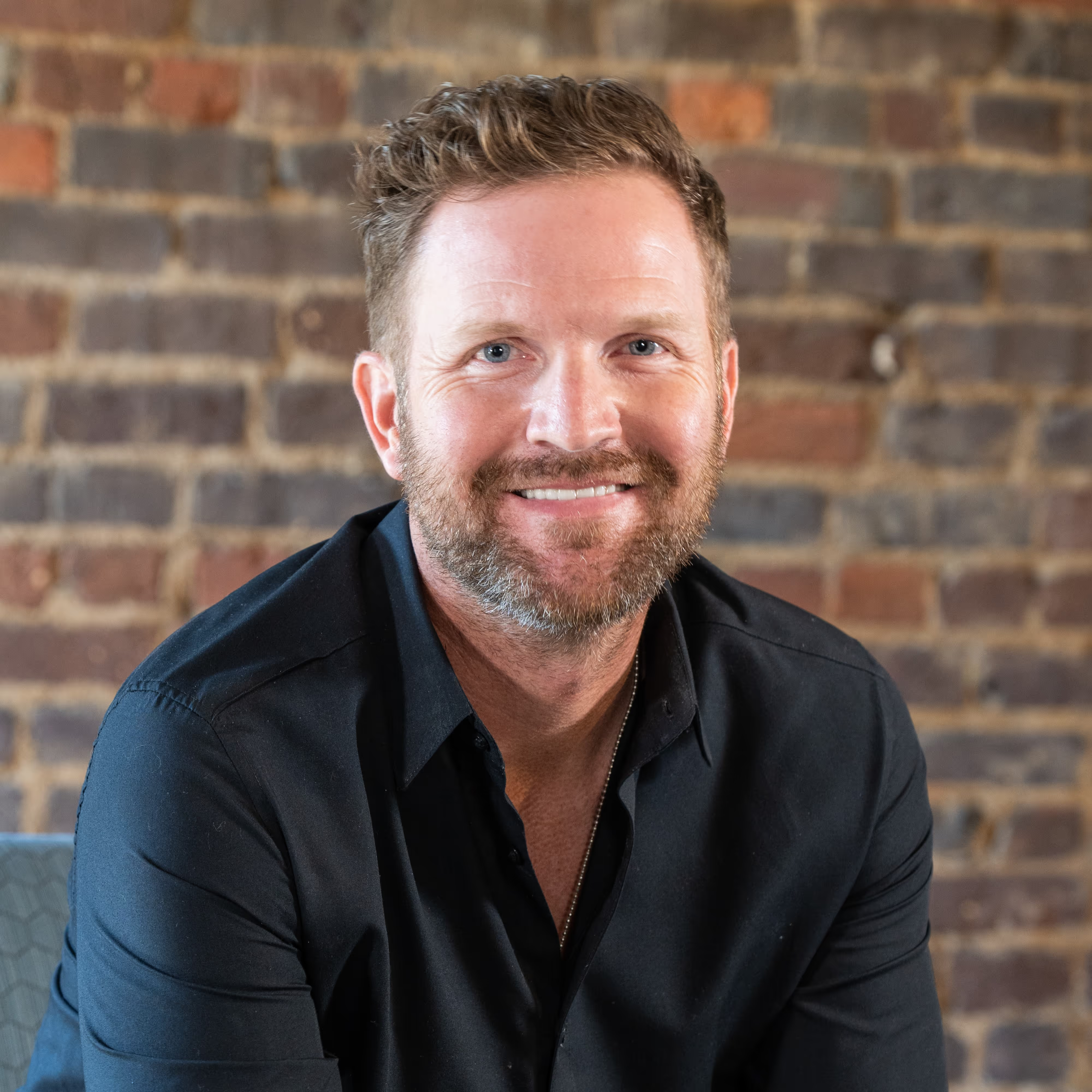
Josh Crisp is a senior living executive with more than 15 years of experience in development, construction, and management of senior living communities across the southeast.
Learn More ▶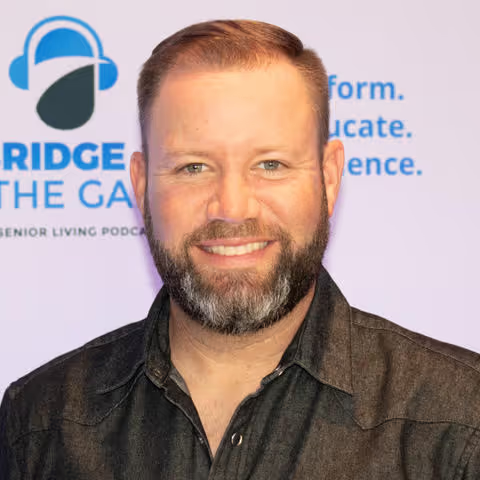
Lucas McCurdy is the founder of The Bridge Group Construction based in Dallas, Texas. Widely known as “The Senior Living Fan”.
Learn More ▶
We see AI as an accelerant for the people, not a replacement for the people.
Josh and Lucas sit down with Kyle Gardner from NIC MAP to discuss the evolution of data-driven decision-making in senior housing and the launch of NIC MAP’s new AI-powered underwriting platform: Deal Intelligence. Kyle shares how institutional investors, private equity firms, and lenders are increasingly entering the senior housing market, fueled by improved access to reliable industry data. The conversation explores how NIC MAP’s 20-year data milestone has transformed capital markets, reduced financing costs, and accelerated confidence in the sector.
Key Ideas
Meet the Hosts:
Connect with Our Guest
Learn More about the NIC MAP
Produced by Grit and Gravel Marketing.
Become a sponsor of Bridge the Gap.







00:49 - 04:56
Lucas McCurdy
Bridge the gap three two. What can the Bridge the Gap podcast. The Senior Living podcast with Josh and Lucas here at Spring. NIC 2026 Nashville. Very excited to get this rolling. Great guest. Kyle, welcome back to the show.
Kyle Gardner
Yeah. Thank you. Thank you. Always good to see you boys.
Lucas McCurdy
Yes. So Kyle Gardner quote NIC MAP. We do these podcasts throughout the year. And it is a it's a great opportunity to dive in to the weeds on data. And y'all also always have some cool announcement which we'll get into in a little bit. But y'all also have a full team here at NIC. And typically I would say per capita, y'all probably have the most meetings as an organization than any other groups here. So that being said, what are the types of conversations that y'all have geared up for to be talking about in spring 2026?
Kyle Gardner
Yeah, absolutely. So we're seeing a lot of interest from new players coming into senior housing, either investment groups or lenders that want to open up their books to have exposure to the space or operators that are spinning up their own portfolio, or maybe just trying to log into growth mode.
And they're asking questions on what's happening in the space, what trends are we seeing? What data do I need to underwrite new acquisitions? What information do I need to help run my my community or my portfolio? And those are the types of conversations were generally having. We're meeting with a ton of customers as well. This is a great way for us to get face time with the industry and just see folks check in on the status of their projects, how portfolio transactions are going, how new developments are proceeding, and things of that nature.
Lucas McCurdy
I've got a follow-up question on this one. So because of y'all's data, we're seeing a huge attention being focused on senior housing. Are you seeing a new type of customer come into your umbrella?
Kyle Gardner
Yes, we're seeing a lot of private equity, a lot of large institutional capital. Want to go headfirst in this space. They want to have exposure, they want to participate. And they've probably been LPs for a while. And maybe they're taking a GP stance. We're also seeing a lot of banks come back into the market who either haven't had exposure directly to the space in a meaningful way, or they did a couple of years ago, maybe pre-COVID, and they're ready to participate again and they're trying to get up, get a strategy in place, get data set in place to help that.
Josh Crisp
Well, a lot of exciting things going on this year and at this event for you guys. One is a huge milestone for data celebrating 20 years of gathering data for our industry. Kyle, a big party. What are we doing here at NIC spring to celebrate that milestone?
Kyle Gardner
We're doing a few things. One, we're taking an opportunity to say thank you to our partners. Thank you to operators. Thank you to everyone who's been in the NIC MAPs story for the last 20 years. And just really take a moment to admire what we've all created together at the same time. NIC MAPs wanting to give back to our customers, give back to the industry. So what we're doing is bringing new markets to the table.
So when NIC MAP started 20 years ago, we launched with 31 primary markets. At the end of April, we will be at a total of 214 markets. So we're growing from 31 to 90 9 to 140. Now we're going to be at 214 markets come April. It's an exciting time at that coverage. We'll have about 85% of the entire population of the US covered and represented, which about represents the senior housing supply as well.
04:56 - 9:36
Lucas McCurdy
I mean, that's huge. I mean, 20 years think of all the information and the data that you all have curated over that time and continue to curate today. So it's obvious the impact that that's going to have on our industry and the end user. But from a macro perspective, how do you think that that has? What effect has that had on your customer base to be able to have access to that level of information?
Kyle Gardner
The biggest impact is in valuation. In cap rates, we've seen a drop of the required rate of return from investors come down over the last 20 years. You know, before NIC MAP existed, there was very little, if any, institutional capital in this industry. Now we've got major Wall Street banks, you've got major private equity firms, you've got specialty lenders.
Every form of a financier is in this industry at this point. And that's brought the cost of capital down dramatically for small operators and large operators alike. That's the biggest thing because as that cost comes down, it allows us to build more product. It allows us to take care of more seniors. It allows us to take care of more older adults.
It's just a good thing. The other thing it's done is add confidence in the way that these teams operate, in the way that these teams make decisions because they know they have reliable, third party, trusted data to go through their day to day.
Josh Crisp
Well, another huge announcement for you guys here. And it's actually, I believe, a new product. And it's called Deal Intelligence. So tell me about that.
Kyle Gardner
Yeah. So NIC MAP has been known as the tool to help with site selection and market research for the longest time. And our data has always been used in underwriting packages, investment committee briefs in market studies or feasibility studies. And we've realized with the data we have, with the experience on our team, a mix of operators, investors, brokers, developers, and with new technologies that we've built over the last few years, we could take our product from providing data to providing answers.
And so deal intelligence helps you screen and underwrite deals in a few minutes by just uploading a rent roll in an income statement, and you get three outputs from that. You get 80 to 90 page full deal evaluation that shows you every aspect of the deal, every aspect of the market. You get a 20 page investment committee brief, something you could share with your leadership team, something you could take to the investment committee themselves.
And you get a fully dynamic pro forma and underwriting model based in Excel. And so you upload two files, you answer 2 or 3 quick questions just to confirm the systems. Reading them right. You hit go, you get a cup of coffee and you come back in that deal screened. It's not going to replace the analyst team. It's not going to replace the investment function.
It's going to let two people do the do the job of ten. And so you should be able to respond to deals faster. You should be able to figure out what's know almost immediately. So if your team is spread across multiple deals and having to respond to low deadlines immediately, you have that tool now to support you and get you there.
Josh Crisp
I was just telling Kyle before this when I was reading through some of the the the talking points around that, it's I think it's going to be game changer for those that are in this fast paced environment where transactions you can't wait, but you have to still be accurate. And so how do you do that? And I think it's a great tool. So I can't wait to preview it myself. I know some of your existing customers are already playing with that tool, and I look forward to the the impact that that's going to have on our industry.
Kyle Gardner
Yeah, we're getting some really good feedback on it so far. It's in pilot mode with about 30 organizations. We're having operators tell us they're going to screen every deal that comes across their desk with it, because they've been mandated to bid on everything in the market.
A lot of the the 50 building operators, they're in growth mode. But even at that scale, they might only have two people, maybe three in the investment cycle. And a lot of those 2 to 3 people are wearing other hats. And that's hard to compete with versus a team of 20 data scientists or something of that nature. And if you go down to a 5 or 10 building operator who wants to grow, the CFO might be doing that themselves.
And so this is meant to equip them with tools to move faster, to trust the third party, or to have trusted third party data to have a an industry specific perspective on what it means to underwrite and scroll and screen and acquisition. But the human still keeps the judgment. We're not going to take the decision making over. We're not going to execute that deal for you.
09:36 - 13:36
Kyle Gardner
We're going to tee you up to move faster and move successfully.
Lucas McCurdy
Well, it sounds like this perfect balance I hear in these conversations a lot of speed to market. And when you balance that out with efficiency, then you got a really good recipe there. And I imagine the more people that start to use this function and give NIC MAP that feedback, imagine the tool just gets better and better over time, correct?
Kyle Gardner
We hope so. We hope so. You know, we spend a lot of time listening to customers meeting with them. This product has been in development for about a year and a half. And we've we've kind of been slowly rolling it out to make sure that it is right. Because to your point, people are making 30, 40, $50 million investment decisions.
You can't mess that up, right? You can't mess that up. The the the reward is incredible, but the risk is high. And so we wanted to make sure that when this came to market as it is now, it was ready for prime time. And all the feedback we've been getting is that it is.
Josh Crisp
So Kyle, I would love to know your opinion on this. And just some of our, you know, offered cord conversations. I hear you and Lucas geeking out about AI and things like that that, you know, candidly, I feel like there's a lot of apprehensive around that topic, just AI in general and how it's being implemented or will be implemented and what organizations are doing. Where do you see that collaboration between your data and this new tool and the actual human element? Where does that collaboration? How does that hand off between the human element and the platform?
Kyle Gardner
We believe fundamentally you have to have the analyst or the human in the loop, and they need to control the process, but they don't necessarily need to do every task in the process. And for a long time, we've been building Excel models that are, you know, doing addition and subtraction, and they've been model doing scenario analysis and things of that nature.
And that helped the person who knew the financial concepts, who knew the the market fundamentals, who was boots on the ground doing tours and site visits, helping them to get more work done faster. And AI is just the next iteration of that. But it can. It can read, it can think, it can see, and it can process multiple problems at one time. And so we see it being an accelerant for the for the people, not a replacement for the people.
Josh Crisp
And potentially more accurate if I'm if I'm understanding potentially a little bit more accurate
Kyle Gardner
I would call it more consistent. Okay. Like any program we can set it up to, you know, follow the same prompts, follow the same rules every single time. And because AI has a generative aspect to it, if it sees something that's odd, it can flag that and tell you about it, and then you can give it instructions to go back and change it, or to proceed as, as it would of otherwise. The accuracy, I think, comes from the underlying data. So the way deal intelligence works, the user uploads an income statement in a rent roll for their target property, and then NIC MAP views that property goes into our data set, pulls all the relevant market comps the construction, the supply, the transactions rate and occupancy, financial information that we have in our data set, and starts building a full profile of the deal. And then it runs through 3 to 400 steps in the background. These are all, you know, questions and analysts would have to answer or probably has been answering themselves. But now it's just being done for you in the background. So you know I think it'll be highly accurate. The feedback we've got it is. But I want you know, I've got to stress it's still it's still a software. It's still an AI. So we need that. We need that human in the loop to do the final step.
Josh Crisp
So dumbing this down a little bit more for me. So if I am looking at a potential acquisition I have access and under NDA for the data rooms, I pull out those documents and literally upload them into the system and it will spit out the analytics.
13:36 - 17:16
Josh Crisp
Is that what you're saying? It's that easy?
Kyle Gardner
Yeah, it's about five 5 to 10 minute process total. And I'm going to get the same level of data resources that I might have spent potentially maybe days or weeks. Well, I was about to save for for our team or small probably would take us weeks. And nowadays it feels like I as an operator, as someone that's looking into active and getting crunched, I'm getting pressured to get that information faster to these brokers because more and more people are using these tools. So I think it's almost would you say this is going to be a necessity moving forward?
Kyle Gardner
I'd like to think it changes the way that stakeholders view the acquisition market where most people have. I think we were chatting before. Most people have like a matrix of like things. I will absolutely do things I might do, things I won't do, areas in the country I'll go and won't go and products I can avoid.
And you can kind of answer those questions from the on just flipping through the pages. But once you pass the test on, I might do this or I will do this, and you need to get into the meat and potatoes of it. Now you're spending serious human time, serious intellectual time, maybe spending money on a on a project or a feasibility study to get some answers.
Our hope is that deal intelligence can answer as much of that for you as possible. In those first 5 to 10 minutes, while you're still flipping through the Om. So that way, when you are ready to move forward, you've already got a foundation that's really strong, that's rooted in data, that's rooted in in truth, in a way that you can move forward and feel good about.
Josh Crisp
Well, let me ask you this. So you I feel like your team there at NIC MAP. Kyle, are always a few steps ahead, not only on what you're rolling out, but you always have to be a lot of steps ahead on where you see the industry going and kind of leading the industry there. If you're already rolling out this and your operators are already testing it, can you give us any insight to in your mind where the future of deal screening is going?
I mean, is it going beyond this? I mean, I feel like this is a huge advancement if we can do this, but is there things beyond that that you're already saying we should be ready for or we should be gravitating to?
Kyle Gardner
We have a few that we're working on and kind of the lab setting, obviously right now, the last few years, it's been an acquisition-only environment. Everything's trading below replacement cost, development, construction costs have been nuts, but we as an industry know development is needed desperately now even. But certainly in the next few years, as the market starts to stabilize and maybe allow for that a little bit more banks come back to the table. Maybe costs flatten instead of keep driving driving up. Maybe we get a reasonable interest rate environment that's not totally chaotic.
So we want to do for deal intelligence what deal intelligence does for acquisitions. We want to do that in development. We want to help that process, site selection, the underwrite. We also want to do that for the operations team, the asset management team. You know, your crew at an operator, your VP of ops or your VP of asset management at a private equity fund.
They have to look at so many different challenges clinical staffing, labor. They're looking at people problems across maybe even more data sets that don't talk to each other. So how can we help solve that problem where we have a lot of the data that they need to benchmark against? We have a lot of the industry know how within our team, and so how can we bring some reports.
17:16 -
Kyle Gardner
So there's a few things that we're cooking up for those use cases. And we'll be rolling those out probably over the next several quarters.
Josh Crisp
Curious here. And if you'll give me the privilege just to jump off topic just for a minute. Sure. But on your R&D, right, you guys are obviously doing a lot of that. Do you get most of those the direction or or the inside or what you want to work on direct from feedback from the operators or these more things that you're seeing happening that are factors like greater, like economic factors, like global economic factors that are you forecast are going to be emerging or happening to our industry that we need to be prepared for. How do you find, like and and determine what you're going to work on and bring to market?
Kyle Gardner
For us, it's a bit of both. And you and when I say that you have you have to act actively, do both. You have to be with the customer. You have to listen to where the pain is. You have to listen to. If this fundamentally changed, what does that impact your business or what impact to your business does that bring? If this problem was no longer problem, what resources would be available to you to go elsewhere and what would you want to do? And then on from kind of the top down standpoint, we look across all kind of commercial real estate tech or proptech as it's sometimes called, and we see what are the trends in multifamily, in commercial and industrial that are maybe larger markets and larger players, but oddly, maybe fewer purchase points.
And so they have just the same type of underwriting problems, asset management needs. What are the tools being built over there? What are the the solutions look like and how do we adapt that to senior housing, which is five six businesses in one and make it useful. So NIC MAP is not going to do everything. We experiment with a lot. A lot of them fail, but that's the point. It's the lab. So we have fun with that.
Lucas McCrudy
You know Josh there's so many takeaways and thoughts that come to mind around this topic of, you know, data driven decision making. Kyle, could you help summarize up maybe a key takeaway around the conversation for our listeners?
Kyle Gardner
Everyone in the modern world is using data on a day to day basis, whether they're proactively thinking about it or not. You're getting stats from your CRM, you're getting text messages from your assistant, you're trading notes on rate and occupancy here at the conference on stage. You're you're hearing about new trends and transactions, things of that nature. But to be proactive about it, to to know what's important to you in your profession, what's important to your business in terms of valuation and growth, and to be intentional about curating those data points to support you, your team, and your customers takes a lot of energy and a lot of work.
And so and NIC MAP, we really pride ourselves on being senior housing only and senior housing focused and bringing a curated perspective for the operators, the investors, the lenders who want to be intentional, who want to commit to this space for the long term. And we're here as a guide and a consultant to help them be successful in that way.
Josh Crisp
Lucas, somewhat of a full circle moment I'm having here. You know, nine years ago, roughly, we started the podcast. I think one of our first events was at NIC. Now we're with NIC MAP Data and our listeners, even though I think this is maybe the largest attendance spring, NIC, in history, perhaps is what we're hearing. There's still thousands that couldn't attend because they're at their communities, but because Kyle is willing to come on a great partnership with NIC MAP, we're able to actually provide this information to him and they can directly connect with these guys.
Kyle, what is the best way for that developer, that and potential investor that operator that wants to connect with you guys. How's the best way to do that?
Kyle Gardner
Two easy ways, NIC. There's a button at the top that says, talk to a product expert or set up a consultation. We'd love to talk to you there. You can ping us on LinkedIn at NIC MAP, and we'll get connected and hear about what your story is, what your needs are, and if there's something we can do to help. I would love the opportunity to do it.
Lucas McCurdy
All right. For those of you out there that want to connect, go to the Show Notes or btgvoice.com connect with Kyle, NIC, MAP and all the content that we have for you there. Thanks for listening to another great episode of Bridge the Gap.


