.jpg)
The Middle Market is here, but do they have a place to stay? Find out from Will Childs as he sits down with Lucas to share his thoughts.
I think it's always operator, operator, operator.
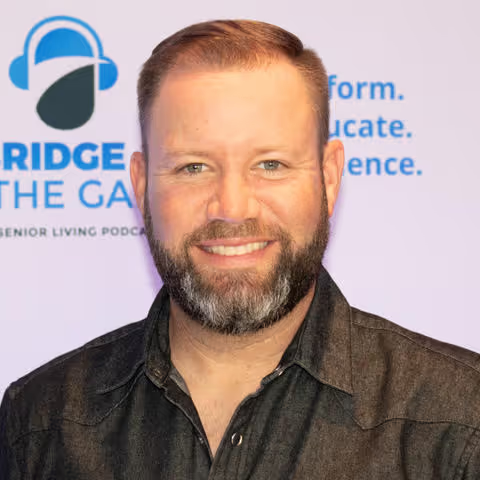
Lucas McCurdy is the founder of The Bridge Group Construction based in Dallas, Texas. Widely known as “The Senior Living Fan”.
Learn More ▶
This need for a solution gets bigger and bigger every day as the swell of boomers moves through their 70s and 80s. I just don't know that there is a one-size-fits-all approach.
Senior housing investment is entering a period of renewed activity, particularly in the middle market. In this episode of Bridge the Gap, Lucas sits down with Will Childs of Senior Housing Services to discuss the forces shaping senior housing transactions, including demographics, capital markets, interest rates, operator performance, and the shortage of new development. Childs explains why middle-market assets are attracting buyers, how operational performance and the capital stack influence transactions, and why properties with excess land can offer additional value-creation opportunities. The conversation also explores the growing challenge of serving seniors who fall between Medicaid-level affordability and higher-end private-pay communities.
Topics Covered
The current senior housing investment and transaction environment
How COVID-era occupancy challenges affected middle-market operators
Why pricing for middle-market assets is normalizing
The importance of operator experience in senior housing transactions
Private equity, family office, and smaller investment-group activity
How interest rates may affect cap rates, modeling, and transaction pricing
The impact of senior housing demographics and limited new development
Value creation through excess land and additional senior living units
The growing need for affordable middle-market senior housing
Creative approaches to serving middle-market seniors
Medicaid reimbursement and legislative approaches
Expectations for the senior housing market heading into 2027
Preparing for the NIC conference
When senior housing owners should begin conversations about a potential sale
Meet the Hosts:
Connect with Our Guest
Learn More about Senior Housing Services
https://seniorhousingservices.com/
Produced by Grit and Gravel Marketing.
Become a sponsor of Bridge the Gap.









01:15 - 03:55
Lucas McCurdy
Three two. Welcome to Bridge the Gap Podcast, this senior living podcast with Josh and Lucas. A really special episode. Today we're going to dive into market conditions. There's a lot of transactions taking place, and there's a high end. There's a low end, and there's also a middle market, which is a big topic of conversation in our industry. And I want to welcome a great guest today, a good friend, Will Child from Senior Housing Services. Welcome to the show.
Will Childs
Thanks for having me, and glad to be here. Exciting time in the market, like you said, to really go through what all is happening because it's been a lot. You know, as Lucas said, I'm Will Childs. I work with Senior Housing Services. I'm based in Atlanta. My partner and the founder of our company, Dan Owens, is up in Charlotte.
We focus on senior housing, investment, sales, independent living, assisted living, memory care, nursing homes, mainly geographically focused in the southeast. But we work beyond the region as well. And really, most of our focus is the middle markets. It's a good topic for us to to be discussing today.
Lucas McCurdy
Well, on those conversations in your day-to-day, bring us into the fold on some of those conversations: what are sellers looking to do, and what are buyers' challenges that they're trying to get through?
Will Childs
You know, there's been a lot of hurry-up-and-wait in the market during COVID. As everybody knows, we had a couple of years of low occupancy, a lot of expirations during the pandemic, you know, people not wanting to move into larger facilities. So occupancy across the board took a major hit. A lot of mom-and-pop operators and midsize regionals really struggled to, you know, get margins and cover their debt service.
And there's a lot of distress in the market. Those assets started hitting the market 2 or 3 years ago. And as demand was coming back in and pricing really reflected it, what we're seeing now is exciting. Pricing is kind of normalizing. You know, a lot of these 20, 30-year vintage middle market assets are getting back closer to, you know, not quite at but getting closer to replacement cost.
Not as many fire sale deals out there and opportunities to buy for pennies on the dollar. But, you know, there's still a lot of avenues for value creation for kind of the savvy, disciplined owners that have good operator relationships or are vertically integrated. So those are the deals we're really seeing getting executed. And then a lot of it's just understanding the capital stack. And, you know, looking at a deal from that debt coverage perspective and making sure you've got an operational story that will get you good coverage and get your deal financed.
Lucas McCurdy
And out of that whole entire kind of like circle of influence there. What's the most challenging piece of that? Is it making sure that the investor has a good operator in place, or is it the capital stack? Which is it?
03:55 - 07:48
Will Childs
You know, I think it's always operator, operator, operator. If we take an 80-bed assisted living facility to market, that's, you know, a $15 - $ 20 million asset; there's no one and there's going to be a lot of people wanting to take a crack at it. But, you know, as an investment sales broker, my job is not just to, you know, get it sold, but it's really to find the right buyer with the right operator in place that can actually hit those operations benchmarks that they underwrite.
So just, you know, looking for that operator or having the operator relationship with the experience in your geographic footprint, you know, enough scale to really get negotiation leverage for contracts and insurance and things like that. And then really just has the staffing model dialed in.
Lucas McCurdy
On the buyers' profiles. Are these largely REITs, private equity, family office, smaller people, people from different industries like multifamily or others?
Will Childs
It's really a mixed bag. You know, especially in the Southeast where I operate every day. And in the middle market, a lot of, you know, smaller investment groups in private equity, you know, we're seeing more family office activity and get get a lot of calls every day, either from people who have worked in the operations side, splitting off, taking on their first 1 or 2 communities and looking for the capital and the equity backer, and then the same on the other side, you know, maybe a family office that doesn't know the industry as well and wants to partner up with a, you know, a good seasoned operator that may be looking to grow.
And those are really groups on joy working with just the kind of starting out early with them and watching them grow, you know, had a wave of that over the last 15 years. And getting to know some of the guys that are now, you know, big operators start out small. So a lot lot of that going on to the institutional money we haven't seen as active.
You know, they're mainly holding out for you know, the stabilized class A deals with some scale. There's just not as many of those to go around. And pricing has gotten incredibly competitive. But that middle market and those smaller investment groups are just super active right now.
Lucas McCurdy
Now, as we're starting around the corner into Q4 of 2026, now we're talking about interest rate increases, which is not what I was expecting to be talking about in Q4. How is that affecting the marketplace?
Will Childs
You know, it's going to be interesting. I think maybe, just like you and a lot of people that took me by surprise just watching, you know, I think there's enough demand with the demographic tailwinds that we have going into this next cycle. And senior housing, combined with no real development in senior housing over the last five-plus years, I think we have enough of a tailwind in the industry to survive 25, 50 basis points without any material change to pricing, but at some point, you know, it does get baked into your cap rates, your modeling, to reflect your cost of capital, and hopefully it won't keep moving in
that direction. But as always, the industry will adapt, and it makes for a little cold water on things temporarily. But, you know, I just I've been doing this for 19 years working in senior housing, and I haven't seen all of the factors align. You know, demographics, capital markets, demand in a way to favor that middle market activity like they have this year. So remaining optimistic. And we'll just have to wait and see.
Lucas McCurdy
Now, on that point that you just made, we're having this kind of collision of demographics where there's a lot of eyes on this industry now, and there's no real ground-up development to speak of. Nothing has been meaningfully built for years. And so it makes a big focus on this, you know, existing, especially value-add.
07:48 - 11:36
Lucas McCurdy
Talk to me about the types of properties that have maybe some extra land attached to them. I've been hearing about adding memory care to an existing AL. Are you having those conversations with buyers as well?
Will Childs
All the time. You know, there's always that cohort of capital that just is looking for some kind of value creation. And right now, with interest rates where they are and with construction costs where they are, it's just tough to find markets for new development that will support rents that are high enough to, you know, to cover your costs and get you the yield you need.
So all that, you know, value creation, money, if you will, is flowing into acquisitions. And we're finding more and more often that a lot of these buyers are favoring deals where there's maybe a little operational underperformance. Rents haven't been fully maximized in another really nice one that appeals to the development-oriented groups is the excess land. Like you said, you know, just the ability to add some senior living cottages, villas, stacks or flats around the existing assisted living building and infrastructure.
It's it's a really nice play. It gives you a chance to create that extra value, you know, on the project in addition to just, you know, putting some lipstick on the existing al and improving occupancy rents. But then also from a return side, most of your staff and support operations are already in place. You don't really have any incremental staffing costs, but on the rent side, for the senior cottages, you can charge a, you know, 20, 30% premium over market rents just by having that proximity to the services and maybe weaving in some services.
So it's a it's really been in demand, you know, any way you can add value to a deal that already makes sense and has a pretty clear path to, to upside. And I think it'll continue to be in demand until more of those markets get to a point where they can support new development.
Lucas McCurdy
Talk to our audience. You know, we have a very diverse audience in the industry, and some people are savvy on the marketplace, just like you, Will. And then other people are really head down, focused on operations and may, may not really be following the real estate trends. Middle market is a very specific thing, and it's got a long history of points in time where it was talked about and other points in time. No one talked about it, and it seemed to be kind of this side thing. Talk to us now about the Middle Market. What does that mean, and how important is it in this given period of time?
Will Childs
Yeah. So there's, you know, it's the demographic of seniors that fall between state-paid, you know, Medicaid-level income qualification and the higher-end private pay that we're currently marketing to with most of the high-end new construction senior living properties.
So it's not the bottom 40, 50% of income and demographics or the top 10 to 20%. There's just a large slug of seniors that will be retiring each year that really don't have much of an option. And, you know, people are chipping away at that middle portion of the market from both sides, you know, doing private pay mixed in with Medicaid on the lower end and finding ways to cut costs and making those peer private pay offerings a little more affordable.
We've seen a lot of creative solutions. I don't think anyone quite yet has the silver bullet. Construction costs are still expensive. Labor, you know, is high, and I don't think it's going anywhere. But, you know, people are always looking for ways to chip away at that middle market that's not fully served yet. You know, just had a conversation with a group yesterday who's acquiring hotels, you know, that have gone under, and they can acquire for pennies on the dollar and just have an affordable independent living facility or age-restricted facility where they can offer rents closer to $2,000 a month.
11:36 - 14:34
Will Childs
That really focuses on that middle market; in some cases, buying an old distressed assisted living asset at a low basis can make sense to repurpose for lower acuity, but see people skinning it from a lot of ways. But it's a true concern and growth area of the market.
Lucas McCurdy
It's something that's such a big deal. To your point, with that and the demand for demographics, I think that there's going to have to be some better solution long term, and what that's going to look like, I candidly don't know myself, and I wouldn't put you on the spot to tell us your crystal ball as well. But middle market is a very important place, and it covers so many people in the industry. There's got to be some solution on the horizon as we move forward in the next five, ten plus years in this marketplace. I mean, any any thoughts or conversation there.
Will Childs
I've been doing senior housing for 19 years, and the industry collectively has been having this conversation, and it's still really just a patchwork. You know, you have some states that are wising up to it, like, I'm here in Wilmington, North Carolina today and just attended a conference here. You know, they just had a 20% increase in their personal care service reimbursement for Medicaid. And they also earlier this year expanded access to Medicaid and their qualifying criteria for assisted living. So, you know, that chipped away at the middle market through legislative action. I think, you know, private sector actions, people are skinning it from a lot of different ways.
You know, in like two, three years ago when assets were really distressed, and you could get huge discounts on deals, it made sense to turn around and repurpose for $2,000 a month senior housing rents. You know, as distressed facility pricing goes up, that's not as much an option anymore. We were just talking about interest rate increases. You know, I think that's going to just add more pressure to price out the new construction for middle market.
It's just a growing concern. You know, this need for a solution gets bigger and bigger every day as the swell of boomers moves through their 70s and 80s. I just don't know that there is a one-size-fits-all approach absent massive government intervention or subsidy or, you know, some other kind of supportive action.
Lucas McCurdy
And that's scary just to say that out loud, right?
Will Childs
Yeah, it really is. And, you know, I have several relatives that come to mind with that exact profile. And, you know, I think it's something we all need to work towards and lobby for and, you know, chip away at as an industry and as stakeholders in the senior housing sector.
Lucas McCurdy
So we're coming into Fall NIC, which is guaranteed to be well attended, probably will set a record for attendance.
14:34 -
Lucas McCurdy
What are you anticipating the conversations largely kind of focused on as we're coming into the end of the year and already looking at 2027?
Will Childs
Really excited to get up there to Chicago. You know, we're on a conference circuit. My partner Dan and I currently have five conferences leading up to Nick around the Southeast. And overall the mood's just been very optimistic. You know, upbeat. You know, we had 2 or 3 years in a row where there was a lot more doom and gloom and pessimism about the markets in general and performance of the sector. And now operationally, you know, the macro data on the industry shows we're doing very well across the board. You know, the demographics are behind us, but 10,000 boomers turning 80, I believe, each day going forward.
So, you know, everybody's had a pretty strong year, I think stronger than expected. Most of the outlook for next year is generally positive, and I think people have the creative juices going on, getting deals done and are just eager to make things, just eager to establish footprint, you know, whether through acquisitions, new development in the markets where they want to be so that their position to capture, you know, all this demographic growth, that's the thing would be a very diligent conference.
Probably a lot of conversation about the middle market. Like you just mentioned, it's a perennial topic that you know is always addressed. And then just state of the capital markets, you know, what does that said rate hike mean for the rest of the year? And does that throw cold water on next year's deal activity? And is there a capital markets factor that we may may need to factor in. But looking forward to it. I think it'll be really exciting conversations and good to see everybody
again.
Lucas McCurdy
So kind of rounding out our conversation, what would be your advice to people attending for maybe their first time walking into Fall NIC Conference and thinking like, why am I here, what am I going to do?
Will Childs
Oh gosh, I know you're taking me back to 2007, when I attended my first one and didn't know anything or anybody. You know, it was overwhelming then and you know, it's at least doubled, if not triple in size since then. And it's it's a lot to take in. You know, I usually like to start about a month ahead of the conference and really identify with everything we just discussed and what's going on in the markets. What are my objectives for the conference?
Who do I really want to make sure I see while I'm up there? And then just schedule those meetings and try to keep your, you know, middle-of-the-day time blocks pretty booked up. Being intentional about who you're having conversations with. There's just so many people now that you know, it's no longer a conference where you're just going to bump into the people you'd like to see.
So scheduling these meetings, you know, always a lot of good events in the evenings, you know, where you can get to run into people and hang out more and formally, I mean, some great memories from those. And I think it's important to, to know that circuit and just relaxing and having fun, you know, it's a people business or relationship business, a service business and just enjoying catching up with old faces and meeting new ones and, you know, enjoying all the energy around the business right now.
Lucas McCurdy
Well, I look forward to seeing you there. And this has been a really helpful conversation, and I think a great conversation leading in to many, many meetings that that will have there in Chicago. Any final thoughts or words of advice or encouragement to your middle market sellers
out there?
Will Childs
Yeah. You know, whether it's your time to do it now or you know, you're considering down the road to sell, you know, I think it's important to go ahead and start having those conversations, you know, with your third parties and professionals that you would work with down the road.
In a lot of cases, now is a perfect time for mom-and-pop operators who have been in the business forever and would like to retire and catch it while the market's, you know, on an upswing. It's not the case for everybody. You know, some organizations, maybe you need to put some money into strategic CapEx and, you know, reposition a little bit and drive some more margin before selling.
But, you know, just being mindful of it and keeping a real, real world being on the pulse of where the market currently is because it's exciting, it's hot. You know, in the middle market, pricing is increasing, demand strong. And really a good time to be on either side of the equation.
Lucas McCurdy
Will Childs, thank you so much for your time today and this great conversation. I look forward to seeing you in Chicago.
Will Childs
Absolutely, Lucas. Look forward to it. And thanks for having me on.
Lucas McCurdy
You got it. And to all of our listeners, go to download this content and so much more. Connect with us on LinkedIn. We'd love to hear your thoughts and opinions on this topic as well. Thanks for listening to another great episode of Bridge the Gap.


