.jpg)
The future of senior living is bright, but what are the practical ways you can prepare for the upcoming growth? Find out from Lucas and Cameron.
Senior housing is hiring and everything around it is hiring.
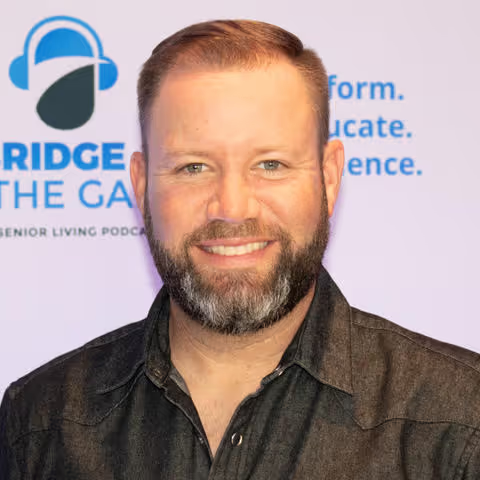
Lucas McCurdy is the founder of The Bridge Group Construction based in Dallas, Texas. Widely known as “The Senior Living Fan”.
Learn More ▶
We are in a very good position to go find talent to come into the space and also bring fresh ideas.
Cameron and Lucas reflect on one of the industry's largest gatherings to date, featuring record attendance, meaningful collaboration, and an inspiring keynote from Damon John. The conversation explores how senior housing continues evolving beyond traditional investment models, with increasing emphasis on strategic partnerships, operational support, data-driven decision-making, and workforce development.
The discussion also addresses why attracting young professionals may become one of senior housing's greatest competitive advantages. Rather than focusing solely on capital, today's industry leaders are finding new ways to support operators.
Key Ideas
Meet the Hosts:
Lucas McCurdy: https://www.linkedin.com/in/lucasmccurdyseniorlivingfan/
Cameron Bell: https://www.linkedin.com/in/cameron-bell-322143147/
Learn More About NHI
Produced by Grit and Gravel Marketing.
Become a sponsor of Bridge the Gap.







01:00 - 05:52
Lucas McCurdy
Bridge the Gap in three two. Welcome to Bridge the Gap podcast, the senior Living podcast with Cameron and Lucas. Today we are in Music City Nashville and we are concluding a awesome NHI Symposium. And there's been so many takeaways. It's been a very fun, successful day.
Cameron Bell
It's been a tremendous day. And thank you for having me. And shout out to Josh Crisp. We miss you. Thanks for letting me sit in your chair. I do not reach his heights of this podcast, but I'm happy to participate and help and excited to unpack our day to day with you. Lucas.
Lucas McCurdy
So about 120 attendees up 25% year over year. Yeah, there's been a lot of new fun changes within hi and your offerings, and you all have talked about those things in the programs and we'll dive into those.
And then we had a fireside chat with Daymond John and the audience just were head over heels in love with with his conversation. He commanded the room and delivered was hilarious and then really connected with your operators and now awesome activities. And we've had some great podcasts
Cameron Bell
We had some great podcasts, and I think, you know, I said it earlier on the stage here when we got started with the day.
It's really cool to see how many operators we have coming to this event. This is our 11th symposium. We had to skip a year during Covid, but yeah, it's our biggest attendance ever and it's so great to see the room grow over time, both from an Nae employee standpoint, also from an operator count standpoint. And the participants from each operator could be growing year in and year out.
And so we're also grateful for you guys to be here. I think it adds to the overall ambiance and event spectacle. So yeah, I think a lot of our operators. Look forward to coming to this event and on our keynote. You know, Daymond John today did a terrific job. You know, he's really world class and connecting with his audience.
And that can be, you know, through the TV shows even today in person. And not that he has a ton of exposure to our industry. He still found a way to connect with the NI operating partners and with us, and I think got people really thinking creatively of how do we tell the truth. That was his whole message.
Today was the fastest and best way to sell your story is to tell the truth. And so that was I think that was really good for the audience to hear and shoot people straight. And, you know, moving a loved one into community is a hard process. And you just got to meet people where they're at, and there's just a terrific, terrific keynote.
And then for NHI kind of where we're heading and what we're doing, you know, Eric mentioned it when he started the day for us. You know, historically speaking we've been mostly triple net lease. We've done loans, development loans as well. And for a long time that was our bread and butter. And we were really good at it. And then with the change in the industry and coming out of the pandemic, I think we demonstrated that we are really good partners and good lenders and landlord.
And, you know, we did some things that, you know, kind of hurt us as a company to some extent, but it was really to help our operators navigate everything they had to. And I think that caught the industry's attention. And so even though we're starting to move into this more shop radio world, and that's something that we're starting to dip our toe into and grow, that we've grown it tremendously in the last 12 months.
A year ago today, we had 15 communities in shop with two operators, and now we're over 40 communities in shop with six operators. And we'll continue to see that grow. But there's still going to be those operators out there that prefer a lease, and we'll still do loans, and hopefully we can start doing some construction again soon and later.
We're actually we've been doing construction the entire time, okay. From Covid. We have an operator that just he's they're really good at finding land. And they've really done a good job on managing their development costs. So we've been working with them and we've done I don't want to say it's quite one a year, but I'd say it's one every 18 to 24 months with this group and so much so, I think it caught the attention of, I forget whatever news publication it was, but they were doing an article about just general construction costs.
And then there was a section about development in our industry because as we said earlier on another podcast, we have the supply demand dilemma. There's a lot of excitement around it, but we've got some work to do. On the other hand. And so this journalist was trying to like peel the onion back on that dilemma, and they reached out to this particular operator that we're working with.
05:52 - 08:52
Cameron Bell
And it's like, how exactly are you championing this and and executing on development in a environment where that's kind of hard to do.
Lucas McCurdy
So on that point, I mean, we're there's a 90,000 unit delta to match demand over the next 20 years, so to speak. And we've mentioned it before. You know, the NIC MAP data shows an $840 billion gap in investment.
And these are, you know, really, really big talking points when you match that up with also the challenges in the labor market, there's some really good challenges and opportunities ahead for operators. And it's really interesting to see the relationship between the right and the landlord and the operator to take those challenges head on.
Cameron Bell
Yeah, I think to that point, you know, I've been at NHI for 15 years now, and so I've seen the portfolio grow over time. And then the needs of our operating partners grows just as the needs of their clients grows. And so how do we differentiate ourselves from other groups in the space. And I think one way we can do that is what we talked about earlier in the session was trying to develop programs intentionally and based upon, you know, actual utilization across our landscape and across our operating platform.
And if we can find ways to be more than a capital partner and to be a true resource, you know, that's something that I find very valuable and something that I will endeavor to do. And it's now kind of my role at the company. And you do that two different ways. One is those vendor partner programs. And then the other way is we receive so much data that we can effectively package it and redeploy it back out to the operators to help them get better.
And so that's also something that brings our team joy, and we're happy to make everybody better to the best that we can. Now it requires participation from them. But you know, I think with how we approach relationship management and how we treat our operating partners, you know, we get good participation when we have to do things like, you know, reporting Covid count numbers on residents and staff.
That was something we had to publish on our website weekly when Covid first started, and it was tough, but the operators were willing to share that information with us, and it was very transparent and informative for our investors, but just the general industry at large. And, you know, we're still having to find different ways to get information out of these groups and the fact that there's still willing to to talk with us and share information with us, I think speaks highly to the team we have here in energy.
08:52 - 11:45
Lucas McCurdy
That's great. Yeah, you can tell just me looking kind of outside in here. The camaraderie, the collaboration between competitors, people sharing industry information to be essentially the tide that rises all boats. I really appreciate that about this industry and always has. And so I think it's been a lot of fun to see that here and what great information. What do you think, looking forward as we round out this year and look to 2027. What do you predict for the next NHI Symposium.
Cameron Bell
So my first prediction will be it'll definitely be in Nashville. Check. And we usually alternate between either this hotel which is the Omni, or the Westin which is closer to the gulch. My second guess is it will probably be at the Westin.
I don't know that for a fact. Sure, sure. But based on our activity level right now, as as a company and all of the interest in this industry and just all the real estate transactions that are occurring, you know, you mentioned earlier, we're up 25% year over year on attendance here. We could probably hit that same mark next year.
So maybe that's another soft assumption here. And two will probably be larger I think. I think we're going to have to go hire some more individuals, just to help us accomplish everything we need to execute well and to share information with our operators. And as a portfolio grows, just you need more human beings to take care of that.
I have no idea who our keynote speaker will be, but I think we have a really good track record of who we've had in the past. So I'm confident in Brittany Spicer and the team. On finding us someone as good as Daymond John. So I very much look forward to that. But I think what has to happen for us between now and then is continue to steward the portfolio well, continue to be good partners.
And then, you know, for me and for the team that I lead, we have to go find additional resources. So next year we can have some more concrete information to share. And then we also have some new people that can meet to continue to expand upon the offerings we have as as capital partners.
Lucas McCurdy
You know, I listen to some tech podcasts and sometimes it can sound a little doom and gloom with the whole AI forecasting and maybe all of that comes true, I don't really know. But one thing that we can say is senior housing is hiring and everything around it is hiring. Yeah, AI is going to help more on efficiency. It's going to help prop up systems and probably a million other things. But what I hear, at least right now, today you're hiring. Senior housing is hiring. They want talented, passionate people.
11:45 - 15:13
Cameron Bell
Yeah. And that's kind of unique right. Because if you look in every other segment it's the opposite. So we we have a very unique opportunity right now as an industry with the supply and demand. That's no ahead of us. And with how AI is impacting other industries and the impact that this industry makes and how that makes people feel that are in it and working in it.
You know, we were talking with Tana Gall from Merrill Gardens earlier. She's involved with the Granger Cobb Institute at Washington State, and we made the observation and unpacked how a lot of late teenagers and college students in the early 20s really have more of an interest in the space as a full career arc coming out of school. And I don't think we really had that.
We definitely didn't have it so much when I started in the industry 15 years ago. So that's, I think, really promising because there's so many opportunities and there's so many different skill sets. We need to get to where we want to go as not only an organization and, but as an industry. So I think that's exciting. Second piece to that is, you know, you go back to that human connection and making an impact.
There's not many industries that allow you to do that. I think there are some, but this one definitely has it and you can feel it almost immediately. And so with this upcoming workforce being able to, you know, basically hand them that, train them in that and make a tremendous impact on the people they work with, the families they serve.
And also there's job opportunities. And so what do college kids need? They need a job. So yeah, we're we are we are in a very good position to go find talent to come into the space and also bring fresh ideas. You know, we were talking also with Tina about how do we meet the demands of, you know, the current resident population, resident population five years from now, 15, 20 years from now, we can leverage those college state kids over that course of time to ascertain what those preferences might be, because they're going to hear it from their mom or dad, or they're going to hear it from their grandparents.
And so you can kind of leverage their experiences, and maybe there's some fresh takes to do stuff to, to meet those needs. And the reason I think that kind of could work is I forget which investor it was. He was talking about investing. He's like, one good technique is to talk to your kids. And Daymond John talked about it earlier, right.
He's like, who buys shoes or who buys socks? And multiple of those. It's those teen like 18 to 30 year olds, maybe 12 to 30 year olds, right? They're the ones that are going to be in the known. What's hip? I know that's a terrible phrase these days, but like, aging myself. But I think that same approach can apply here is just boots on the ground trying to get information from everyone you interact with in order to create good living environments and to, you know, ultimately drive good quality care.
Lucas McCurdy
Well said. Well, we got a jam packed schedule here and more to come. This has been a great conversation, a great conference, and really great insights brought from NHI Symposium here in Nashville 2026. Thanks, Cameron. Thank you, Lucas, and to our listeners, thanks for listening to another great episode of Bridge the Gap.


