.avif)
How can you take your communities from feeling like home to being a true home? George Kutnerian joins the show to give the answer.
There's this misconception that assisted living is the beginning of the end, and we're trying to transform that narrative.
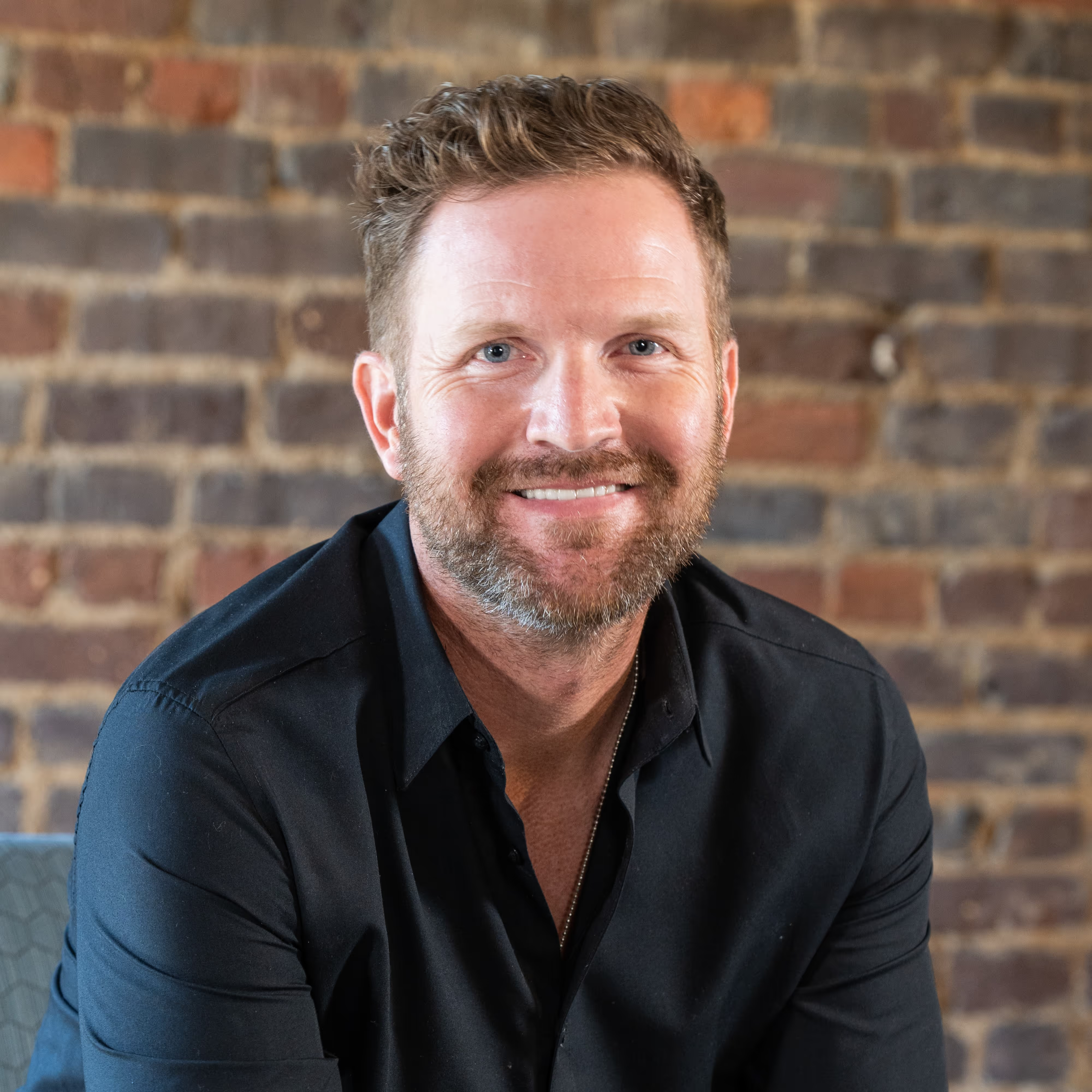
Josh Crisp is a senior living executive with more than 15 years of experience in development, construction, and management of senior living communities across the southeast.
Learn More ▶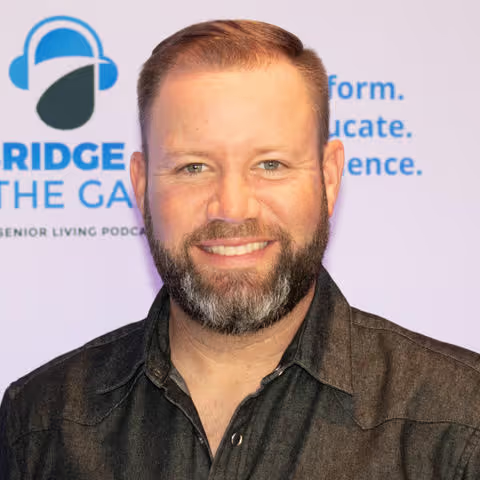
Lucas McCurdy is the founder of The Bridge Group Construction based in Dallas, Texas. Widely known as “The Senior Living Fan”.
Learn More ▶
There's this notion that there's a trade-off between affordability and quality. Our goal is to disrupt that equation. You don't have to make that trade-off.
What if senior living felt like home, not just looked like it? In this episode of Bridge the Gap, Josh and Lucas sit down with George Kutnerian of Wellpointe Inc. to explore their fast-growing residential care home model. With over 67 locations across California, George shares how small, six-resident homes are reshaping the future of assisted living by prioritizing intimacy and personalization. If you’re interested in the future of aging, this episode offers a powerful look at what’s next.
Meet the Hosts:
Connect with Our Guest
Learn more about Wellpointe Inc.
Produced by Grit and Gravel Marketing
Become a sponsor of Bridge the Gap.








1:01- 04:37
Lucas McCurdy
Welcome to Bridge the Gap podcast, the senior living podcast with Josh and Lucas. A beautiful day here in San Diego, California. And we are off and running here at Senior Living 100. We have a great guest on today. We want to welcome George Kutnerian and co-founder and president and CEO of Wellpointe. Welcome to the show.
George Kutnerian
Hey, thanks for having me. Thanks for the work you guys do. Well.
Lucas McCurdy
Thank you. You know, we're excited to have you on, to talk about residential care homes. That's. We're going to be diving into you. And Josh are actually on a speakers panel today. Tomorrow, actually, to talk about bespoke models, right? Things that are not your standard cookie-cutter regular, you know, 80-bed AL. Right. That's, on every corner in, in America, residential care homes are, really emerging. I think, there's a lot of different talking points bring us into the fold. Number one, how did you even get interested in senior housing and specifically residential care homes?
George Kutnerian
Yeah. So a little bit about Wellpointe. We operate 67 communities in California, across Fresno, Los Angeles, Irvine, and Mission Viejo. And so they're all residential, assisted living. So they in California, which basically entails six residents or fewer per location. And so we really positioned them as boutique residential assisted living communities, to have like an intimate feel.
We also specialize in care coordination, and that's really important for us. But the way we started, so my sisters, my co-founder, but our parents started in 1984 with a single home. And so then, you know, over time, in 2013, we came back and started working with them side by side. And then about five, six, or so years ago, we kind of fully took over the legacy organization, rebranded it as Wellpointe, and went from about, I think at the time was about 12 locations, to 67 now, making us the largest operator in this particular segment, 67 residential care homes.
Josh Crisp
That's incredible. What does that been like to scale at that, that size?
George Kutnerian
There's, you know, a couple of key ingredients. I think you have to have the right team. So, really bringing top-quality people into the organization, a combination of people from within the industry. But a lot of people from outside the industry, as well. And then technology has been really key. So, like, you know, people are talking about AI a lot and rightfully so. But, you know, for us, technologically, the first thing was the IoT revolution. So Internet of Things. And so this whole concept of a smart home, well, we really had to embrace that and lean into that so that we can scale, you know, these smaller kinds of fragmented locations.
But really, I think the customer value proposition is also really key for us is the concept of a home. So we know from research, you know, 85% of older adults want to live as home, live at home as long as possible. So we're not here trying to, resist that fact or be in conflict with it. We're actually embracing it. And basically providing an option that's as close to home as you can get.
Josh Crisp
Well, so I have so many questions. I imagine when you do something, especially when you scale something that is, not extremely common, there's going to be challenges as well as, great benefits. And obviously, I'm sure you've experienced both. So starting on the challenge side, what have been some of the biggest obstacles for you scaling a platform like this?
04:37 - 10:29
George Kutnerian
Yeah, I mean, I think the first thing was that you need capital. And I think the cap on the capital side, educating the lender community, you know, educating the banks and the private credit lenders, you know, they look at it from the outside, and they're like, well, okay, it looks like a home, like residential. But then on the inside, it appears that there's a business, and so is it residential or is it commercial?
And so these were early conversations 5 or 6 years ago that I was having with commercial banks. So a lot of education up front. And now we're at a point where we have some, you know, big institutional lenders, that support what we do and believe in our mission and us as operators and so that's, I think, you know, without the capital, it's really hard.
And then the other thing is, again, just operationally the fragment fragmentation of it, being able to use technology, looking at technologies that aren't even geared for our industry. So we don't wait for, you know, a technological solution in the space come to us and say, hey, were built for senior living or whatever. We actually go outside the industry to find solutions because we aren't that kind of standard box, if you will.
So a lot of the standard solutions in the industry don't actually work for our model. That makes sense. So is it the same? On the capital provider side, are you going to traditional capital providers and lenders that are already in the senior living community space, or these fund sources outside of senior housing on the lender side for debt?
We're going it's within the industry, but it required a lot of education. But now the product from our perspective is, is is accepted within the industry. So much so that there's a panel on on this whole model at NIC coming up as well. So so finally it's getting attention. But we've been kind of building that, education and proof of concept since, you know, with the lender community in the space since 2021, how do you you've obviously grown really quickly.
How do you identify, the markets or the neighborhoods or what? Whatever you're going into is and is that sort of a, ground up new construction, or is this acquiring existing homes and converting them into care homes?
George Kutnerian
So first, in terms of the type of home, we really look for a median price, home median plus maybe, and that's not by accident. I mean, statistically, most people will relate to the median. That's what the median. Right. It's the middle point. And so that resonates with a broader swath of people. So you know, you don't want to do a low-end home, you don't want to do. We're not targeting luxury home either. So that's first and foremost. So a relatable product and then a neighborhood that can bring in, can serve as many people as possible.
So something again, it doesn't it's not like necessarily a high-end neighborhood, but it's something again mid-price point. Right. So that type of neighborhood, and in terms of what we do with the home, we haven't done ground up yet, these are basically adaptive reuse. So we'll take, the home that meets our profile could be 3 to 4 bedrooms starting.
We'll take it down to the studs, and then we'll expand it, do an addition, take it to six bedrooms, and then generally we'll go from like 2 to 3 bathrooms to 4 to 5 bathrooms. Some residents can have private bathrooms as well. But our standard model is to have all private rooms. So that's kind of out of the box.
Part of our value proposition is that we want everyone to have a private room because we believe that's what consumers value. And I think you said in California, the maximum number of residents you can have is six. It's the maximum if you would like to do the homes as of. Right. So basically, if we don't want to go through conditional use, permitting or zoning variances, then six is the limit.
If you go beyond six, then you know, the land use piece kind of changes and it gets a little more complicated. Have you found resistance in some of the neighborhoods you go to that you know, some of the neighbors are like, hey, we don't know if we want this use in our neighborhood if they're not as, familiar.
Sometimes it's more about fear of the unknown. So it's really about kind of educating, showing that you're good neighbors. So we really take great care of the homes. You know, the lawns are beautiful. You know, fresh paint replaces roofs. So, I mean, we really, you know, in a typical home, you know, we're putting in when we do our adaptive reuse, we're generally putting in for $500,000 into a home to purpose redevelop it to meet the needs of, you know, aging adults.
Josh Crisp
What does staffing look like in a model like this?
Out of the box, at a minimum, you have one staff to six residents at all times. So that's just minimum out of the box, which is superior to a lot of other types of settings. And then oftentimes will have two residents most of the time during the day.
And in some cases it can even be three, just depending on what the needs are. And then we have a staff person who stays on site overnight, I would imagine. I mean, so most states have some category of licensure like this, but it doesn't seem like there's, high use of that category. Have you found challenges with regulators not really even understanding the model really well and being able to regulate it well in California?
Interestingly, whether you're six beds or 100 beds, you're actually under the same licensure type. Oh, wow. Now, there are some delineations on how things operate depending on where you are with number of beds. So in California there's kind of different bed thresholds. So like I think over 15 is one I think over 49 is another. Think 99 is another.
So there's just different thresholds. But it's all within the same universe of regulations and it's all within the same licensure type.
Josh Crisp
Well, that's interesting. So you know, some of the challenges, I'm sure. And we could talk for a long time about those. But what about the benefits? Obviously, you're passionate about this, for more than just the real estate play.
10:29 - 15:55
George Kutnerian
Yeah. So I mean, we could do big, bigger footprint facilities of communities if we wanted to. Sure. Choose. You know, we're intentionally choosing this model. Why is that? Yeah. You obviously feel that this is a great quality model for the resident. I think it's resonating with consumers because, again, like I said, 85% of older adults want to live in their current home as long as possible.
And so in order to resonate with that, we don't want to resist that. We want to embrace that fact. And we believe that with a single-family residential home model, we can essentially recreate a home. I think home is not just a physical construct; it's a social construct. Home is a state of mind. It's about how you feel about a place and what's happening in that place.
And so what's really great about these homes is you kind of live in them as you would in your own home, and you do the things that you would do in your own home. So, like an example, we just got a message over the weekend about a resident. His name is Vance, and their staff were like, Vince wants to do a yard sale in the front yard. His brother brought a bunch of his stuff over, and Vince wants to sell it and do a yard sale. And that was the first time anyone asked us about doing a yard sale. So we just thought, you know, pause for a second, like, okay, well, I mean, could I do a yard sale at my own house? I mean, yeah, I can, so why can't Vince it's Vince, his home.
So we said, yeah, go ahead. So basically it was literally like I think yesterday Vince did a yard sale in the front yard. So I think it's about being able to create these, spontaneous organic moments as opposed to like manufactured moments, like we have planned activities. That's great. But there's a lot of organic things happening in these types of homes.
I just recently put a story on my LinkedIn about two of our residents, Jane and Fernando. They both moved into a home, at different times. Didn't know each other before. Both were single, became friends. And then now, you know, they found love. So like the neither of them were probably planning that or expecting that. But in this small kind of six resident environment, you know, it's life.
And so we're trying to change the narrative and we're at where what I think is like the misconception in the public about the kind of assisted living industry in general. There's this kind of misconception about assisted living is the beginning of the end, and we're trying to transform that narrative to the beginning of what's next, that this is a place to live and that's what that's that's why we're passionate about it.
Josh Crisp
So talent acquisition, this is not a traditional, senior living community, which is already challenging enough. What have you had challenges on talent acquisition? Like labor. Everybody talks about it. You hear operators all over the country. What? What is your take on that? It's more at the direct care level?
George Kutnerian
At the direct care level, I actually think we have a really interesting value proposition because of the, higher staff to resident ratios that we have. So I think we're an actually attractive alternative for some people to come and work in a smaller, homelike setting with maybe more staff than they're generally accustomed to. So we actually think that, you know, we're we're becoming an attractive alternative.
And so, you know, is it hard? Yeah. It's hard. You know, I think we're navigating it pretty well. We we really emphasize benefits and basically trying to turn caregiving from a transient job into a career. So we try to do like, career laddering and creating up so as we grow, there's naturally becoming more opportunities for people to advance in the organization.
We also naturally bake over time into a lot of our shifts. Not every single position, but we put overtime in them so that we can kind of create generate higher pay. So a lot of folks in the industry will just be like, we're not paying overtime. No overtime. Everything's just an eight hour shift max because California has daily overtime and, and weekly overtime, and potentially double time.
But by creating those types of shifts, even though in theory, we can do more optimize shifts that pay out less. It's almost like a recruiting tool. The other thing is our employee advance program. We do advances to really help promote, housing security and transportation security. So if we have employees, for example, maybe they have bad credit or no credit.
Well, the security deposits for apartments when you have no credit or bad credit is a lot higher than it otherwise would be. So we'll help advance money for apartment deposits, for example. Or if they need help with getting a car and they need a down payment for a car, and they're going to carpool with other, coworkers.
Like, we're trying to promote those types of things and not just the standard like, well, this is your rate to pay. This is what you get paid. You know, helping them solve their challenges. So you're talking about that senior living 100, your model. You're also, I think, maybe doing a talk at Nick, about your model. It's not something through the years I've heard a lot of talk about even though there's in some states, as we've talked about, there's a regulatory category that's just underutilized, probably.
Josh Crisp
Do you see in the coming years that this is going to be a more mainstream model that everybody's aware of and talking about and trying to scale 100%? It's just a matter of time. And it's just a matter of what the operator footprints are going to be. The models are there in other states, too. It's just really fragmented.
15:55 - 20:31
George Kutnerian
So what's happening is this, you know, you might have someone that's a small family business, you know, they might have one, two, three, maybe four locations. In California, that's kind of the average is about 3 to 4 locations. Is about as big as, you know, an operator will get, so, you know, in the mainstream part of the industry, we don't hear about it as much because of all the fragmentation.
And so now what's happening? Is there certain operators in different states that are starting to emerge with some sense of notable scale? You know, us and California, there's other providers in Colorado, Texas, you know, and other others are emerging and other states. And so and I think as the capital sources get more acquainted with the product and the offering, I think more that capital will start to flow and that will help give rise to more availability, because I think of the capital is not there.
We can all want to do it, but I just think it's going to be hard if the capital is not there. And I would assume it seems like the capital follows the data. And with it being so fragmented, I would imagine there's not a lot of data out there that you can find unless you're you're obviously aggregating data from your your platform now that you have scale.
But is that a difficulty you all have found in just finding out data in other states and from other providers? It's, I think, traditionally been opaque. I think there's becoming increasing transparency with state regulators. And, you know, all the states are kind of on this trend of making more things visible. And so I think, data is becoming more available, but I think it's still sparse, like, we don't know, like occupancy metrics of these smaller communities.
We don't necessarily have as much rate data. So, you know, it's not like the, you know, the NICs reporting that they do, the formally map, you know, those analytics and you know, those there's no data sets like that for our industry. But to your point, we are capturing our own data internally with our systems about who we're taking care of.
You know how old they are. You know what what the profile of these residents look like. All these things we are collecting. And so when we're having conversations, we can point to the data.
So I heard you say, when you're looking at a market as far as feasibility, you're looking at homes that are sort of in the average. Is that also where from affordable affordability standpoint for the consumer or are we talking is this an average senior living product or do you pay a premium for this or is it more affordable? Where do you see this product fitting?
George Kutnerian
We view it as a market rate product that's designed for affordability to to be accessible. So we do utilize, heavily, Medicaid waivers.
So in California that'd be Medi-Cal. So we utilize the assisted living waiver. We're working more directly now with managed care plans. So, you know, we and I think that's what's made us successful is that there's this notion of there's a trade off between, you know, affordability and quality. And so our goal is basically to disrupt that equation.
You don't have to make that trade off. So we do also have private pay, and we're able to command private pay rates. But we try to make the model accessible and really democratize access to to everyone. And that also means you know, becoming more diverse in terms of who we're trying to serve. So our customer base is more, you know, ethnically diverse than it's ever been before.
Like one of our markets, for example, Fresno is 55% Hispanic. So, you know, we've been growing in that segment. Basically, we want the composition of our homes to mirror what the population and the community looks like. We want it to be representative. We don't want to be niche. We want to be more mainstream.
Josh Crisp
Lucas, this is really exciting. I feel like we have a front row seat to see change happening. And it's been talked about and I think you're seeing this in Texas and other states that you're working. It's exciting times to be in senior living.
Lucas McCurdy
It is. It's, I think, you know, with this demand, for older adults who are age and income qualified. And, when we look at the NIC MAP data, we start to see that occupancy is going to be at max in the next coming years. I think this is a great option not only to bridge the gap there, but it's just a great option for older adults to have to choose where they want to have home.
George Kutnerain
Yeah, it's a great option.
Lucas McCurdy
We know that you've got a busy schedule here, and this is a great conversation. Thank you so much for spending time with us today.
Thanks for having me, guys. Appreciate it.
Lucas McCurdy
To our listeners. You can go to btgvoice.com and download this content and so much more. Thanks for listening to another great episode of Bridge the Gap.


