.avif)
The next wave of residents is coming, but are you ready to receive them? Don't miss this insightful conversation on how to prepare for the future of senior living.
Until we can dumb it down, we really can’t have alignment.
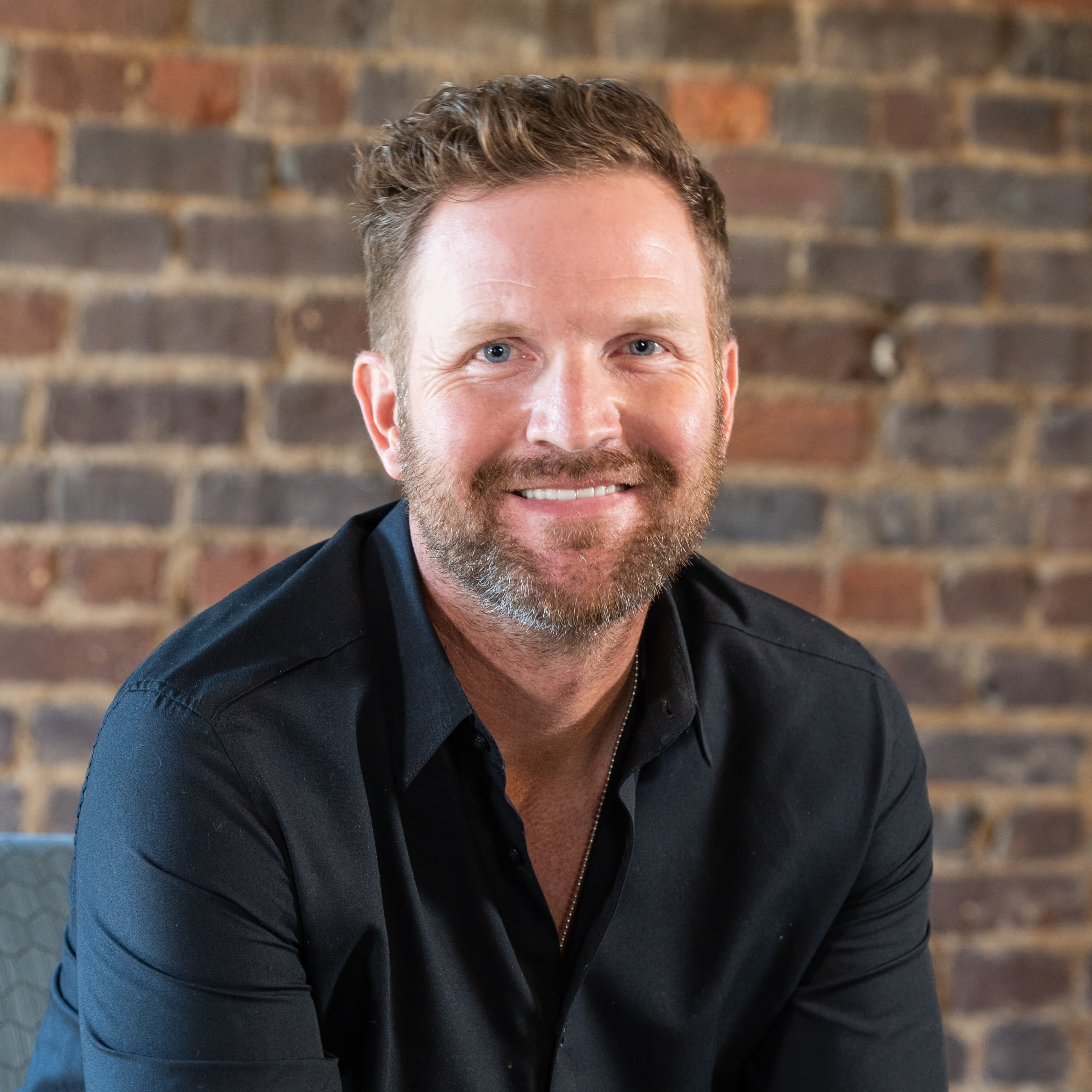
Josh Crisp is a senior living executive with more than 15 years of experience in development, construction, and management of senior living communities across the southeast.
Learn More ▶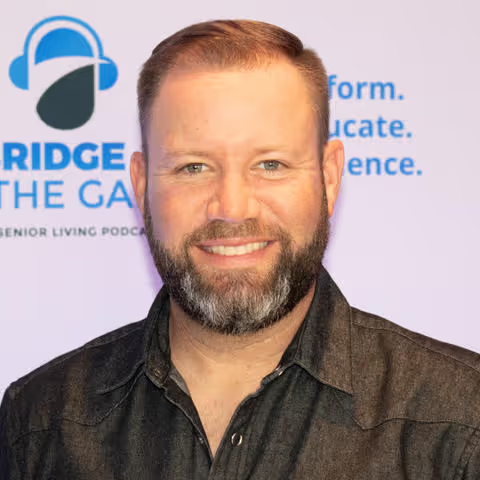
Lucas McCurdy is the founder of The Bridge Group Construction based in Dallas, Texas. Widely known as “The Senior Living Fan”.
Learn More ▶
Oftentimes, the team has an understanding of where they're going, but they haven't taken the time to articulate it.
The senior living industry is on the brink of massive transformation—but are operators truly prepared? In this episode of Bridge the Gap, hosts Josh and Lucas sit down with Tiffany Karlin and Robert Zondag to unpack the realities behind the much-discussed “silver tsunami.” While many assume baby boomers are already filling communities, the data tells a different story: the surge is just beginning.
From rising Alzheimer’s rates to workforce shortages and limited new development, the challenges are complex and urgent. Tiffany and Robert break down why strategic alignment across organizations is critical and how leaders can simplify complex plans into clear, actionable directions for their teams.
Key Topics Covered
Meet the Hosts:
Connect with Our Guests
Produced by Grit and Gravel Marketing.
Become a sponsor of Bridge the Gap.







00:38 - 04:06
Bridge the gap in three two. Welcome to Bridge the Gap podcast, the senior Living podcast with Josh and Lucas and awesome day high energy here in Nashville, Tennessee. We've got some great guests on some great supporters of our podcast from Wipfli. We want to welcome Tiffany Karlin and Robert Zondag. Welcome to the show.
Tiffany & Robert
Thanks for having us. Thank you.
Lucas McCurdy
So good to see you again. And you know, one of the things that I love to do, and we love to do this on the podcast, is we want to know the State of the Union. We want to know where are we at? And this is such a great opportunity to have both of you on to talk about, like these cutting edge conversations. So, Tiffany, kick us off. Tell us where we're at. Bring us into the fold.
Tiffany Karlin
So interestingly enough, the market thinks that baby boomers are already fully into our senior living communities when in reality, in 2021 was when the first baby boomers were turning 75.
And if you think about that, our average age of baby boomers that are entering into just senior living, independent living is in their 80s. So we haven't even seen what the entourage of just a huge amount of our people that are coming into senior living, in fact, by the year 2020, excuse me, by year 2032, we're going to have another 3.4 million baby boomers that are turning just 75.
And so again, what is it? I'm talking with our providers now because what is it that we're doing to prepare, as we've seen even at the Nic conference, the absorption rate in senior housing is staggering. But we aren't building more units. Right. So what where are all of these people going to go beyond that? We're also talking to our providers about the fact that Alzheimer's is on the rise.
We all know it. Alzheimer's and dementia. I'm sure all of us, you all probably have a family member that's managing that. So there's an estimated 7.2 million Americans that are at some point in nine that are 65 years and older, that are currently living with Alzheimer's, 74% of those are 75 years and older. That's again, that's huge. 1 in 9 people aged 65 and older have Alzheimer's.
It's a staggering number. And how are we now looking and preparing for what we do to care for those people? The acuity of those people are much higher. So now we're seeing we haven't even seen this huge amount of people coming into senior living. We're seeing now that skilled nursing numbers are on the rise again. Occupancy is now hitting in the 90 percentile nationally, and yet we aren't really prepared for that future.
We often see that our our non-for-profit communities are thinking about strategy. What should we do to change the way that we need to do and deliver services for older adults into the future? But what is it that our for profit operators are doing the same? To think about strategy around what the future holds within what senior services might be, not just today, but five years and ten years from now.
04:06 - 8:12
Josh Crisp
Well, Tiffany, so you literally just unpacked something that equally frightens me and also excites me at the same time. Very tragic to hear those staggering numbers of Alzheimer's. That's something we've got to do something about. We could have a whole long series of conversations about that. The demographic, while it's super exciting, that paints a real opportunity, which I think is why NIC is so excited here about that.
But it's a great opportunity to for us to talk about strategy. You you touched on something there, very subtle between nonprofit and for profit. And you I think what you're indicating is the nonprofit sector. There's some things that we could learn as for profit providers about them. Could you kind of dive into that a little bit and talk about strategy and what you're saying? Maybe some of the nuance that us in our industry could learn?
Robert Zondag
Yeah, I think the first thing we need to talk about is uncertainty. That excitement and being scared means we have to be really aligned in what we're going to do, whether we're for profit or not, for profit. We have an immense demographic change. We have changes in how we're getting reimbursed in some cases, and then we have everything that's happening globally.
And when that happens, we have to be really clear about where we're headed and real alignment across our stakeholders. If you're for profit, that's a return to shareholders, right? We need to be really clear. What are the strategies we're going to take to give that return that we've promised or it's expected? If you're not for profit, you still have a group of stakeholders, and that's where that alignment also has to take place. And to Tiffany's point. Strategic planning or taking a step back to work on the business instead of in the business is key when we're both scared and excited. I don't know if that makes sense.
Josh Crisp
It makes total sense, and it makes me want to lean in a little bit more to the conversation. Because when we start talking about strategy, you know, obviously, you guys are front row. You get to work with a lot of organizations, myself and many of our listeners, we're sort of in the silo of trying to figure out and and listen to educational episodes like this to, to learn. And I think that's one of the great things about our industry is the wealth of information share that we have. So as you're talking to organizations, what is sort of the framework from which you approach to talk about strategy with organizations?
Robert Zondag
We really advocate what's called agile, and that means we're going to look right now at what we think the macro disruptions are, or what we think we're really good at. From there, we're going to make a plan 1 to 3 years, knowing that we're going to have to shift in those 1 to 3 years, but we're going to develop a Northstar.
We're going to develop 3 to 5 priorities. The tactics, what we do, how we shift, where we might change our investments will change. But at least having some alignment, if the four of us were leaders of an organization that's like an elephant, the classic inner room. I feel the tail. Tiffany feels the trunk until we get together and say, listen, these are the 3 to 5 priorities that are going to move us forward in the next foreseeable year.
Three years. Say, for instance, we really are going to be shooting at the hip because we have to have a plan to go back to that. We all go back and say, no, we all agreed this is what we're going to do. This is how we're going to deal with this disruption. This is where we see the market going.
This is what we need for people. This is what we need for process. This is what we need for technology. Just think about technology. The next three years, from everything our futurist team looks at, we may have robotics, the robotics, technology that's coming out. Everyone's in that world is saying people have a car and we'll have a robot.
They'll cost the same. And people are going to have one of each in their home. Think about what that means for your life. Think about what AI means for your life. In addition to everything, Tiffany is talking about the massive demographic changes. And that goes back to what you said, and I love it. I'm both excited and scared, and when I'm excited and scared, I'm in the middle.
08:12 - 12:30
Robert Zondag
And that means often I won't make a decision.
Josh Crisp
Do you find, as you're going in and and having these discussions or, or maybe even starting the discussions, how receptive? I mean, is it when you go into these organizations, so many different types, you sort of have to lay the groundwork and level set to get everybody, hey, we got to think about this the same way. Or is everybody just like understanding this when you go in?
Robert Zondag
I think it varies. The first thing is I love working with Tiffany because she can bring industry perspective, so I can focus on the alignment. Oftentimes the team has an understanding of where they're going, but they haven't taken the time to articulate it. I may think we're headed southeast.
You may think we're headed southwest. And it's that fine. Adjustment or tuning that can make us from good to great. If you've ever read ten x is easier than two x, that's what we're talking about here. Let's take a step back. Let's look at the macro disruptions. Let's look at where our opportunities are both internal and external.
Let's talk as a team about what we're really good at. And then let's have some real clarity. The clarity is what is going to turn X or we cannot have that. The other thing I think is having an outside facilitator, someone who can have rough conversations, crucial conversations and, preserve the relationship across the stakeholders. If you're a nonprofit or not for profit, sometimes that means challenging board members.
And if I'm working for the board, I can't have those challenging questions. If it's for profit, it's preserving the relationship between the board, the investors. And so I think a lot of times, and Tiffany and our team comes in, it's about being Switzerland, having the challenge or questions. And I think that's real power that you can't achieve if you facilitate it yourself.
Josh Crisp
I would imagine so because, I mean, you take away at being impersonal immediately, and that seems like a huge barrier that you have to overcome. Just in the beginning. So I'm curious, you know, it seems like what we like to talk about are the, the major icebergs that we, we know are coming. You know, it's the positive demographic diseases, illnesses and things like you touched on with Alzheimer's.
This big looming problem, the labor shortage. Are there other things out there that you take into account, like in in every group, no matter who you're talking to? I think you touched on some of them, like reimbursement. You talked, about some maybe the regulatory environment, the greater economy and what's going on. So this is not just a labor and a demographic symphony and a rent issue and expense control.
I mean, it's a very holistic thing. And how much are you doing in your strategy to sort of hedge the bet on all the things that could happen to us that we're not really, like, responsible for as an organization?
Robert Zondag
I think first of all, it's the mix of services or mix of, what we do. We all may serve senior life, let's just say.
But each of us has a different segment of what we do. Well, and that mix determines our strategy or informs our strategy. Are we going to have some things that we have to do because they're loss? Leaders say we're a nonprofit. What are the things that are going to be contributing so we can support those? If we are in a growth mode, we're for profit.
Well, why did we choose that? Particular star? What's our cash cow? What's our question mark? What's our dog? Are we willing to divest of it if we're not willing to divest of it? Why? So I think it's very nuanced. If we think of it like making bread. Say, we all, now sour dough. You know, it's a big craze right now.
We are all going to have a slightly different recipe and a different taste to our bread. And part of strategic planning is goes outward. What's happening in industry? Can we get an expert like Tiffany to come in and help us look at the industry, but also inward? What are our strengths and capabilities and where are our weaknesses and threats?
12:30 - 15:38
Josh Crisp
Sure. So, you know, when we're talking about this makes total sense. Me, even if you guys are dumbing it down for me and I understand it, but then it's like, oh my gosh, I start thinking about the complexity of this is going to require some commitment and some time commitment. So for an organization, what do we need to sort of be psychologically, financially, and labor as leadership prepared to embark on this endeavor if we're not already strategically planning for things like this? What does that look like for a leadership team?
Robert Zondag
I go back to something you said that I think is really important. The work we do is like we have to get really clear, and that's not dumbing it down. It's if we can't talk it in simple layman's terms, I don't know how if we have 5000 people on staff or even 400 if they don't understand strategically what we're doing, if they don't understand why that particular mix of services we have, which shows, then I don't know how culturally we get from good to great.
So part of it is taking, a look at ourselves and how much we talk in industry speak or how much we look at very sophisticated models or reimbursements or how we're going to structure a particular finance deal and really step back and say our job as a leader, regardless, for profit or not for profit, is to radiate out that strategy to the greater good.
Have it in line with whatever we think. Our experience for our residents, our seniors, whatever we call them, is going to be and put it in the most clear terms possible, knowing that the rest of the time when we leave strategic planning, it gets incredibly complicated. But until we can dumb it down, so to speak, we really can't have alignment and alignment so that when, say I have skilled nursing and you have, assisted living or you have just regular, senior living, we should be able to explain that to both teams the same way, with the same clarity. The rest of it gets complicated.
Josh Crisp
So from a time commitment standpoint, what are we looking at? Do we need to dedicate a year to put together a strategy like this is six months. Three months is different per organization or how does it work?
Robert Zondag
We would say generally when you're doing the planning, it's probably a good two days in person. Now you're going to do a lot of pre-work. Sometimes you're going to ask all your different stakeholders. You might have some analysis from an expert like Tiffany and her team come in and really give you an analysis. Then that's sit in a room, not in your place of business, really hash it out, and then make a plan on how you're going to release it to everyone, like almost an internal branding.
And then develop the cadence. Are you going to meet as a senior leadership team every other month to look at it? Is it going to be quarterly? Part of it is, saying, how are we really going to embed this? So it becomes muscle memory versus just saying we made the plan. And then a year from now we're going to look at the plan.
15:38 - 19:58
Josh Crisp
And I think I heard or understood what you're saying, I mean, that plan, at the highest level, it has to communicate effectively all the way down to your front line worker, to your caregiver, that CNA, that resident assistant, that dietary worker. That seems complex. That seems like that has to be extremely well thought out, because I think of these sophisticated operators now and even maybe non sophisticated operators.
But you have people in different geographies, different cultures now in, in the US almost anywhere you've got different language barriers. And so I mean that does the strategy behind it, the thoughtfulness and intentionality. It seems like something that would be extremely difficult for any size organization to do alone.
Robert Zondag
I think it's taking a step back and saying, how are we going to communicate our three year plan internally? It's a three year plan we're seeing right now. And so marketing branding is important. How do we, get this pushed out? If we have 100 locations, it might be, hiring a group like you to do some podcasts, and then we push it out to people who may not have email. You know, many of our locations, we have people that aren't at a desk looking at things.
So we might need a podcast, we might need a video, we might need some promotional items. Then we need to have all of the infrastructure in place. That's usually the senior team. But if you think of it from a branding or messaging, you're going to step back and say, how do we really make this work? I think, if you don't mind, part of it too is our strategic planning team.
Tiffany Karlin
And what Robert is doing is kind of the at the high level, the first step right after that, an implementation is a lot of people change management. Right. And and Robert coordinating with our change management team around. And some of that is, you know, typically are a strategic plan with senior living organizations is around growth. So sustainability talent and technology.
And I can put that in one box because a lot of times talent is going to help with that or technology is going to help with the fact that we are, as you mentioned, pretty tight workforce. Now, how did then Robert's plan and his team's plan working with that organization? Who else do we need to bring in the fold to help implement some of those change management tools that are going to need to be at a disposal for an organization, because it's doing a three year projection, people are not going to change overnight.
And some of these big thinking that needs to happen, right? Senior living organizations that are truly changing into what the future looks like is in some cases, changing, a huge way of doing business or diversifying greatly into different aspects of what you need to do to care for the older adult of tomorrow. That takes a great amount of people.
Movement. And I think a big part of what I try to impress upon our clients today is what are we doing to also invest in our people as you're going through this plan, because the more buying in that you have, right? If everyone's red, the iceberg is melting, starting at the lowest common denominator, building up, the more buying you have within what this strategy looks like and what we believe in to serve older adults, the better you're going to be able to be successful into the future.
Josh Crisp
This what you guys are talking about makes perfect sense. I'm wondering, as you're talking to a lot of leaders, kind of on the forefront of all things here in our industry, how receptive are our, our our industry leaders to this? Are the organizational leaders to this? Are we sort of drunk on the Kool-Aid of just we know the demographics on its way and we feel really comfortable and and we're excited. Rah rah rah rah. Or is it a lot of what you're doing right now is just kind of firing the alarm of, like, we have to be talking about strategy right now.
Tiffany Karlin
That's exactly right. It's firing the alarm. I think there has to be a little bit of a mentality shift within our senior living operators to say it is important that if we're going to see the future through, it's not just about what the executive leadership thinks it's going to need to be, but it's also migrating change with a collective group that wants to help get there.
19:58 - 26:01
Tiffany Karlin
If you look again at where the market is shifting, it's it's what you and I want in a senior living organization is very different than what people that are currently there need. Who do we need to have at the table to understand that market? If we want to diversify into other platforms that are home and community services, are those the same people that are sitting at the table with you today?
Yes. It isn't simply about who's who we're currently caring for. It really has to be about having all of the right parties at the table setting that is planning for that strategy. Robert just did a great strategic plan with a client of ours in Northern California, including stakeholders that are in the community, including stakeholders of people that they serve now, including regulatory stakeholders.
It's thinking beyond that. And then saying afterwards, do something with this. What's the plan that we're going to do on executing? And I and right now, again, we look at numbers, we say, okay, well I'm well as an executive I'm ready for it. Yeah. But is everybody ready for and are you truly ready for you might be ready for today in the challenge of today.
But our view truly, except for your mindset, positioned your entire organization to have the same mindset. Sure. Right. And that's that's a very big difference. And and I believe there are really strong operators out there that have a they're a go after go get em. And I love those guys. Right. But it's getting it's getting by in the collective total to do that. And that. Take some sit down strategic thinking.
Josh Crisp
Absolutely. Recognizing that that change is coming. We've got to have a strategy widening the circle. Any changes? Uncomfortable. Lucas, you make me change all the time. I just wanted to say that it's just so uncomfortable
Lucas McCurdy
That’s what I’m here for. Just to keep you uncomfortable all the time. And we love those real life stories.
And I'm sure there are many different success stories that you have as we kind of round out the conversation. Is there another success story of people that have walked the journey, you know, climb this mountain and had some setbacks and have had success? Is there any real life stories that come to mind?
Robert Zondag
I can think of adding on to what Tiffany said.
Oftentimes we take it to the next level, and that's like a journey map or an experience. And I think to Tiffany's point, there's a lot of people understand where the demographics are, where the industry is headed, but the rest of the organization doesn't understand it. So we've had some really good success defining what is the journey that you're offering your seniors, what is the experience?
Because to Tiffany's point, different demographics, different regions have different expectations for what senior living or senior life is about. So I think that's something to really think about. If your listeners can say a little, Eric, curating what we want or we letting it happen, if we're letting it happen, that's different.
Tiffany Karlin
Coming back from a strategic plan, I often get clients that'll that'll email me or give me a call. And they're the simple, I haven't even done a Swot analysis for an organization in ten years. 20 years, even that simple request of like, what are we good at, what's out there and what should we be aware of? And then having that refreshing. Yeah. And we just went through it and it's amazing what we didn't know or it's amazing what we uncovered when we brought all of the right stakeholders to the table and said, yeah, we're really great at this, or here's our, here's our weaknesses and where do we want to improve and what do we want to see for the future?
It's like a light bulb goes off and it creates this. You know, I already talked about how I get to see these senior living operators that are already go getters, and they're out there fighting and doing the right thing, but that even invigorates them even more, because that sense of purpose, when you have a whole team of people behind you that are like, okay, let's go after this charge forward, it just creates new energy. And that's what I love to see, is that new energy infuse into an organization and people that everyone collectively believes in.
Josh Crisp
Well, you know, what this reminds me of is, I mean, we have so much excitement and like anything in your personal life, when you want to bring about really, big change and you're excited about it, it's real easy to get excited but lose momentum really quickly without strategic accountability and some type of partner most of us have have gone through, some level of personal trainers and guides and things like that.
But an accountability guide like you guys to help guide through this process, because this is not going to be easy. But what a awesome opportunity we have right now ahead of this great opportunity that we have, that it will bring unique challenges, growth opportunities for us. Lucas, I'm actually really excited and I'm excited that we've got partners like this and our listeners have resources like this.
24:55 -
Lucas McCurdy
That's right. And we appreciate the passion Tiffany and Robert here because, you know, all of these things, these initiatives that we talk about. The cool thing is, at the end of the day, it's all for to have great outcomes for older adults living in these communities. We want their lives to be the best to thrive. And, just have a wonderful, experience in these communities. And y'all's, part of aligning that team to make that happen is, a great goal.
Tiffany Karlin
Today's older adult as and looking into the future and what that older adult looks like and how
we're also able to do the same. Absolutely. It's exciting times for all of us.
Lucas McCurdy
Very well said. Thank you so much, both of you, for your time on the podcast today.
Tiffany & Robert
We appreciate it. Thank you.
Lucas McCurdy
And so to our listeners, I know that your head is spinning. You're thinking, how can we create this level of alignment so that we can hit our goals too? We're going to, scroll down in your show notes and you can connect with them in the show notes there. And you can also go to btgvoice.com download this content and so much more. Connect with us on LinkedIn. We'd love to hear your thoughts about this topic. And thanks for listening to another great episode of Bridge the Gap.


