.avif)
How can fall detection be transformed into something personal and welcoming? The team from Nobi has the answer on this episode of Bridge the Gap.
It's our job to make sure that we are so efficient in our mission that we don't replace people, but free up every minute of time so that they can spend it where it matters most, which is with people.
Josh Crisp is a senior living executive with more than 15 years of experience in development, construction, and management of senior living communities across the southeast.
Learn More ▶
Lucas McCurdy is the founder of The Bridge Group Construction based in Dallas, Texas. Widely known as “The Senior Living Fan”.
Learn More ▶
Good care needs to be good business
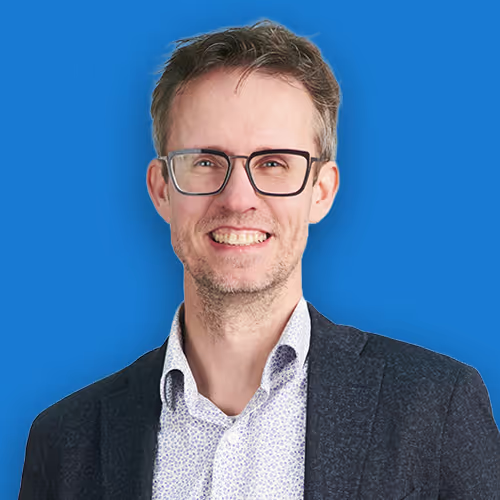
This week on Bridge the Gap, we sit down with the Roeland Pelgrims and Stijn Verrept of Nobi to discuss how technology is reshaping the future of senior living. The conversation explores the operational realities caregivers face daily, the challenges senior living operators encounter amid staffing shortages, and why discreet, intelligent technology is critical to the future of aging services.
Key Topics
- The origin story behind Nobi’s smart lighting platform
- Why caregiver workflows inspired the company’s mission
- The operational burden of fall-related investigations
- How AI-powered fall detection works in senior living
- Reducing falls by 50–55% in assisted living and memory care
- The importance of dignity-centered technology design
- Staffing shortages and operational efficiency in senior housing
- Why connected ecosystems are the future of care delivery
- AI’s role in simplifying senior living technology adoption
Meet the Hosts:
Connect with Our Guests
Learn More about Nobi
Produced by Grit and Gravel Marketing.
Become a sponsor of Bridge the Gap.






00:51 - 04:10
Lucas McCurdy
Bridge the gap in three two. Welcome to Bridge the Gap podcast, the senior Living podcast with Josh and Lucas an awesome day here in Nashville, Tennessee. The energy is rising. You can hear the coffee in the background, the people networking. It's a fantastic day and we've got on our friends. Some know be great partners of the podcast. We wanna welcome Stijn and Roeland. Welcome to the program.
Stijn & Roeland
Thanks for having us.
Lucas McCurdy
Yes, well, we're excited to have you guys. You know, tech has dominated senior housing in the past couple of years. You know, years ago, you know, Josh and I've been coming to the Nick conferences for 15, 17 years. And we did not used to see a lot of tech companies. And now it's just like tech companies.
You guys have come in and brought products and services that are changing the landscape of aging. And we're so excited to sit down with you as founders of Nobi and kind of get the origin stories. And also, we want to know what's going on now and what the future is going to bring for tech. But we'd love to get, you know, rolling your passion behind both of you gentlemen starting this.
Roeland Pelgrimms
Well, both Stan and I were in senior living in technology. And, on that crossroads, we were running a group of 182 communities. And one day, we were reviewing the performance of a caregiver. Wasn't good. We had some complaints, late interventions, and we notified that person. And then we got a kind but very short letter back from that lady saying, you don't have a clue that that's interesting: vague enough to be interesting.
So we went to that community, talk to that lady, and she said, have you ever spent a day working here? So. Well, to be honest, no. Okay, then can you please do so? Which we did. I spent a week there in that community and noticed that a lot of the things we ask from caregivers are just impossible.
They are impossible if you don't have great insights and great data to get that job right. I mean, you cannot blame people for not being in a room when help is needed. If that room is blind and and at the same time, Stan and I were also running a technology company, so we saw a lot of potential to improve that and to solve that problem, to make sure that those letters would not be needed any more in the future.
And when we started diving into what for us mattered most in that quest, it was first and foremost false. False was the thing that challenged our communities most and had the biggest burden on our caregivers and the biggest impact on our residents. So that's what we started working on. And when we looked at technology and the market out there, there were three things that we didn't like.
First of all, we felt that everything was way too ugly. And dignity matters. We we installed technology where people live. So design and desirability should be front and center. The second thing we didn't like is the performance of those technologies was just not good enough. A lot of false positives, a lot of false negatives. That's an operational burden.
We could not afford ourselves. And the third thing is we didn't like the philosophy point solutions that would only tackle a single problem. And we really wanted to transform dumb and blind environments into smart and connected ones. And so after a while of of looking and selecting technology, we said, let's build this ourselves. And when I say we said, let's build this ourselves.
04:10 - 08:17
Roeland Pelgrimms
I said, then you should build this, because that's actually what he does best.
Josh Crisp
That was sort of the background. But you guys invented or manufactured this this light. Yes. And that was sort of just the beginning. Right. That was the beginning of the story.
Roeland Pelgrimms
Yeah, absolutely. And that is 2018. So after three years of development, Stan and his team created Nobi, smartest light in the world. So it's all about beauty on the outside, intelligence on the inside. It's stuffed with technology, but it feels. And it looks like a normal light fixture. And it started with fall detection. I think we're still the gold standard in there with with 0% false negatives in the in the field out there. So it hasn't happened that we missed a fall with the current generation of technology 50 to 55 reduction, percent reduction in the number of falls in assisted living and memory care, and a lot of functionality that we can add, such as circadian rhythm lighting to improve sleep quality thanks to the fact that we are a light fixture. So yeah, started as a fall detection platform that's now really expanded to a smart care platform, that transforms dumb and blind environments and smart and connected ones.
Josh Crisp
Speaking of dumb, you're going to have to dumb this down a little bit for me. So, you talked a little bit about how accurate can you explain the why behind why your system is so accurate in the fall detection in particular?
Stijn Verrept
Yeah. So we have a very good vantage point of the room. Basically, we're mounted in the center so we can very well see the complete room. And we've trained it on thousands and thousands of beds people. So the eye is extremely accurate and we tend to on the safe side. That's really important. So we rather never miss a fall instead of causing too many false false positives and the false positives.
We also have a very good way of coping. So we have one false positive over more than 1 in 416 days. So every device only if one more than a year before it causes a false positive. So it's really important to cope with alert fatigue.
Josh Crisp
Which is a huge point for operators, for managers, for administrators, because the risk mitigation is huge in that
Stijn Verrept
Care staff knows when nobody sounds the alarm, somebody is on the floor. And that's really important.
Josh Crisp
So a lot of, I would say us consumers or US operators maybe not have heard of you guys yet, but you've been at this a while. What are some of the consistent things you're hearing from, as operators and management companies and some of their pain points as you're talking to them?
Roeland Pelgrimms
I think those pain points are pretty universal. We have an aging demographic of people that need more and more care at the same time, it's more and more challenging to find care staff and even more challenging to keep them. So you are continuously trying to optimize the way caregivers deliver care so that they can do what they do best, which is spending time with people.
And what everybody is looking for is a way to combine great care with good business, because I strongly believe that everybody who is in this industry really has this mission of delivering great care to residents who need it most. But that mission is a warm mission in a cold reality. The numbers, in the end need to work, and that's where technology comes in.
It's our job to make sure that we are so efficient in our mission that we don't replace people, but free up every minute of time so that they can spend it where it matters most, which is with people. To give you one example, if a fall has an unidentified root cause that can easily take up 4 to 6 hours of investigation reporting with nobody, that's something that completely disappears.
That's 4 to 6 hours that you can spend talking to a resident, taking care of a resident and not invest in paperwork. And that's, I think, the universal need of, of every care organization give me infrastructure that makes care more efficient. And by being more efficient, we can actually deliver better care and better outcomes to residents.
08:17 - 13:22
Unknown
So efficiency and effectiveness.
Roeland Pelgrimms
Absolutely. Good care needs to be good business.
Josh Crisp
Yeah. So a very interesting so, I'm a little curious myself. And you guys are very successful. Nobody is very successful doing some cool things. But your personal founders stories, can you unpack your why behind each one of you? Being involved in this
Stijn Verrept
Falls is a universal issue. I think, probably everybody has a relative who had a fall. For me personally, it was my grandmother who had the fall was on the floor for hours. And this is something we wanted to avoid. We wanted to, to tackle, with my technology background, I always thought, like, there has to be a way of not having that.
And probably all of you know, that a pendant or a resident pendant or a panic button that doesn't work. People, when they're on the floor, they don't have a weight, they don't have the state of mind of pressing that. So we were really looking for technology who is present without being invasive. It's a light, nice design, but when you walk into the room, it's not like, whoa, what is this? Is this a camera looking at me? We wanted to really avoid that.
Roeland Pelgrimms
I think that what we try to do is to be part of the solution for one of the biggest social challenges of our times, the aging population. That demographic challenge is right up there with climate change and, and the other big challenges of our time.
And if I look at how technology has been trying to answer that challenge in the past, I find that disappointing. Medtech and healthcare has always focused almost solely on the practical problem to have the practical solution to a practical problem, and it has resulted in technology that is really not desirable. And if you look at how much people crave for dignity in aging, that's I think, what what drives me personally most, I think it's unacceptable that we just go for the easy path of mounting a camera in the corner of a room and saying, all right, we've done our job.
We have solved a practical problem in a practical way. No, that's not true. You have transformed a place where people live into a medical monitoring environment that's not innocent, that's chipping away at dignity. And I think what we really want to do is make sure that we combine, a great life with safety. And all good technology should therefore be discrete technology. And I think that's that's personally what I try to do, you know, solve a very big problem, but in a way that makes people happy.
Lucas McCurdy
We can hear the passion coming out of these two gentlemen. Roland, I really appreciate your comments there. So as we round out the conversation, talk to us about the future. I mean, everything is changing. It seems like every day there's something new with AI and technology. Where are you guys directing your future?
Roeland Pelgrimms
I think that's, that's a very exciting future. I mean, one of the biggest problems in technology adoption in the past has always been the interface problem. You have a digital reality that is super powerful, but the access to that reality comes through digital skill, which makes training and retraining of people one of the biggest challenges.
And technology adoption, one of the biggest weaknesses. Now with AI, there is a promise of that problem disappearing, of great skill being replaced by great intention and all systems that you have in senior living seamlessly working together because the technology will be a digital reality that has an intuitive interface. It's going to be verbal, it's going to be individualized, and it's going to require much less training.
So I think the future is one in which an HR, a resident engagement platform, room monitoring systems, nurse call systems all work together to make sure that data gets translated into actionable insights and recommended actions that are presented to caregivers in a way that makes it effortless to do the best job possible. And so I think that's a very exciting future.
Josh Crisp
Wow, Lucas, if that doesn't get our listeners excited, I don't know what will, exciting times to be in senior housing and exciting times to enter senior housing for anyone that's on the cusp of wondering if this is for them. I'm so excited about it. The demographic is on its way here. It's great to have partners. Now is the time to choose the partners that are going to take you into the future. Thank you for, no being a partner to our industry and to our network. We couldn't do this without people like you.
Stijn & Roeland
Thanks for having us, guys. Yes.
Lucas McCurdy
Thank you so much for your time. Busy day here at the Spring
NIC Conference. Roeland and Stijn. We're going to connect with you guys, in our shownotes. Appreciate your time today.
Stijn & Roeland
Thank you very much. Thank you.
Lucas McCurdy
Yes. So, to our listeners, we know that you're going to have, you know, we want you in the conversation. Connect with us at btgvoice.com. Download this content so much more. Hit us up on LinkedIn. We want to hear your comments. What are your challenges when it comes to fall prevention and management in your communities? And then hit those links to Nobi and find out more. Thanks for listening to another great episode of Bridge the Gap.


