.jpg)
Is the industry for the wave of new tech entering the market? Kyle Gardner and Jessie Lucci join Lucas to discuss if senior living is ready to adopt.
The industry needs not just vitamins. Vitamins aren't good enough. We need painkillers.
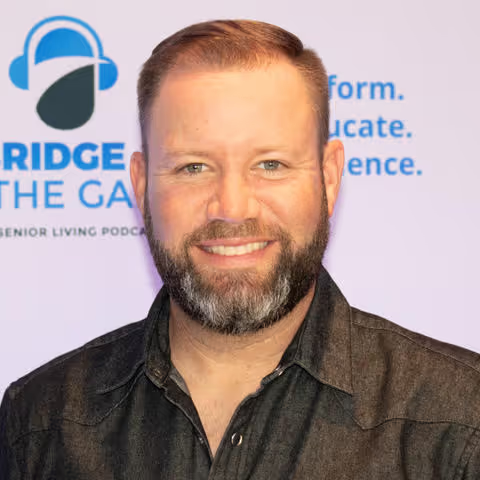
Lucas McCurdy is the founder of The Bridge Group Construction based in Dallas, Texas. Widely known as “The Senior Living Fan”.
Learn More ▶

There are more customers now than there ever have been for senior housing.
Senior living is entering an unprecedented period of demand, but operators are also facing persistent labor challenges, tight margins, and technology systems that often haven't kept pace with the complexity of the business. In this special of Bridge the Gap, Lucas joins Kyle Gardner of NIC MAP and Jessie Lucci of AllieHealth to explore whether senior living is actually ready for the next wave of technology and AI. The conversation covers rising senior housing occupancy, the coming wave of demand from aging baby boomers, constrained new construction, workforce competition, technology adoption, and the importance of building tools that genuinely solve operators' most urgent problems.
Key Topics
Senior housing occupancy and the current market outlook
The growing demand created by the aging baby boomer population
The gap between senior housing demand and new construction
Labor competition and workforce shortages
Why senior living technology adoption has historically been slow
The challenges of implementing technology for frontline workers
Why technology must be simple and easy to adopt
The importance of integrations between software systems
Balancing mission, margin, and technology investment
Measuring technology's impact on the bottom line
Using technology to give caregivers more time with residents
Meet the Hosts:
Produced by Grit and Gravel Marketing.
Become a sponsor of Bridge the Gap.
01:04 - 05:30
Lucas McCurdy
Okay, listeners, a really exciting episode. You're going to want to lean in and listen to. This is a series called Signal on Technology and Senior Living, and we have a great panel of guests on today: Kyle Gardner, COO at NIC MAP, and also Jessie Lucci at AllieHealth. These are rock stars in the world of tech and AI, and they have a great conversation on our first episode today.
You're going to want to hear it. And it's all around senior living. And is senior living actually ready for technology in what's coming? So listen in. We're talking about tech and senior housing and Houston. We have a problem. There are some problems with that. We're in a really kind of like this unbelievable window of time in senior housing that I don't think we've ever been in, where we have a lot of attention on our space.
The occupancy is rapidly going up as we are recovering from the worst time in our lives during, you know, the pandemic. You know, Kyle, you're on the forefront of the data. And Jessie, you're on the forefront of how the operators are managing their staff and the problems that they have every single day. You know, Kyle, let's dive into some of the data to say, like, where are we right now?
Kyle Gardner
So in our latest published data, we have shown that the primary markets, you know, the 31 largest metros in the country are around 89% occupied across, you know, what we call senior housing. So I'll memory care. And that is on the back of like three and a half years of continuous occupancy improvement. So really nice traction and performance across markets in senior housing.
When you zoom out a little bit more, and you go and look at the primary and secondary, so now you're looking at the top 100 markets in the country based on size, occupancies in the low 90s like 90.5, something like that. So all markets across the country tend to be improving. Some are getting better, you know, better being just filling up faster than others.
00:03:27:12 - 00:03:54:06
Unknown
And that's being driven really by two things. We all know the baby boomers turned 80 this year for the first time, and more of them will be entering their 80s over the next few years at a pace we really haven't seen in this country before. And we've been talking about as an industry for a really long time, but now we're kind of experiencing it and living it, and that is bringing a lot of demand for our product and for the service.
But that's kind of juxtaposed by a supply constraint. New construction is near all-time lows on a percentage of inventory basis. You know, we're only really delivering like 10 to 20,000 units a year right now. We need to be delivering north of 50,000 units a year to really keep up with the demand. And Nick map just released our second edition of the Senior Housing Market Outlook report, completely free to download on our website.
That kind of lays out what the supply and demand imbalance looks like over the next 20 to 25 years. So a lot of great data in there. But the takeaway is like there are more customers now than there ever have been for senior housing. And while we have a tremendous amount of supply in this country, we need to greatly accelerate the pace at which we're delivering new capacity and new offerings.
Seniors are going to look for care either in a community that we create or at home or in some alternative setting, and there's a lot of new attention in the aging economy. As you know, we've kind of acutely seen here.
Lucas McCurdy
I mean, it's exciting, and there's so much opportunity, and there are also challenges. And, you know, Jessie, you're on the forefront of a lot of these conversations where you're dealing on the ground with operators that are going through this transition and rise in occupancy. I'd love to get your thoughts on this.
05:30 - 10:31
Jessie Lucci
I mean, from my side, what I get to see is we have this industry that has amazing, passionate operators who are extremely talented. I think the challenge is really just that they don't necessarily have the tools they need and to keep up with the growth. So keep up with the live changing dynamic. And I always think about my Uber days and line.
Days before I joined Uber, I thought about, you know, Uber has two products. You know, on one side is a rider app. On the other side is a driver app. When I joined the company, it was an eye-opening moment. It's like, oh man, we have 20, 30, 40 different software and some tools supporting the growth on every single segment and workflow of the business, from driver fraud detection to, you know, writer retention to driver onboarding.
And that's really what unlocks the growth. When we think about, you know, when you're on a rocket ship, it's really just keep up with it. And I think about, you know, like we have passionate operators. We sometimes hear, you know. Get to see them answering emails at 11:00 at night time. They care about the business. But the tool they have a lot of time are lagging behind.
And a lot of times are not giving them the time back. And I also think about, you know, like the software, the technology, who develops those tools. A lot of the time, you know, we don't have a full picture of this complex business because senior housing is not a hospital. It's not; it's a lot of things. Right?
It's care is dining, hospitality, is 24 seven physical asset, and it's a tight-margin business. And I think the industry needs a lot of attention and a lot of investment, really supporting, you know, the innovation and the margin development to be really able to support the operators we have.
Lucas McCurdy
And that's also a big challenge and balance. I think both of you have dealt with this is and I hear this term mission and margin, and technology obviously is going to be a great solution to help with workflows and operations.
But technology is also expensive. Certainly there should be some sort of an offset there. But how do operators even balance all of the technological options that they have? Number one, just finding and picking and choosing and then affording it. I mean, you both deal with that every day. I'm sure.
Jessie Lucci
If I put my operator hat on. I think the industry needs not just vitamins. Vitamins are not good enough. We need painkillers. Right? We need something to work now, today. And nice to have, like, solutions. And we really just have to think about like, hey, does this solution solve the problem I have? Is the hair on fire problem I have and the supporter support me today, tomorrow, five years and ten years from now. And I think both thing has to exist from my point of view.
Kyle Gardner
There's a need for a technology kind of across the business. If, like you said, Jessie, there's an operations component, a care component, there's facility management, there's entertainment, there's a bunch of sub-businesses underneath the operator. And normally if you kind of look at the regional staffing model or the corporate staffing model, you've got a VP, you know, for each subject matter, and then you've got a litany of building-level staff who play on that team, and everyone's trying to coordinate within their own department.
But then you've got you need the departments to talk to each other. So when those technology solutions come into play, you know, on the tech side, we're really used to adopting point solutions. Hey, I need I have one problem. And this little startup did a great job solving that one problem. And it's $20 a month. And it's really easy for me as a developer or as a sales leader to utilize that tool.
But, you know, we're small teams were typically like tech companies have a little bit more savvy, like engineering talent versus operators are typically staffed with non-technical people for the most part. So when that new tech comes into play, it can't just solve the one problem that's table stakes. It's got to be easy to use. It's got to connect to other systems.
It's got to be simple to implement because it's a, you know, it's a people business in the sense of like, hey, it's kind of a non-technical led business in many ways. And the technology and the data can sometimes be a scary component when we're implementing that
10:31 - 16:11
Jessie Lucci
100%. I mean, adoption is key, right? Easy to use is key for adoption. Integrations across other ecosystems are key to adoption. On the other side, it's like, does it solve the bottom-line problem as well, beyond adoption, beyond the, you know, like greater care. And I would like to say, just, you know, like margin should not be a bad word, right? I mean, at the end of the day, when you have a bottom line, you attract innovation, you attract capital, you attract talent.
And it has to be a balance between all three legs of the stool to be able to think about, oh, this is a great technology because our staff, our frontline staff using it, our managers are using our regional home office, are using it and is creating value to our bottom line, creating value for our, you know, like residents and family. Those needs all like have all been met in order to be able to to get to the right part.
Lucas McCurdy
But, you know, we've been at this a number of years, maybe me even longer, I think I'm now 18 years and in senior housing, but it was not that long ago that I would walk through buildings and there was no wifi, and there were paper sheets and paper signings.
They still have paper signings. Yes. Yeah. And I mean the the industry we talk about adoption slow to adopt these new technologies. I think a lot of that has changed. But I'd love to get each of your thoughts on that kind of transition is or those days gone or there's still some lagging slow adopters out there.
Jessie Lucci
Before I dive in there. Actually, like I worked as a caregiver for at a community near me before I started the Ali Health Journey. It was an moment for me. You get to see, you know, people using pen and paper, a lot of things. We're talking about the nurse nursing director, the clinical director. Print out a long excel sheet every two hours, pinned as a schedule, pinned in the staff break room was all the color coatings you get to see.
You know, all my off days, I will just, like, sit at the office and people watch. You get to see the Ed either on back to back calls, then running between her office and the printer and the fax machine. And it's it's, you know, it's mind boggling. But I opening the same time. And when you talk to the frontline worker a lot of time, you know, like if you think about who they are, a lot of times they will tell you.
Hey, I'm not good as technology. They would tell you like three word in. And a lot of time, you know, they speak the second language. They have a second and third job. You know, when we think about adoption, we think about interest alignment, interest alignment for every single aspect of the user. How the dining director adopt technology is very different from the nurse adopt technology.
You know, a lot of them don't even, you know, like commonly use a laptop to begin with, right? A lot of times they don't remember they're using password. You know, 50% of adoption just failed right there. If you want your caregiver to click on screens, a lot of them have long nails. And, you know, you hear the click, click, click and they don't read the language.
And a lot of times they think of like, oh, you know, like for example, if you're like, oh, maybe tell me about calling off two, three weeks ahead of time. Well, that segment, the user don't behave that way. The life is hacked. If they have a second or third job they think about today and dealing with today. So when we think about technologies, we think about what does that segment of user care about, right.
Is for example, I'll always use scheduling examples like, oh, that's a scheduler. Care about just putting a body on the floor, right. Having that floor filled, that's easy. Care about the margin. Right. Does the the caregiver care about, you know, like me showing up on my shift, you know, picking up extra shift. What is the you know, the technology consumption channel.
00:14:39:06 - 00:15:11:10
Unknown
They're also different as well. Right. So as the frontline staff to think about, oh you know, maybe an app just like my, you know, my Facebook, my Instagram because they're very commonly used those, you know, direct to consumer technology tools that it has to be modernized has to be really to feed them the right information at the right time on the other side is like, hey, do my Ed get to logging into five different apps and laptop, you know, like web browser at the same time.
00:15:11:10 - 00:15:43:06
Unknown
They don't have that time, you know? So think about, you know, the interest alignment for every single segment of a user. Think about how do every single segment of a user consume technology? I think that's where you start to shift the adoption curve. And if you don't do that homework, if you don't consistently listen to those segment of users, if you think they all behave the same or, you know, sometimes even worse, you know, we assuming the frontline worker, they are faceless labor supply.
00:15:43:11 - 00:16:11:03
Unknown
They don't matter. I mean we learned the lesson from Uber. It's like hey drivers driver matters. You know, we internally even change the word from driver supply to driver partners because that's essentially who are the people serving the industry day in and day out. So that's my thought on adoption.
16:11 - 23:38
Kyle Gardner
Jessie, I want to ask a follow-up. When you were doing time in the community and working with residents, was that before Covid or was that after Covid? That was after Covid. Okay, yeah, we still have to wear a mask. And yeah, like obviously you follow procedures. Yes. Did you see you know post Covid. You know, obviously, so much of the economy went to work from home and really started embracing Zoom calls as the standard meeting. But in the community setting, right. Like, your face-to-face with people. How, how, if at all. Did you see kind of the virtualization happen in the community, or do you think that the community still kind of behind maybe the corporate office in that way?
Jessie Lucci
I think the community are still very hands on. There's not much remote or virtualization going on in that aspect because, again, the care, the needs taking care of residents 24 over seven, right? It's hard to replace with virtualization if you need to take the residents out for a walk on a very hot day. I mean, that's my first impression of a caregiver. You have a really awesome caregiver. Well, take them in a walk, wipe their sweat and ask them whether they want a peanut butter smoothie. I think that's a part that cannot be replaced and should not be replaced right by technology.
But at the same time, you get to see there's a large amount of work paperwork going on every single day. But also I get to see the front line and the first line of sight in terms of shortage of labor. One example is the clinical director work in the community who also use on demand. She's a nurse and she does on nurse, you know, services.
And she will drive on Halloweens on DoorDash because I was like, why? She's like, she's like, yeah, people tip well, you know, on those days. And so essentially we're competing on labor workforce on so many different aspects, not only just a frontline staff. I think that's really the aspect we need to think about. But on the other side is like, you know, like the eight hour shift, the working in the community is taxing.
It's long. But what really I mean, personally, what pulls my string is like really connect with the residents. And I can say like, that's, that's the the work that most of the people in the community really get excited about. So the question is like, how can we release them back to do more of that and versus lock them in front of a desktop?
Kyle Gardner
I think that's such a great story. And like, you're you've nailed so many good points, right? Like the main reason that at least people in the community, I think, come to this industry is that human connection and that it is kind of an instant feedback loop. If I'm making an impact on one person and, you know, the butterfly effect of that into the into the local community, you know, outside of the physical building.
And I've met many people at conferences in my time here in the in the space of like, hey, even in the management company, you know, that's what really gets them excited. That's what's gotten them to stay in the space for so long. I do kind of want to go back to Lucas's story for a second when he was talking about, you know, paper schedules or paper documents.
I wonder how much of that comes down to, like, the size of the operator. Right. Because we all know the technology curve. There's a really small cohort at the bleeding edge who's quick to adopt and test everything you've got. You know, basically two thirds of the population who's somewhere in the middle where they'll try it, they'll learn about it.
They may not be the first ones, but they won't be the last ones to use it. And then you've got the laggards who are holding on to the old way for dear life, and they never want to let it go. No matter, no matter what it is like. There's some comfort in that. And like that. That kind of model applies to our industry.
It applies to really any type of technology. But I do feel like in a business where margins are generally low, especially post-Covid, you know, we're really only now getting back to pre-COVID revenue margins. At least that's what the data is telling us. So we've had this period of like five years where people have revenues have been going up, but margins are still lower than they were before.
So how much of it comes down to like, available like capital to put into processes? And when you've got, you know, 50 problems to solve at a community scheduling, staffing, dining, menu preparation, you know, medical management, HR. And that's just at the one building. Then you go up to the corporate office and you're thinking about growth. You're thinking about attracting new capital.
You're thinking about managing development processes or acquisition processes. There's so many like areas that require attention. And how do you decide where to put money to work? I think a lot of it's going to come down to like how much money I have. And what's the biggest burning problem? Maybe that's not always the best way. You know, I hope people think about like, how do I get my business to succeed and grow for the long term and what's going to give me that payoff? But, you know, Lucas or Jessie, what have what have you seen like operators kind of go through that or think through that approach?
Jessie Lucci
Oh, I see the first question. Alfredo typically asks is like, who's paying for it? How is this paid? Right. Yeah. You cannot have more and more line item on your expense lines. So when we think about what product you built and also looking at, you know, our peers or product, are they building, we think about, hey.
Are we solving what problem or solving. Can we solve two problems. Same time means like hey, can we move the bottom line? Creating the bar budget, have our tool pay for itself, but actually create a month one week one? Well, at the same time releasing the time back, giving fitting into existing, you know, community or operation or home office workflow.
So I think when we think about where do we tackle, you know, can we meet both side. So you will have the adoption, you will have the margin and also obviously make it black and white. Don't don't just say, hey, you know, we're saving time. You know, as a former operator who lived and breathed on PNL for the longest time, it's like, oh, you know, saving time is nice to have the panel still come at that time of the month. And I still have to explain, hey, why? You know, like my margin is what it is. So the realization of the, the margin of the performance has to be fast and it has to be quantifiable.
Lucas McCurdy
That's great. That's great. And a great final send off here on our signal series around technology in senior housing. Kyle and Jessie, thanks so much for the conversation today. And to our listeners, I know you're going to love this content. We want to hear your thoughts. Connect with us at com. And if you want to connect with Kyle and Jessie, just scroll down in the show notes and click those links right there. I'm sure they're happy to engage. And thanks for listening to another great episode of Bridge the Gap.